
Specific Gravity of Cement: The Le Chatelier Flask Method
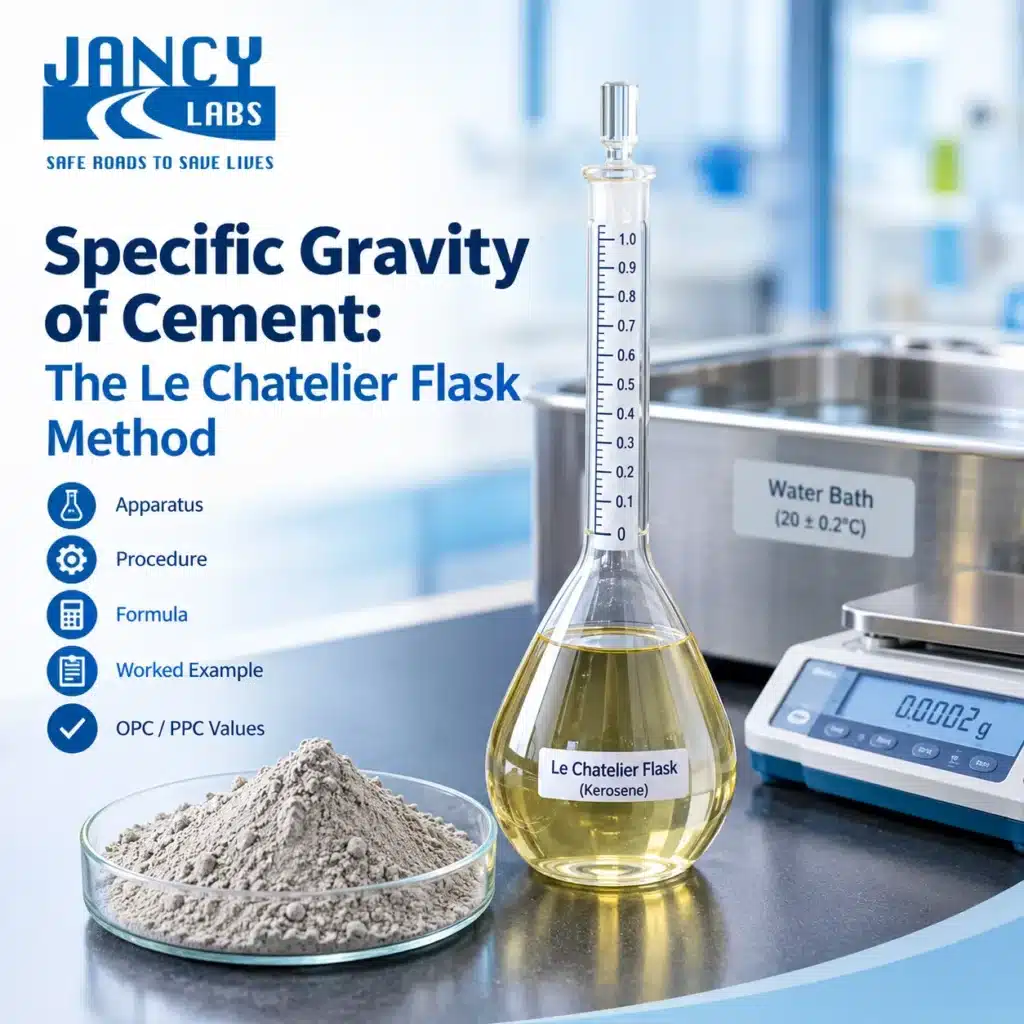
The specific gravity of cement tells you how heavy cement particles are compared with water. Labs in India measure it with a Le Chatelier flask under IS 4031 (Part 11):1988. The value feeds straight into concrete mix design, so a wrong figure shifts the volume of every ingredient. Here is the apparatus, the steps, the formula and what the results mean.
Key takeaways
- Specific gravity of cement is the density of cement particles divided by the density of water. OPC is usually close to 3.15.
- The test follows IS 4031 (Part 11):1988, using a Le Chatelier flask and water-free kerosene.
- The lab adds about 64 g of cement and reads how much liquid it pushes up the neck.
- Two tests are averaged. If they differ by more than 0.03, the test is repeated.
- PPC and PSC read lower, around 2.90, because fly ash and slag are lighter than clinker.
What is the specific gravity of cement?
The specific gravity of cement is the mass of cement particles divided by the mass of an equal volume of water. A value of 3.15 means the particles weigh 3.15 times as much as the same volume of water.
IS 4031 (Part 11), published by the Bureau of Indian Standards, reports the result as density in g/cm³. Because water is 1 g/cm³, density and the specific gravity of hydraulic cement are the same number.
Specific gravity of cement test apparatus
The specific gravity of cement test apparatus under IS 4031 (Part 11) has four parts:
- Le Chatelier flask: a glass flask of about 250 ml with a neck marked in 0.1 ml steps.
- Liquid: water-free kerosene, or naphtha with a specific gravity of at least about 0.73.
- Balance: reads to 0.0002 g.
- Water bath: holds the flask within 0.2 °C.
Kerosene replaces water because cement reacts with water and starts to set, which would change the volume being measured.
Note that the flask is not the Le Chatelier mould, which is used in the soundness test of cement.
Cement specific gravity test procedure
The cement specific gravity test measures how much kerosene a known mass of cement displaces.
- Fill the flask with water-free kerosene to between the 0 and 1 ml marks, and dry the neck.
- Place the flask in the water bath until the temperature is steady, then record reading V1.
- Weigh about 64 g of cement at the same temperature as the kerosene.
- Add it in small amounts so it does not splash or stick to the neck.
- Stopper the flask and roll it at an angle until no air bubbles rise.
- Return the flask to the bath and record reading V2 once it stops changing.
- Run a second test and average the two. Repeat if they differ by more than 0.03.
The water bath matters because kerosene expands by roughly 0.1% per °C. In a 250 ml flask, a 1 °C drift moves the level by about 0.25 ml, which is more than 1% of a typical reading.
How to calculate specific gravity of cement
Divide the mass of cement by the volume it displaced, which is the final reading minus the first.
Specific gravity = Mass of cement (g) ÷ (V2 − V1) (ml)
Reading | Test 1 | Test 2 |
Mass of cement (g) | 64.00 | 64.00 |
First reading V1 (ml) | 0.40 | 0.50 |
Final reading V2 (ml) | 20.70 | 20.95 |
Displaced volume (ml) | 20.30 | 20.45 |
Result (g/cm³) | 3.15 | 3.13 |
The two results differ by 0.02, within the 0.03 limit. So the lab reports the average, 3.14.
Typical values for OPC, PPC and PSC
OPC usually reads close to 3.15. PPC and PSC read lower because fly ash and slag are lighter than clinker.
Cement type | Main ingredients | Typical value |
OPC 43 / 53 (IS 269) | Clinker and gypsum | About 3.15 |
PPC (IS 1489 Part 1) | Clinker, gypsum and fly ash | About 2.90 |
PSC (IS 455) | Clinker, gypsum and slag | About 2.90 |
These are typical figures, not limits. IS 269 sets no specific gravity requirement for OPC. Instead, the value serves as a design input and a check on what is in the bag.
Why the value matters in mix design
IS 10262:2019 uses the absolute volume method, where cement volume equals mass divided by specific gravity times 1,000. The IS 10262 mix design guide shows the full calculation.
For 380 kg of cement per m³, 3.15 gives 0.121 m³, but 2.90 gives 0.131 m³. As a result, a wrong value throws the aggregate quantity off by about 10 litres per m³.
The Blaine fineness test also needs density to set the mass of the test bed. For trial mixes, see our concrete mix design service.
What an unexpected result tells you
A reading near 2.90 on cement sold as OPC suggests blended material. Cement that absorbed moisture in storage can also read low, because partly hydrated particles are lighter.
Results that drift between tests usually point to trapped air, water in the kerosene or a temperature change.
For project records, use a lab accredited by NABL. Our cement testing lab runs the specific gravity of cement test alongside fineness, setting time, soundness and strength.
Get Your Cement Tested at Jancy Labs
Jancy Labs Private Limited is an accredited civil material testing laboratory (ISO/IEC 17025:2017, Certificate No. TC-12176) in Madurai, Tamil Nadu. We collect samples across Tamil Nadu and accept courier samples from anywhere in India.
Or call +91 86800 49004 · jancylabsmdu@gmail.com · Request a quote
4.8★ · 100+ Google reviews · Mon–Sat, 10:00–18:00
Frequently Asked Questions
What is the specific gravity of OPC 53 grade cement?
OPC 53 grade cement usually reads about 3.15, the same as OPC 43 grade. The grade refers to 28-day compressive strength in MPa, not density.
Which IS code covers the specific gravity of cement?
IS 4031 (Part 11):1988 covers it under the name determination of density. It uses a Le Chatelier flask, about 64 g of cement and water-free kerosene, with two tests averaged.
Is the Le Chatelier flask the same as the Le Chatelier mould?
No. The flask is a glass vessel used to find the density of cement. The mould is a split brass cylinder with pointers, used in the soundness test to measure expansion.
Can I use 3.15 in a mix design without testing the cement?
For OPC from a known source, many designers start with 3.15. Test PPC, PSC and long-stored cement, because a wrong value shifts the calculated volume of every ingredient.