
Flakiness and Elongation Index: Why Aggregate Shape Decides Strength
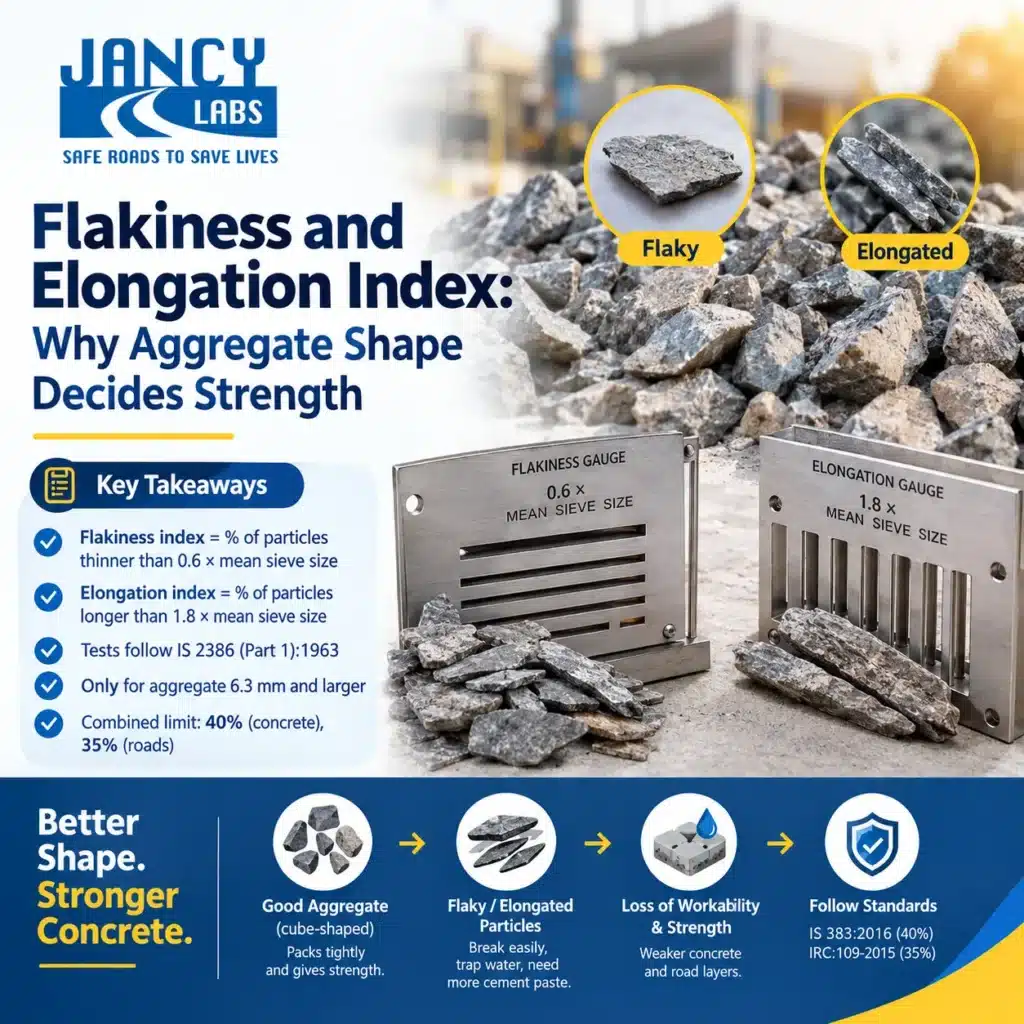
The flakiness and elongation index tells you how much of a coarse aggregate sample is made of thin, flat stones or long, needle-like ones. These shapes break easily, trap water and need extra cement paste. As a result, a mix built on flaky stone loses workability and strength. IS 383:2016 caps the combined index at 40% for concrete, while road specifications go tighter.
Key takeaways
- Flakiness index is the percentage by weight of particles thinner than 0.6 times their mean sieve size.
- Elongation index is the percentage by weight of particles longer than 1.8 times their mean sieve size.
- Both tests follow IS 2386 (Part 1):1963 and apply only to aggregate of 6.3 mm and larger.
- IS 383:2016 limits the combined flakiness and elongation index to 40% for concrete aggregate.
- IRC:109-2015 limits the combined index to 35% for wet mix macadam road bases.
What is the flakiness and elongation index?
The flakiness and elongation index is a pair of shape tests that measure how much badly shaped stone a coarse aggregate contains. A flaky particle is thin for its width, while an elongated one is long for its width. Good aggregate, by contrast, is roughly cube-shaped, so it packs tightly. Labs then add the two results into one combined figure, because Indian specifications set their limits on that value.
Why does aggregate shape affect strength?
Flaky and elongated stones weaken concrete and road layers in three ways. First, thin pieces snap under load or compaction, which changes the grading. Second, flat stones trap bleed water underneath, so they leave weak, porous zones. Third, these shapes have more surface area per kilogram, so the mix needs more water and paste.
In road layers, flat chips tend to lie in one direction during rolling, so stones interlock poorly. For this reason, road specifications usually set tighter shape limits than concrete codes. Our bitumen testing lab also tests aggregate for road projects.
How is the flakiness and elongation index test done?
The test uses two steel gauges from IS 2386 (Part 1):1963, published by the Bureau of Indian Standards. Slots in the thickness gauge are 0.6 times the mean sieve size of each fraction, while pins on the length gauge sit 1.8 times that size apart. Our aggregate testing lab follows these steps:
- Sieve the sample. Dry the aggregate and sieve it into standard fractions between 63 mm and 6.3 mm.
- Count the pieces. Take at least 200 pieces from each fraction and weigh them.
- Check thickness. Pass each piece through the matching slot of the thickness gauge. Pieces that pass are flaky, so weigh them.
- Check length. Next, try the non-flaky pieces on the length gauge. Pieces too long to fit between the pins are elongated.
- Work out each index as a percentage by weight, then add the two to get the combined index.
Flakiness Index (%) = weight passing thickness gauge ÷ total weight tested × 100
Elongation Index (%) = weight retained on length gauge ÷ weight tested × 100
However, some specifications work out elongation on the non-flaky weight instead of the whole sample, so a clear report states which basis it used.
Gauge sizes and acceptance limits
Gauge sizes follow directly from the two ratios in IS 2386 (Part 1). The table shows the calculated gaps for common concrete and road fractions.
Fraction (mm) | Mean size (mm) | Thickness slot, 0.6× (mm) | Length gap, 1.8× (mm) |
25 – 20 | 22.50 | 13.50 | 40.50 |
20 – 16 | 18.00 | 10.80 | 32.40 |
16 – 12.5 | 14.25 | 8.55 | 25.65 |
12.5 – 10 | 11.25 | 6.75 | 20.25 |
10 – 6.3 | 8.15 | 4.89 | 14.67 |
Next, the lab checks the combined figure against the limit for the end use. Road limits come from the Indian Roads Congress and the Ministry of Road Transport and Highways specifications.
End use | Combined limit | Source |
Concrete aggregate, crushed or uncrushed | 40% maximum | IS 383:2016, Clause 5.3 |
Wet mix macadam base | 35% maximum | IRC:109-2015, Table 1 |
Bituminous layers (DBM, BC) | As per contract | MoRTH Section 500 and project specification |
What to do when aggregate fails the shape limit
A high combined index usually points to the crushing process rather than the rock. A jaw crusher alone tends to give slabby pieces, whereas adding a cone or vertical shaft impactor stage gives more cube-shaped stone. In practice, site teams have four options:
- Ask the supplier to retest after changing the crusher setting or the source.
- Blend the batch with well-shaped stone, then retest the blend before use.
- Refer the result to the engineer-in-charge, who may relax the IS 383 limit.
- Rerun the mix design if the shape changes, because water demand changes too. Our design mix testing team can help.
How to read a flakiness and elongation index test report
A complete flakiness and elongation index test report lists, for each fraction, the weight tested and the weight of flaky and elongated pieces. After that, it gives both indices, the combined value and the limit applied. Also check the standard, sample ID and elongation basis. Reports from a lab with NABL accreditation carry more weight with consultants, and you can pair them with concrete testing results.
Get Your Aggregate Shape Tested at Jancy Labs
Jancy Labs Private Limited is an accredited civil material testing laboratory (ISO/IEC 17025:2017, Certificate No. TC-12176) in Madurai, Tamil Nadu. We collect samples across Tamil Nadu and accept courier samples from anywhere in India.
Or call +91 86800 49004 · jancylabsmdu@gmail.com · Request a quote
4.8★ · 100+ Google reviews · Mon–Sat, 10:00–18:00
Frequently Asked Questions
What is the limit of flakiness and elongation index as per IS 383?
IS 383:2016 limits the combined flakiness and elongation index to 40% for crushed or uncrushed coarse aggregate used in concrete. However, the engineer-in-charge may relax it after reviewing aggregate availability and concrete performance tests.
Which IS code covers the flakiness index test?
IS 2386 (Part 1):1963 covers both the flakiness index and elongation index tests. The standard remains in force.
What is the combined flakiness and elongation index?
The combined value adds the flakiness index and the elongation index. The lab measures elongation on the non-flaky pieces left after the flakiness check.
How many pieces are needed for the flakiness index test?
The lab takes at least 200 pieces from each size fraction, then gauges and weighs each fraction on its own.
Does the test apply to aggregate smaller than 6.3 mm?
No. IS 2386 (Part 1) applies both shape tests only to aggregate of 6.3 mm and larger, so finer material is controlled through grading instead.