
Carbonation Test on Concrete: Phenolphthalein Method and Depth
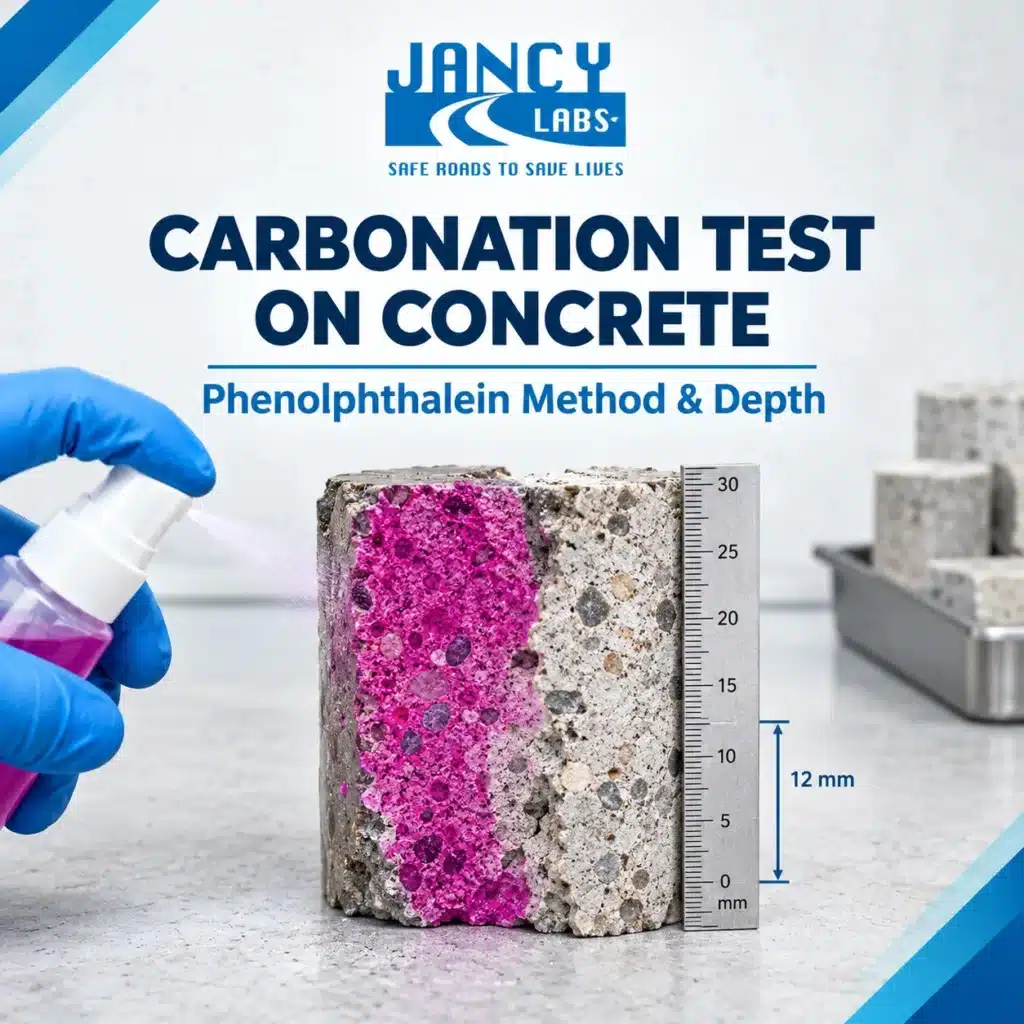
A carbonation test shows how far carbon dioxide from the air has moved into hardened concrete. The depth matters because carbonated concrete no longer protects the steel inside it. Once the carbonation front reaches the bars, rust can start, and cracks and spalling usually follow. The method itself is simple: you spray an indicator on a fresh concrete face and then measure the zone that stays colourless. Engineers usually read it alongside other non-destructive tests on concrete during a condition survey.
Key takeaways
- The carbonation test uses a 1% phenolphthalein indicator sprayed on a freshly broken face or split core.
- Alkaline concrete turns magenta, while carbonated concrete stays colourless.
- In India, the method is IS 516 (Part 5/Sec 3):2021, which asks for at least three specimens per member.
- IS 516 sets no pass or fail depth, so engineers compare the depth with the cover to the steel.
- When the front reaches the steel, the bars lose their protective layer and corrosion can begin.
What is a carbonation test?
A carbonation test measures how deep concrete has lost its natural alkalinity through reaction with carbon dioxide (CO2). You report the result in millimetres from the exposed surface.
New concrete is strongly alkaline, with a pore-water pH of about 12.5 to 13.5. That alkalinity keeps a thin protective film on the steel. Over time, however, CO2 from the air enters the pores and reacts with calcium hydroxide to form calcium carbonate. As a result, the pH falls to around 8 to 9, as IRICEN’s laboratory note explains. The film then breaks down, and the steel can rust once moisture and oxygen are present.
Carbonation test procedure: the phenolphthalein method
In India, the carbonation test procedure follows IS 516 (Part 5/Sec 3):2021, published by the Bureau of Indian Standards.
- Expose a fresh surface. Break off a small piece of concrete, or take a core and split it lengthwise. If you cannot split the core, dry its surface and seal it.
- Clean the face. Brush away dust and loose particles straight away, before the fresh face reacts with air.
- Prepare the indicator. Dissolve 1 g of phenolphthalein in 100 ml of a solvent made from 70 ml ethanol and 30 ml deionised water.
- Spray a fine mist. Use a light spray so the liquid does not run and form channels across the face.
- Wait and read. Measure after about 5 to 10 minutes, once the colour settles. If the colour is weak, let the face dry and spray again.
After spraying, uncarbonated concrete turns magenta, while carbonated concrete shows no colour change.
How to measure and report carbonation depth
Measure from the exposed face to the edge of the magenta zone, in millimetres. When the front is straight, one reading (dk) describes it. For an uneven front, record both the average depth (dk) and the maximum depth (dk,max).
IS 516 also sets two correction rules. First, if an air void pushes the front less than 4 mm deeper, include that reading in the mean; otherwise, leave it out. Second, where a dense stone blocks the front, draw a straight line across the stone.
Test at least three specimens from each member and report the mean. The report should also list the member, its age, the concrete grade if known, the test date, every reading, and photos of any uneven front.
Carbonation depth vs concrete cover: how to read the result
IS 516 gives no acceptable carbonation depth. Instead, you compare the depth with the cover, the concrete between the surface and the nearest bar. IS 456:2000 sets the nominal cover for each exposure condition, as shown below.
Exposure (IS 456) | Nominal cover | Typical setting |
Mild | 20 mm | Protected from weather, away from the coast |
Moderate | 30 mm | Sheltered from heavy rain, or in normal soil |
Severe | 45 mm | Heavy rain, wetting and drying, coastal air |
Very severe | 50 mm | Sea water spray or corrosive fumes |
Extreme | 75 mm | Tidal zone or aggressive chemicals |
When the front is well short of the cover, the steel is still protected. If it is close to the bars, plan surface protection before damage starts. Once it has passed the bars, check them for corrosion before you plan repairs.
Carbonation also slows with age, because depth grows roughly with the square root of time. So a front at 10 mm after 16 years would reach about 20 mm at 64 years, if conditions stay the same.
Limits of the carbonation test and common mistakes
The method is quick, but four errors can make the result useless.
- Spraying an old surface. A weathered face has already carbonated, so it shows no front.
- Reading at the wrong time. Wait 5 to 10 minutes for the colour to settle.
- Spraying too much. Runs blur the front.
- Testing one spot. Depth varies with cover, cracks and exposure, so one reading cannot stand for a whole building.
Phenolphthalein only marks where pH drops below about 9, so partly carbonated concrete beyond the line still looks magenta. Moreover, the test says nothing about strength. For that, pair it with the rebound hammer test, the UPV test, or core tests at a concrete testing lab.
Get Your Concrete Tested at Jancy Labs
Jancy Labs Private Limited is an accredited civil material testing laboratory (ISO/IEC 17025:2017, Certificate No. TC-12176) in Madurai, Tamil Nadu. We collect samples across Tamil Nadu and accept courier samples from anywhere in India.
Or call +91 86800 49004 · jancylabsmdu@gmail.com · Request a quote
4.8★ · 100+ Google reviews · Mon–Sat, 10:00–18:00
Frequently Asked Questions
Which IS code covers the carbonation test?
IS 516 (Part 5/Sec 3):2021 is the Indian code for measuring carbonation depth in hardened concrete. The code sits in Part 5 of IS 516, which covers non-destructive testing.
What is an acceptable carbonation depth?
IS 516 sets no single acceptable depth. Instead, engineers judge the result against the cover to the steel. As long as the front stays well short of the bars, the steel remains protected.
Is the carbonation test destructive?
IS 516 lists the method under non-destructive testing. However, it needs a fresh face, so you must break off a small piece or take a core and then patch the spot.
How is accelerated carbonation testing different?
Accelerated carbonation testing, under IS 516 (Part 2/Sec 4):2021, exposes lab specimens to high CO2 to judge how well a new mix resists carbonation. The phenolphthalein method, by contrast, measures carbonation that has already happened in a real structure.