
Aggregate Crushing Value Test: Procedure and Acceptance Limits
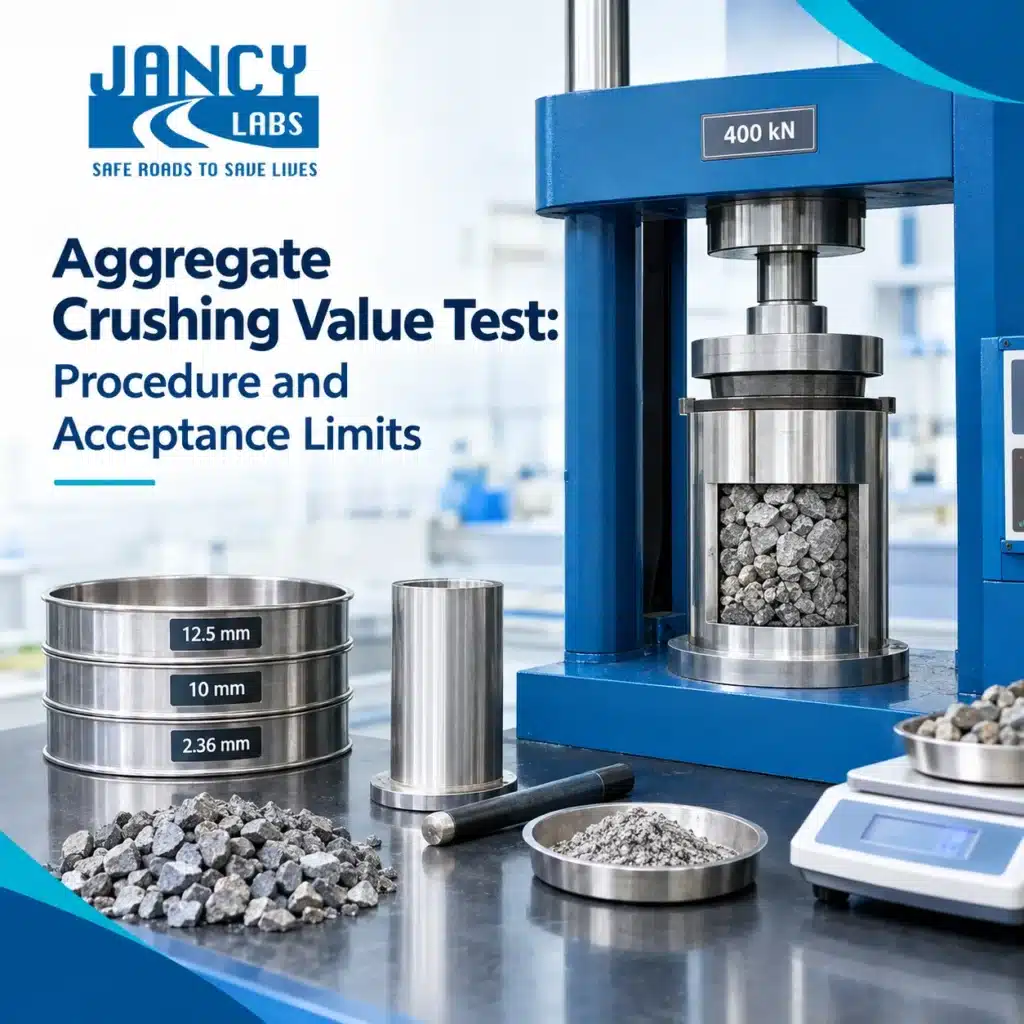
Aggregate crushing value shows how well coarse aggregate resists crushing under a slowly applied compressive load. A lower value means stronger aggregate. IS 2386 (Part 4):1963 sets the test, and IS 383:2016 sets the limits for concrete. Engineers then use the result to accept or reject stone for concrete and road work. This guide therefore covers the procedure, the formula and the limits.
Key takeaways
- Aggregate crushing value is the percentage of fines that pass a 2.36 mm sieve after 12.5–10 mm aggregate takes 400 kN in 10 minutes.
- The formula is (B ÷ A) × 100, where A is the sample weight and B is the weight of fines, so a small B means strong aggregate.
- A lower value means stronger aggregate, so no minimum exists.
- IS 383:2016 caps the value at 30 per cent for wearing surfaces.
- For other concrete, a value above 30 per cent calls for the ten percent fines test, with at least 50 kN.
What is the aggregate crushing value test?
The aggregate crushing value test measures the resistance of coarse aggregate to crushing under a gradually applied compressive load. That is its objective. The result is therefore the percentage of crushed fines that the load produces. Because the load builds up slowly, the test avoids the shock of the impact test. Weak aggregate breaks down easily and gives a high value, while strong aggregate gives a low one.
What apparatus does the test need?
The aggregate crushing value test apparatus is simple. It has these parts:
- A 15 cm open-ended steel cylinder, with a base plate and a plunger.
- Measuring cylinder of 11.5 cm diameter and 18 cm height.
- Tamping rod with a rounded end.
- Compression testing machine that can apply 400 kN.
- IS sieves of 12.5 mm, 10 mm and 2.36 mm.
- Finally, a balance accurate to 1 g.
Aggregate crushing value test procedure
The procedure follows IS 2386 (Part 4):1963, which the IRICEN laboratory guide also describes. It also uses aggregate that passes a 12.5 mm sieve and is retained on a 10 mm sieve.
- Prepare the sample. Sieve the aggregate to the 12.5–10 mm fraction, then oven-dry it.
- Measure the sample. Fill the measuring cylinder in three layers, tamping each layer 25 times. Then weigh the sample as A.
- Fill the test cylinder. Transfer the sample to the 15 cm cylinder in three layers, tamping each layer 25 times. Then fit the plunger.
- Apply the load. Place the cylinder in the compression machine, then load it so that 400 kN is reached in 10 minutes.
- Sieve the crushed material. Release the load, then sieve the aggregate on the 2.36 mm sieve. Weigh the fraction that passes as B.
- Calculate the result. Record the value to one decimal place, and repeat the test on a second sample.
What is the aggregate crushing value formula?
The aggregate crushing value formula divides the weight of fines by the weight of the sample, so the result is a percentage:
ACV (%) = (B ÷ A) × 100
Here A is the weight of the oven-dried sample, and B is the weight of the fraction that passes the 2.36 mm sieve. For example, a sample of 3,000 g that yields 630 g of fines gives 630 ÷ 3,000 × 100 = 21.0 per cent. These figures are illustrative, not lab data.
What are the acceptance limits?
IS 383:2016, Clause 5.4, sets the limits for aggregate used in concrete. It also refers to IS 2386 (Part 4) for the test.
Use of the aggregate | Limit | Clause |
Wearing surfaces, such as runways, roads and pavements | 30 per cent maximum | IS 383:2016, 5.4.1 |
Other concrete | If above 30 per cent, run the ten percent fines test with at least 50 kN | IS 383:2016, 5.4.1 |
Concrete of grade M65 and above | 22 per cent maximum | IS 383:2016, 5.4.2 |
Many older references quote 45 per cent for concrete other than wearing surfaces. That figure comes from the earlier IS 383:1970. So check that your specification names the current edition.
What is the minimum crushing value of aggregate?
No minimum crushing value exists. Standards set a maximum, because a lower value means stronger aggregate. As a result, a very low value is never a reason to reject stone.
Where can you get aggregate tested?
Jancy Labs tests aggregate at its Madurai laboratory. See the aggregate testing lab page for the tests on offer, or request a quote for your samples. Also, more guides sit on the Jancy Labs blog. The Bureau of Indian Standards publishes the standards cited here.
Get Your Aggregate Tested at Jancy Labs
Jancy Labs Private Limited is an accredited civil material testing laboratory (ISO/IEC 17025:2017, Certificate No. TC-12176) in Madurai, Tamil Nadu. We collect samples across Tamil Nadu and accept courier samples from anywhere in India.
Or call +91 86800 49004 · jancylabsmdu@gmail.com · Request a quote
4.8★ · 100+ Google reviews · Mon–Sat, 10:00–18:00
Frequently Asked Questions
What is the objective of the aggregate crushing value test?
The test measures how well coarse aggregate resists crushing under a slowly applied compressive load. Engineers use the result to accept or reject aggregate for concrete and road work.
What is the formula for aggregate crushing value?
Aggregate crushing value = (B ÷ A) × 100. A is the weight of the oven-dried sample, and B is the weight of the fraction that passes the 2.36 mm sieve after crushing.
Which aggregate size is used in the test?
The test uses aggregate that passes a 12.5 mm IS sieve and is retained on a 10 mm IS sieve.
How much load does the test apply?
The machine applies 400 kN, and the load builds up evenly so that it reaches 400 kN in 10 minutes.
What is the minimum crushing value of aggregate?
No minimum exists. Standards cap the value, because a lower value means stronger aggregate. IS 383:2016 sets a 30 per cent maximum for wearing surfaces.
Can I courier aggregate samples to Jancy Labs?
Yes. Jancy Labs collects samples across Tamil Nadu and accepts courier samples from anywhere in India.