
Direct Shear Test: Cohesion, Angle of Friction and Procedure
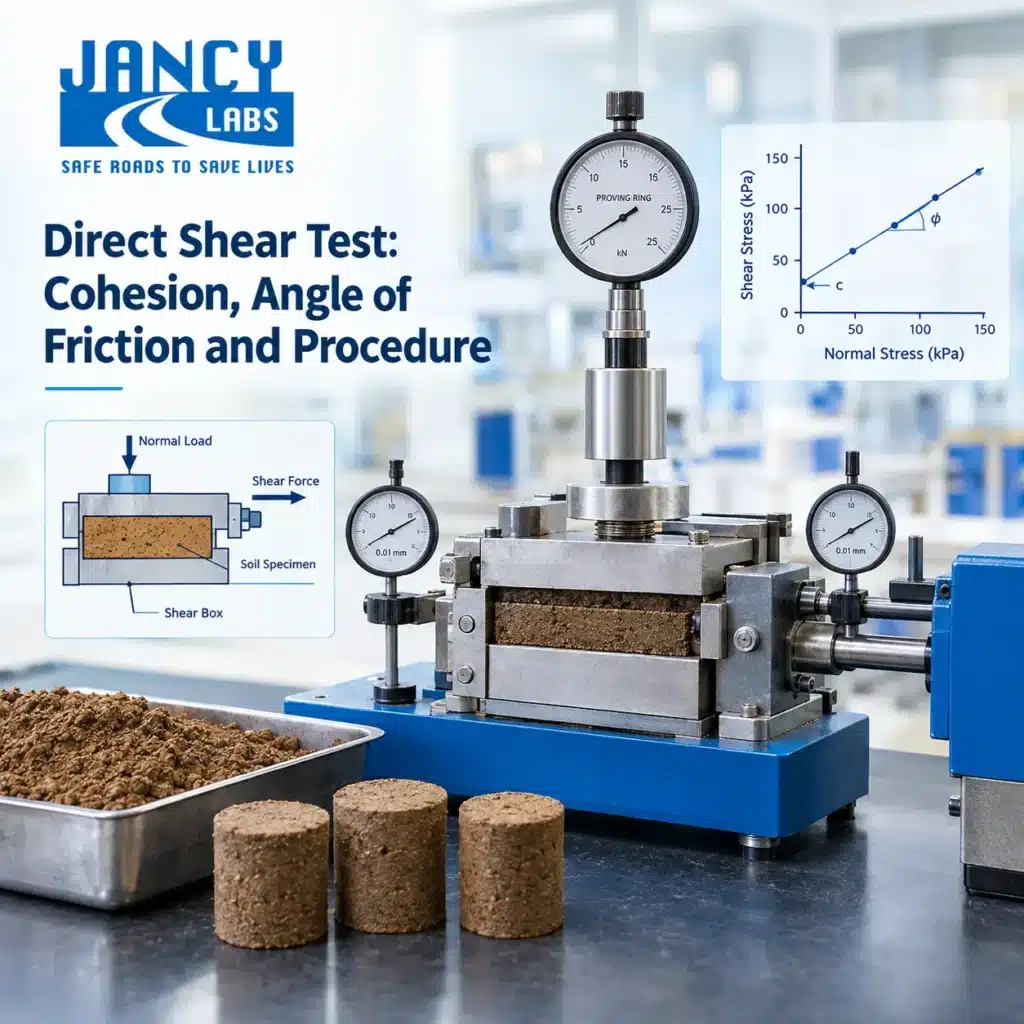
The direct shear test measures the shear strength of soil by forcing a sample to slip along one fixed horizontal plane. It gives two numbers: cohesion (c) and the angle of internal friction (φ). Engineers use both to design footings, retaining walls and slopes. In India, IS 2720 (Part 13):1986 governs the method.
Key takeaways
- The direct shear test gives cohesion (c) and the angle of friction (φ) from three or four specimens tested at different normal stresses.
- IS 2720 (Part 13):1986 covers soil with particles up to 4.75 mm.
- The standard allows undrained, consolidated undrained and consolidated drained tests.
- Drained tests shear sand at about 0.2 mm/min and clay at 0.01 mm/min or slower.
- A plot of shear stress against normal stress gives φ from the slope and c from the intercept.
What is the direct shear test?
The direct shear test is a laboratory method that finds soil shear strength by sliding one half of a specimen over the other. A square shear box holds the soil and splits at mid-height. A vertical load presses down on the soil. Then a horizontal force pushes the top half until the soil fails along the split.
Soil strength follows the Mohr–Coulomb equation:
τ = c + σ tan φ
Here, τ is the shear strength, σ is the normal stress on the failure plane, c is cohesion and φ is the angle of friction. Clay gets most of its cohesion from bonding between fine particles. Friction comes from grains gripping each other, so it rises as the load rises.
Direct shear test procedure as per IS 2720 Part 13
The Bureau of Indian Standards publishes the method as IS 2720 (Part 13):1986. It covers soil with particles up to 4.75 mm. The test needs at least three specimens, and four is better. Each one is sheared under a different normal stress.
- Prepare the specimen. Trim an undisturbed sample, or compact a remoulded one, to fit the shear box.
- Assemble the box. Lock the two halves with the pins. Then place grid plates and porous stones above and below the soil.
- Apply the normal load. Fit the loading pad and add the chosen normal stress.
- Consolidate if required. For consolidated tests, let the specimen settle until the vertical dial gauge stops moving.
- Remove the pins and shear. Start the motor at a constant rate.
- Record the readings. Log the proving ring, the horizontal displacement and the vertical displacement at regular intervals. The dial gauges read to 0.01 mm.
- Stop at failure. Stop at peak shear stress. In an undrained test, stop at failure or at 20 per cent displacement, whichever comes first.
- Repeat on fresh specimens. Use a new specimen at each remaining normal stress.
What are the three types of shear test?
IS 2720 (Part 13) allows three test conditions: undrained, consolidated undrained and consolidated drained. The condition decides whether water can leave the soil and how fast you shear it.
Test | Drainage while consolidating | Drainage while shearing | Typical use |
Undrained | None | None | Short-term strength of clay |
Consolidated undrained | Allowed | None | Soil that settled under load, then loads quickly |
Consolidated drained | Allowed | Allowed | Long-term stability and sandy soils |
In an undrained test, shear fast enough that no water drains. In a drained test, shear slowly enough that water escapes. The standard suggests about 0.2 mm/min for sandy soil and 0.01 mm/min or slower for clay.
How do you calculate cohesion and angle of friction?
You calculate cohesion and angle of friction by plotting peak shear stress against normal stress and fitting a straight line. The slope of the line gives the angle of friction. The intercept on the shear stress axis gives the cohesion. Shear stress is the horizontal force divided by the area of the shear box.
The worked example below uses illustrative figures, not lab data.
Specimen | Normal stress (kPa) | Peak shear stress (kPa) |
1 | 50 | 45 |
2 | 100 | 70 |
3 | 150 | 95 |
The line rises 25 kPa for every 50 kPa of normal stress, so the slope is 0.5. Therefore φ = tan⁻¹(0.5) = 26.6°. The line meets the vertical axis at 20 kPa, so c = 20 kPa.
What are the limits of the test?
The main limit is that the box forces failure along a fixed horizontal plane, which may not be the weakest plane in the soil. In addition, the apparatus cannot measure pore water pressure, and drainage is hard to control in clay. The contact area shrinks as the box slides, so many labs correct for it.
Because of these limits, engineers switch to the triaxial test when they need pore pressure readings or full control of drainage. Even so, direct shear is quicker and cheaper for sands and routine checks. ASTM D3080 is the comparable international method.
Where can you get soil shear strength tested?
Jancy Labs runs soil tests at its Madurai laboratory. See the soil testing lab page for the tests on offer, or request a quote for your samples. More guides sit on the Jancy Labs blog.
Get Your Soil Tested at Jancy Labs
Jancy Labs Private Limited is an accredited civil material testing laboratory (ISO/IEC 17025:2017, Certificate No. TC-12176) in Madurai, Tamil Nadu. We collect samples across Tamil Nadu and accept courier samples from anywhere in India.
Or call +91 86800 49004 · jancylabsmdu@gmail.com · Request a quote
4.8★ · 100+ Google reviews · Mon–Sat, 10:00–18:00
Frequently Asked Questions
What is the direct shear test used for?
The direct shear test finds the cohesion and angle of internal friction of soil. Engineers use these values to design footings, retaining walls and slopes.
Which IS code covers the direct shear test?
IS 2720 (Part 13):1986 covers it for soil with particles up to 4.75 mm. ASTM D3080 is a comparable international method.
How many specimens does the test need?
The standard asks for at least three specimens, and preferably four. Each one is sheared under a different normal stress.
What shearing rate should you use?
In drained tests, shear sandy soil at about 0.2 mm/min. Shear clay at 0.01 mm/min or slower so that water can escape.
Does sand have cohesion?
Clean sand has little or no cohesion. Its strength comes mainly from friction between grains, so the failure line passes close to the origin.
Can I courier soil samples to Jancy Labs?
Yes. Jancy Labs collects samples across Tamil Nadu and accepts courier samples from anywhere in India.