
Marshall Stability Test: Mix Design, Flow Value and MoRTH Limits
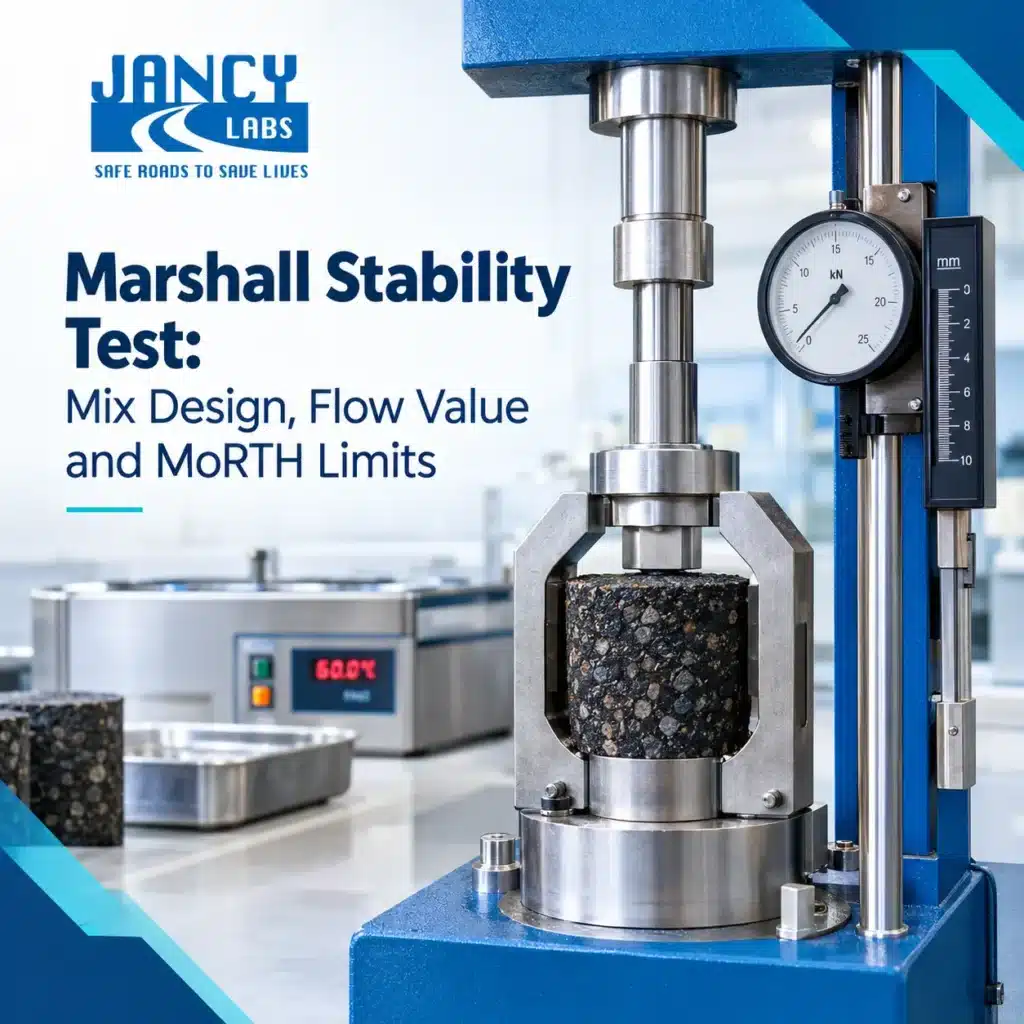
The Marshall stability test measures how well a compacted bituminous mix resists deformation under load. It gives two headline numbers: stability in kilonewtons and flow in millimetres. Engineers then use both, with density and voids, to choose the binder content of a road mix. This guide covers the procedure, how to read the results and the MoRTH limits for BC and DBM.
Key takeaways
- Marshall stability is the peak load a specimen carries at 60 °C, while flow is how far the specimen deforms as it fails.
- Specimens are about 102 mm in diameter and 64 mm high, compacted with 75 blows per face for heavy traffic.
- In the Marshall stability test, specimens soak in a 60 °C water bath, then load at about 50 mm/min.
- The MoRTH Fifth Revision limits for BC and DBM at 75 blows are 9.0 kN minimum stability, 2–4 mm flow, 3–5% air voids and 65–75% VFB.
- ASTM D6927 is the current ASTM method, but ASTM D1559 is withdrawn.
What is the Marshall stability test?
The Marshall stability test is a laboratory test that measures the resistance of a compacted bituminous mix to plastic flow. A cylindrical specimen is squeezed across its diameter until it fails. Stability is the peak load the specimen carries, while flow is the deformation measured as it fails.
The current ASTM method is ASTM D6927-22, which replaces the older ASTM D1559 designation. Indian road specifications also build on the Asphalt Institute’s Marshall mix design method.
What apparatus does the Marshall stability test need?
The apparatus has five main parts:
- First, a 102 mm compaction mould with a base plate and collar.
- One 4.536 kg compaction hammer that drops 457.2 mm, with a pedestal.
- Thermostatic water bath held at 60 ± 1 °C.
- Marshall test head with curved jaws.
- Finally, a loading frame with a load gauge and a flow gauge.
Marshall stability test procedure step by step
The procedure follows ASTM D6927-22 for the testing stage, but mix design adds the steps before it. Labs usually prepare specimens at five or more binder contents, spaced 0.5 per cent apart, so they can compare results across a range.
- Prepare the mix. First, heat the aggregate and bitumen. Then mix them at each trial binder content.
- Compact the specimens. Fill a 102 mm mould, then apply 75 blows to each face.
- Measure density. Cool and extrude the specimen. Next, weigh it in air and in water to find bulk density and air voids.
- Condition the specimens. Soak them in the water bath for 30 to 40 minutes, because the mix must reach the test temperature throughout.
- Load to failure. Place the specimen in the test head and load it at about 50 mm/min until it reaches peak load. Finish within 30 seconds of removing it from the bath, since the specimen cools quickly.
- Record and correct. Read peak load as stability and the deformation as flow. Then correct stability if the specimen height is not standard.
How do you read stability and flow?
You read stability and flow together, because neither number tells the full story. High stability shows a stiff mix that resists rutting, but flow shows how much the mix deforms before it fails. A mix with high stability and very low flow may crack. However, a mix with low stability and high flow may rut under traffic.
In mix design, the lab plots stability, flow, density, air voids, VMA and VFB against binder content. The optimum binder content is then the one that meets every limit together.
What are the MoRTH limits for Marshall stability?
The MoRTH Fifth Revision sets Marshall limits for BC and DBM compacted with 75 blows per face. The table below lists them.
Property | Requirement (BC and DBM) |
Compaction | 75 blows on each face |
Minimum stability at 60 °C | 9.0 kN |
Flow | 2–4 mm |
Air voids | 3–5% |
Voids filled with bitumen (VFB) | 65–75% |
Voids in mineral aggregate (VMA) | Minimum depends on nominal maximum aggregate size |
These values come from the MoRTH Specifications, Fifth Revision, issued for the Ministry of Road Transport and Highways. However, some training material quotes a higher 12.0 kN minimum. So confirm which clause and edition your contract invokes before you accept or reject a mix.
Why do Marshall results fail?
Most failures trace back to temperature, binder content or compaction. For example, a specimen that cools below 60 °C before loading reads too high. A delay of more than 30 seconds after the bath has the same effect. Also, too much binder raises flow and cuts stability, but too little binder raises air voids. Finally, wrong blow counts change density and distort every other result.
Where can you get a Marshall stability test done?
Jancy Labs tests bitumen and bituminous mixes at its Madurai laboratory. See the bitumen testing lab page for the tests on offer, or request a quote for your samples. Also, more guides sit on the Jancy Labs blog.
Get Your Bitumen Tested at Jancy Labs
Jancy Labs Private Limited is an accredited civil material testing laboratory (ISO/IEC 17025:2017, Certificate No. TC-12176) in Madurai, Tamil Nadu. We collect samples across Tamil Nadu and accept courier samples from anywhere in India.
Or call +91 86800 49004 · jancylabsmdu@gmail.com · Request a quote
4.8★ · 100+ Google reviews · Mon–Sat, 10:00–18:00
Frequently Asked Questions
What is a good Marshall stability value?
For BC and DBM at 75 blows, the MoRTH Fifth Revision sets a minimum of 9.0 kN at 60 °C. Always confirm the limit in your contract specification.
What is the flow value in the Marshall test?
Flow is the deformation of the specimen, in millimetres, as it fails under peak load. MoRTH asks for 2 to 4 mm for BC and DBM.
Is ASTM D1559 still valid?
No. ASTM D1559 is withdrawn. The current ASTM method is ASTM D6927, which covers Marshall stability and flow of asphalt mixtures.
Why is the specimen kept at 60 °C?
A temperature of 60 °C approximates the hottest pavement conditions, when a bituminous mix is weakest. Testing at that point checks the mix under its worst case.
How many blows does the compaction hammer give?
Heavy traffic mixes get 75 blows on each face of the specimen. Specifications set fewer blows for lighter traffic.
Can I courier bituminous mix samples to Jancy Labs?
Yes. Jancy Labs collects samples across Tamil Nadu and accepts courier samples from anywhere in India.