
IS 516: Methods of Test for Strength of Concrete, Decoded
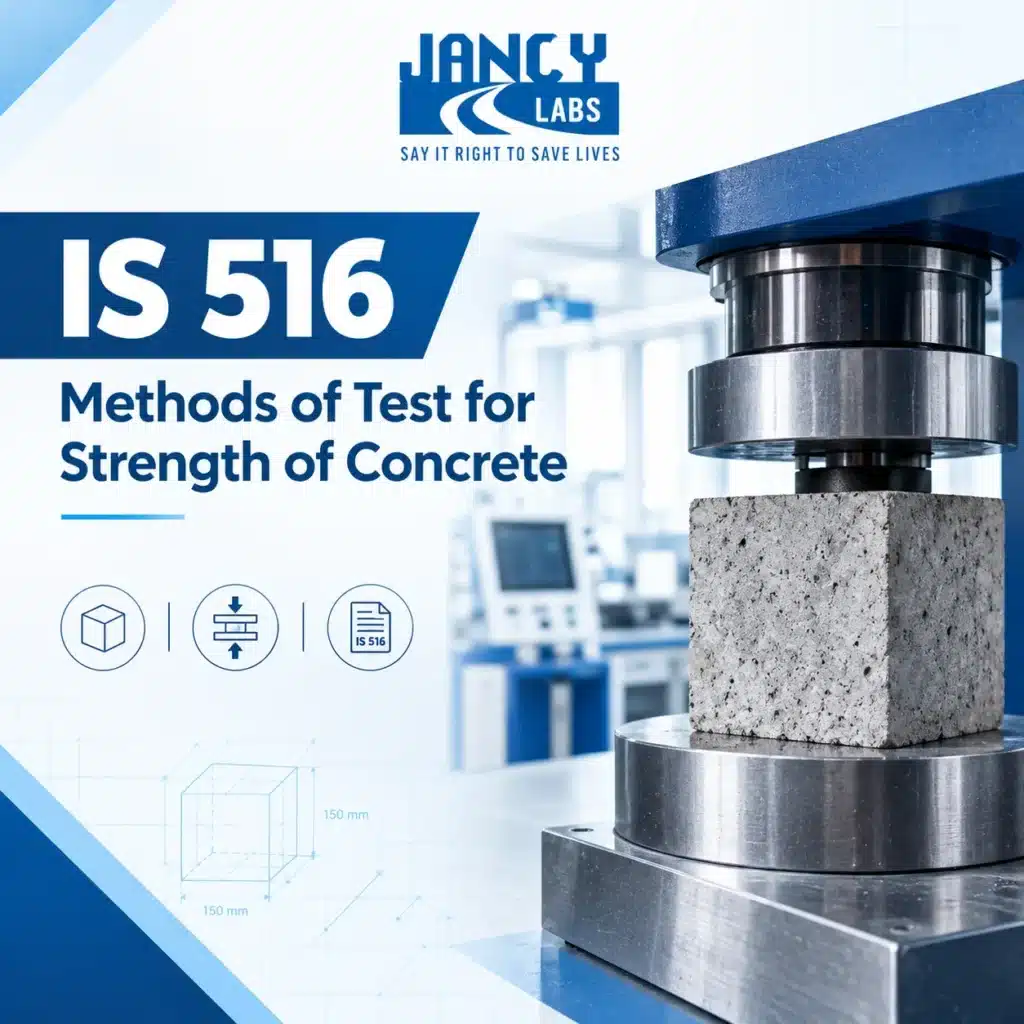
IS 516 is the Indian Standard that tells a lab how to test hardened concrete, from the cube test to the rebound hammer. For 60 years it was one document from 1959. Now it is a family of parts and sections, and many reports still cite the old version. This guide maps the new structure and the numbers that matter on site.
Key takeaways
- Compressive, flexural and split tensile strength now sit in Part 1/Sec 1:2021.
- Cores moved to Part 4:2018, and non-destructive tests moved to four sections of Part 5.
- Labs load cubes at 14 N/mm² per minute and test at least three at each age.
- The rebound hammer and UPV tests left IS 13311 and now sit in Part 5.
- A report that cites only the 1959 edition should be queried.
What is IS 516?
IS 516 is the set of test methods for hardened concrete, published by the Bureau of Indian Standards. In short, IS 456 tells you what strength the concrete must reach, while this standard tells the lab how to measure it.
The single 1959 document has been split into parts, each with its own year. So a modern report should name the exact part and section, not just the number.
Which parts of IS 516 are current?
Six parts and sections cover most site and lab work today. However, the older standards in the last column still appear on many reports.
Part / section | What it covers | Takes over from |
Part 1/Sec 1:2021 | Compressive, flexural and split tensile strength | IS 516:1959; IS 5816:1999 |
Part 4:2018 | Sampling, preparing and testing concrete cores | Earlier core method (first revision) |
Part 5/Sec 1:2018 | Ultrasonic pulse velocity (UPV) | IS 13311 (Part 1):1992 |
Part 5/Sec 2:2021 | Half-cell potential of uncoated rebar | Earlier edition (first revision) |
Part 5/Sec 3:2021 | Carbonation depth | — |
Part 5/Sec 4:2020 | Rebound hammer | IS 13311 (Part 2):1992 |
Other parts cover properties such as modulus of elasticity. Check the BIS catalogue for their current status before citing them.
What does Part 1/Sec 1 say about the cube test?
Part 1/Sec 1 sets the loading rate, the number of specimens and the rule for odd results. So these three points deserve a close look on any cube report.
Item | Rule in Part 1/Sec 1:2021 |
Loading rate (compression) | 14 N/mm² per minute until failure |
Specimens per age | At least three |
Odd results | Average stands only if each value is within ±15% of it |
Common test ages | 7 and 28 days; 56 days, 90 days and 1 year for later strength |
Early ages | 24 hours ± 30 min and 72 hours ± 2 hours |
Reporting | Compressive strength to the nearest 0.5 MPa |
For the full method, step by step, read our concrete cube test guide. To judge the results against a grade, see compressive strength of concrete.
How are flexural and split tensile tests run?
The same section covers flexural and split tensile strength, each at a much slower loading rate than the cube test. That is why a lab cannot reuse cube settings for beams or cylinders.
- Flexural strength: the lab loads prisms at 0.7 N/mm² per minute. If a 150 mm prism breaks within 170 mm of a support, the lab discards it; for a 100 mm prism, the limit is 110 mm.
- Split tensile strength: the lab loads cylinders at 1.2 to 2.4 N/mm² per minute and reports results to the nearest 0.05 MPa.
Flexural strength matters most for pavements and floors. Our flexural strength testing guide covers it in detail.
What changed for NDT under IS 516?
The biggest change is that NDT methods moved out of IS 13311 and into Part 5. IS 13311 Parts 1 and 2 are now withdrawn, so a 2026 report that cites them is out of date.
As a result, Part 5 now holds four methods: UPV, half-cell potential, carbonation depth and the rebound hammer test. In practice, engineers run two or more of them together, because each one answers a different question.
How do you check a report against IS 516?
First, check that the report names the part, section and year for every test. Then confirm the loading rate, the number of specimens and the test age match the method.
Next, confirm the lab’s accreditation lists that method. You can check this on the NABL website. Jancy Labs tests cubes, beams and split tensile cylinders at its concrete testing lab.
What mistakes show up most on concrete test reports?
Most report errors come from old citations, because the change to parts happened over several years. For example, watch for these five.
- Citing only the 1959 edition, even though Part 1/Sec 1:2021 now holds the strength methods.
- Quoting IS 13311 for UPV or the rebound hammer, although Part 5 replaced both parts.
- Naming IS 5816 for split tensile strength, since Part 1/Sec 1 now covers it.
- Testing only two cubes at an age, so the ±15% check cannot work properly.
- Loading beams at cube speed, which can inflate the flexural result.
These are small slips, but they make a report easy to challenge. So fix them before the report reaches the client.
Get Your Concrete Tested at Jancy Labs
Jancy Labs Private Limited is an accredited civil material testing laboratory (ISO/IEC 17025:2017, Certificate No. TC-12176) in Madurai, Tamil Nadu. We collect samples across Tamil Nadu and accept courier samples from anywhere in India.
Or call +91 86800 49004 · jancylabsmdu@gmail.com · Request a quote
4.8★ · 100+ Google reviews · Mon–Sat, 10:00–18:00
Frequently Asked Questions
What is IS 516 used for?
It sets the methods for testing hardened concrete, including compressive, flexural and split tensile strength, cores, and non-destructive tests.
Is IS 516:1959 still valid?
No. IS 516 (Part 1/Sec 1):2021 has taken over its strength test methods, so new reports should cite the part, section and year of each method.
What is the loading rate for cubes?
Part 1/Sec 1:2021 sets a loading rate of 14 N/mm2 per minute, applied until the cube fails.
How many cubes are tested at each age?
At least three. The average counts only if each result is within plus or minus 15% of it.
Which part covers the rebound hammer test?
Part 5/Sec 4:2020 covers the rebound hammer. It replaced IS 13311 (Part 2):1992, which is now withdrawn.