
Compressive Strength of Concrete: Grades, Formula and Acceptance Criteria
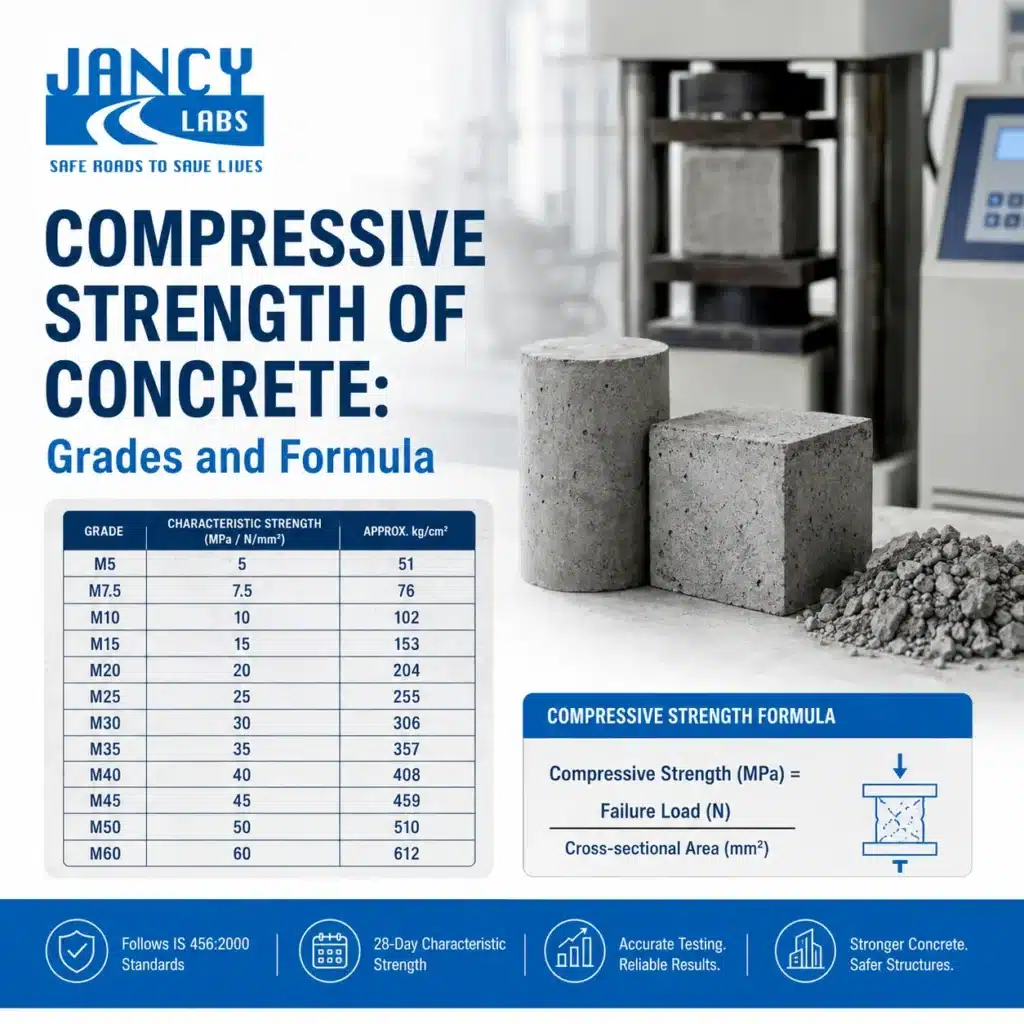
Every concrete grade you see on a drawing, M20, M25, M40, is a promise about compressive strength of concrete. That single number decides which loads a structure can carry. Getting the grade wrong in either direction, therefore, wastes money or risks safety. Here is what the number actually means, the full grade table, and what genuinely moves it up or down.
Key takeaways
- Compressive strength of concrete is the maximum stress it can bear before crushing, expressed in MPa or N/mm².
- Grade designation follows IS 456: the number after “M” is the characteristic strength at 28 days.
- MPa and N/mm² are the same unit; kg/cm² is roughly 10.2 times the MPa value.
- Water-cement ratio, curing, aggregate quality, and cement grade all move the result independently of the mix design on paper.
- Choosing the right grade for the application matters as much as hitting the target strength on test day.
What compressive strength of concrete actually measures
Compressive strength is the maximum stress concrete can bear under a compressive load before it crushes. Bureau of Indian Standards IS 456:2000 defines that strength statistically as the characteristic strength. This is the value below which no more than 5% of test results are expected to fall. Consequently, a single low cube does not automatically fail a batch. Instead, acceptance criteria look at a group of results rather than one number in isolation. Internationally, ASTM International C39 covers the equivalent compression test, following a broadly similar statistical approach with different numeric thresholds.
Concrete grade table: compressive strength of concrete in MPa
The grade designation itself is the strength value. M25 means the concrete targets a characteristic compressive strength of 25 MPa. That target is measured at 28 days:
Grade | Characteristic strength (MPa / N/mm²) | Approx. kg/cm² |
M5 | 5 | 51 |
M7.5 | 7.5 | 76 |
M10 | 10 | 102 |
M15 | 15 | 153 |
M20 | 20 | 204 |
M25 | 25 | 255 |
M30 | 30 | 306 |
M35 | 35 | 357 |
M40 | 40 | 408 |
M45 | 45 | 459 |
M50 | 50 | 510 |
M60 | 60 | 612 |
MPa and N/mm² are numerically identical, so a compressive strength of concrete in MPa and the same value in N/mm² are simply two names for the same reading. Converting to kg/cm² multiplies by roughly 10.2, which is why older drawings sometimes quote strength in the hundreds.
Compressive strength of concrete formula
The compressive strength of concrete formula is simple:
Compressive strength = Failure load ÷ Cross-sectional area
The formula is the easy part. Everything upstream of the test actually decides the result: mix proportions, water content, aggregate quality, curing, and time. A compressive strength of m25 concrete result of 18 MPa, therefore, is not a formula problem. It is a process problem somewhere between batching and curing.
What actually moves compressive strength
- Water-cement ratio — in fact, the single biggest factor; too much water dilutes strength even with correct cement content.
- Curing — however, inadequate curing can cost 30% or more of design strength, regardless of how well the mix was designed.
- Aggregate quality — similarly, weak, porous, or poorly graded aggregate limits strength no matter how much cement is used.
- Cement grade and age — for instance, 43-grade and 53-grade cement reach different strength curves, and old cement underperforms even at correct dosage.
- Compaction — finally, trapped air voids from poor compaction reduce effective strength significantly.
Choosing the right grade for the application
Specifying a higher grade than needed wastes cement. Specifying too low, meanwhile, risks structural failure. IS 456 sets minimum grades by exposure and use, and site practice generally follows this pattern:
Grade range | Typical application |
M5 – M10 | Lean concrete, PCC, blinding layers |
M15 – M20 | Residential slabs, footings, low-rise structural work |
M25 – M30 | RCC framed structures, most urban residential and commercial buildings |
M35 – M40 | High-rise buildings, bridges, heavily loaded structural elements |
M45 and above | Specialised structures — marine works, high-rise cores, precast elements |
For structural work, a formal concrete mix design actually determines whether a target grade is achievable with your available materials. Assuming a standard proportion will hit the number, by contrast, is a common and costly mistake. If you are unsure which grade your project needs, our team can walk through the exposure conditions and loading before you finalise a mix.
Why grade selection is not just a cost decision
Specifying a lower grade than needed does not just risk safety; it also risks rejection during quality review, which costs far more than the cement saved. Specifying a higher grade than needed, meanwhile, adds real cost across a large pour without adding real value, since the structure never uses the extra capacity. The right approach, therefore, is matching grade to exposure condition and load, not defaulting to a familiar number out of habit.
Acceptance criteria: reading a result against the grade
A single test result rarely tells the full story. Concrete compressive strength test acceptance under IS 456 looks at groups of results: the mean of four consecutive samples must exceed the target by a defined margin, and no individual result may fall too far below the grade. Our concrete testing lab evaluates results against exactly this framework, not just a pass/fail read of a single cube.
Frequently Asked Questions
What is the compressive strength of M25 concrete?
25 MPa (N/mm2) at 28 days is the characteristic strength target for M25 concrete under IS 456.
How is compressive strength of concrete measured in MPa?
It is calculated as failure load divided by the cross-sectional area of the test specimen, giving a result directly in MPa, which is identical to N/mm2.
Which IS code governs compressive strength of concrete?
IS 456:2000 governs grade designation and acceptance criteria, while IS 516 governs the physical test method used to measure the strength.
Can a low compressive strength result be fixed after the fact?
Not by changing the number. If a result is genuinely low, options are core testing to verify in-place strength, load testing, or in serious cases, structural strengthening - the mix itself cannot be retroactively corrected.
Get Your Soil Compaction Tested at Jancy Labs
Jancy Labs Private Limited is an accredited civil material testing laboratory (ISO/IEC 17025:2017, Certificate No. TC-12176) in Madurai, Tamil Nadu. We collect samples across Tamil Nadu and accept courier samples from anywhere in India.
Or call +91 86800 49004 · jancylabsmdu@gmail.com · Request a quote
4.8★ · 100+ Google reviews · Mon–Sat, 10:00–18:00