
Concrete Core Cutting Test: What to Do When the Cubes Fail
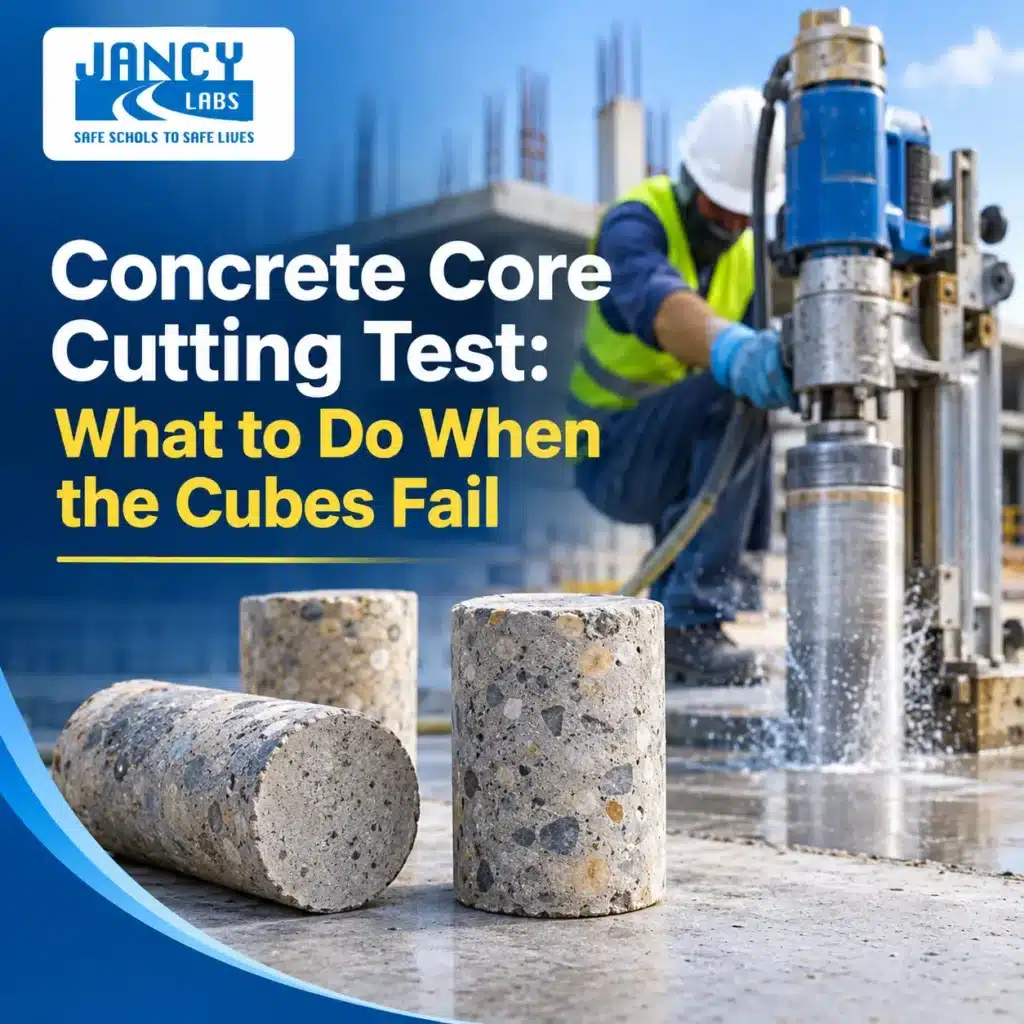
A concrete core cutting test is the usual next step when 28-day cube results come back below the specified grade. However, low cubes do not always mean weak concrete, because poor compaction or curing can spoil the cubes alone. A core drilled from the actual slab, beam or column shows what is really in the structure.
.
Key Takeaways
- A concrete core cutting test measures the in-place compressive strength of hardened concrete in the finished structure.
- IS 516 (Part 4):2018 sets the test method, while IS 456:2000 Clause 17.4 sets the acceptance limits.
- Labs must test at least three cores, and each core diameter must be more than three times the maximum aggregate size.
- Labs correct core strength for its length-to-diameter ratio, then multiply it by 1.25 to get an equivalent cube strength.
- Concrete passes when the average equivalent cube strength is at least 85% of the grade and no single core is below 75%.
What Is a Concrete Core Cutting Test?
A concrete core cutting test drills a cylinder of hardened concrete out of a finished structure and crushes it in a compression testing machine. It shows the strength of the concrete actually placed, not a sample cast beside it.
Engineers order core tests when cubes fail, when a structure shows cracks or honeycombing, or before altering an old building. Often they first run non-destructive testing such as rebound hammer and UPV, so they can drill cores at the weakest spots.
How the Concrete Core Cutting Test Is Done
The Bureau of Indian Standards publishes the method as IS 516 (Part 4):2018, which covers sampling, preparing and testing concrete cores. It also replaced the core clauses of IS 516:1959 and IS 1199:1959.
Step-by-Step Procedure
- Locate the steel. Use a cover meter to mark drilling points clear of reinforcement.
- Check the age. Drill concrete up to M25 only after it is at least 14 days old.
- Drill the core. Cut the core with a water-cooled diamond core drill.
- Prepare the ends. Trim and cap or grind the ends flat so the length-to-diameter ratio falls between 1 and 2.
- Soak the core. Keep the core in water at 27 plus or minus 3 degrees C for 40 to 48 hours.
- Crush the core. Load the core in a compression testing machine and record the maximum load.
- Repair the hole. Fill the hole with non-shrink grout or repair mortar.
Choosing Core Size, Number and Location
Core size depends on the aggregate. IS 516 (Part 4) requires the core diameter to be more than three times the nominal maximum aggregate size. So for concrete with aggregate up to 20 mm, the standard prefers a 100 mm core.
The engineer-in-charge decides where to drill, but the cores must represent the doubtful concrete. Also, avoid joints, edges and congested steel, because damaged or steel-filled cores read falsely low.
How Core Strength Converts to Cube Strength
You cannot compare core strength with cube results directly. First, the lab corrects it for shape. Then it converts the corrected value into an equivalent cube strength.
The Three Calculations
Measured strength = maximum load ÷ cross-sectional area
Corrected strength = measured strength × F, where F = 0.11N + 0.78
Equivalent cube strength = corrected strength × 1.25
Here, N is the length-to-diameter ratio, and F equals 1 at the preferred ratio of 2. Shorter cores read stronger, so F scales them down. Cores under 100 mm also get a size correction.
Worked Example: M25 Slab With Failed Cubes
Suppose the 28-day cubes for an M25 slab fell short of the grade. So the engineer orders a concrete core cutting test on three 100 mm cores, each with an area of 7,854 mm². These figures are illustrative only.
Core Results at a Glance
Core. | Length (mm). | Load (kN). | Measured (N/mm²). | Factor F. | Equivalent cube (N/mm²). |
C1. | 150. | 160. | 20.37. | 0.945. | 24.06. |
C2. | 180. | 150. | 19.10. | 0.978. | 23.35. |
C3. | 200. | 128. | 16.30. | 1.000. | 20.37. |
Average. | –. | –. | –. | –. | 22.59. |
The average of 22.59 N/mm² beats the 85% limit of 21.25 N/mm². Also, the weakest core, at 20.37 N/mm², clears the 75% floor of 18.75 N/mm². Therefore the slab passes, even though the cubes failed.
IS 456 Acceptance Limits and What to Do If Cores Fail
Under IS 456:2000 Clause 17.4.3, published by the Bureau of Indian Standards, a concrete core cutting test passes if the average equivalent cube strength is at least 85% of the specified grade at that age. No single core may fall below 75%.
Acceptance Limits by Grade
Grade. | fck (N/mm²). | Minimum average, 85%. | Minimum single core, 75%. |
M20. | 20. | 17.00. | 15.00. |
M25. | 25. | 21.25. | 18.75. |
M30. | 30. | 25.50. | 22.50. |
M35. | 35. | 29.75. | 26.25. |
If the Cores Also Fail
When cores fail, IS 456 allows a load test on the part in doubt. If that also fails, the structural engineer chooses between strengthening, such as jacketing, and partial rebuilding. Either way, review the mix with a design mix check before the next pour.
A concrete core cutting test is only as reliable as the lab, so choose one accredited by NABL under ISO/IEC 17025. See our accreditation details and the concrete tests we offer.
Get Your Concrete Cores Tested at Jancy Labs
Jancy Labs Private Limited is an accredited civil material testing laboratory (ISO/IEC 17025:2017, Certificate No. TC-12176) in Madurai, Tamil Nadu. We collect samples across Tamil Nadu and accept courier samples from anywhere in India.
Or call +91 86800 49004 · jancylabsmdu@gmail.com · Request a quote
4.8★ · 100+ Google reviews · Mon–Sat, 10:00–18:00
Frequently Asked Questions
How many cores are needed for a core cutting test?
IS 456 Clause 17.4.2 requires at least three cores from the area in doubt. The engineer-in-charge chooses the points, and the cores must represent the concrete in question.
What is the minimum core diameter for concrete?
The core diameter must be more than three times the nominal maximum aggregate size. For concrete with 20 mm aggregate, IS 516 (Part 4):2018 prefers a 100 mm core.
Why is core strength lower than cube strength?
Cores come from concrete compacted and cured on site, not in a lab tank. Drilling also causes minor damage at the core edges. That is why IS 456 accepts an average of 85% of the grade, not 100%.
Does a core test weaken the structure?
A core leaves a small hole that the lab fills with non-shrink grout or repair mortar. Since cores sit away from main bars, a well-planned test does not weaken the member.