
Chloride and Sulphate Limits in Concrete Mixing Water
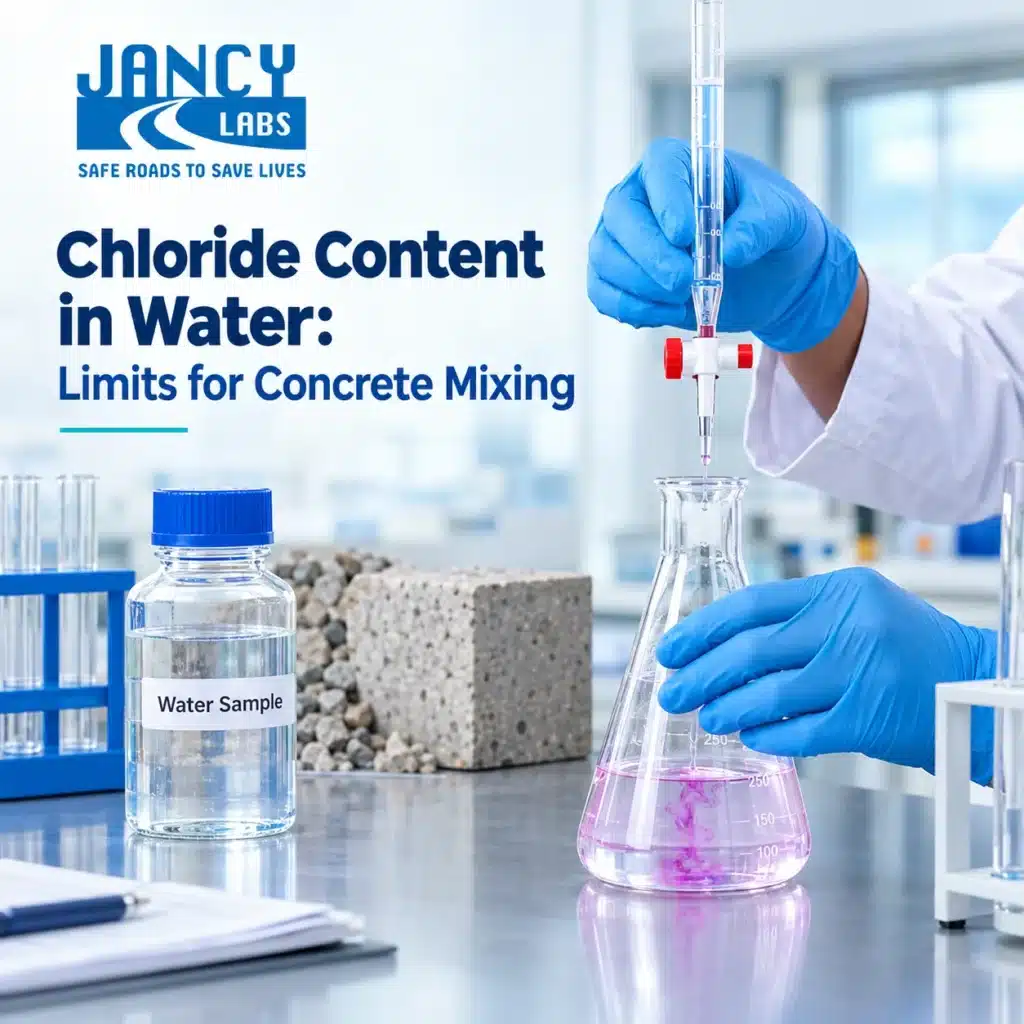
Chloride content in water decides whether that water is safe to mix into concrete. IS 456:2000 caps chlorides at 500 mg/l for reinforced concrete and 2,000 mg/l for plain concrete. It also caps sulphates at 400 mg/l. Chloride attacks steel reinforcement, while sulphate attacks hardened concrete. This guide explains the limits, how labs measure them and what to do when water fails.
Key takeaways
- Chloride content in water must stay under 500 mg/l for reinforced concrete and under 2,000 mg/l for plain concrete, as IS 456:2000 requires.
- Sulphates (as SO4) are limited to 400 mg/l in mixing water.
- For dilute water, 1 mg/l equals 1 ppm, so 500 mg/l is 500 ppm.
- Sea water holds roughly 19,000 mg/l of chloride, so it fails both limits.
- Drinking water can still fail, because IS 10500:2012 permits up to 1,000 mg/l of chloride when no alternate source exists.
What are the chloride and sulphate limits for mixing water?
IS 456:2000, Clause 5.4, sets the limits for mixing water as maximum concentrations of dissolved salts. The standard checks chloride and sulphate against the values below. IS 456:2000 points to the IS 3025 series for the test methods.
Parameter | Maximum limit | Test method |
Chlorides (as Cl), reinforced concrete | 500 mg/l | IS 3025 (Part 32) |
Chlorides (as Cl), plain concrete | 2,000 mg/l | IS 3025 (Part 32) |
Sulphates (as SO4) | 400 mg/l | IS 3025 (Part 24) |
The chloride method is IS 3025 (Part 32). The sulphate method now also appears as IS 3025 (Part 24/Sec 1):2022, which covers the gravimetric and turbidity methods.
Why does chloride content in water matter for concrete?
Chloride content in water matters because chloride ions break down the protective film around steel bars. Once that film fails, the steel rusts. Rust takes up more space than steel, so it cracks the cover concrete and shortens the life of the structure. That is why the limit for reinforced concrete is four times tighter than the limit for plain concrete.
Sulphate causes a different problem. It reacts with the hydrated cement and causes expansion and cracking in hardened concrete.
What is the chloride content of sea water, drinking water and DM water?
The chloride content in water differs sharply by source. Sea water carries roughly 19,000 mg/l of chloride, while drinking water carries far less. The table compares each water type with the 500 mg/l limit for reinforced concrete.
Water type | Chloride content | Against the 500 mg/l limit |
Sea water | Roughly 19,000 mg/l | Fails |
Drinking water, acceptable limit | 250 mg/l | Passes |
Drinking water, permissible limit | 1,000 mg/l | Fails, though plain concrete allows it |
DM water | Normally very low | Passes if the test confirms it |
The drinking water figures come from IS 10500:2012, which also sets sulphate at 200 mg/l acceptable and 400 mg/l permissible. As a result, water that passes as drinking water may still fail for reinforced concrete. IS 456 does not recommend sea water for mixing or curing, and its Amendment No. 4 strengthens that prohibition.
How do labs test chloride and sulphate in water?
Labs test chloride content in water and sulphate with standard chemical methods from the IS 3025 series, then report each result in mg/l.
- Collect the sample. Rinse a clean bottle with the water, then fill it and seal it. Label it with the source and date.
- Measure chloride. The lab titrates the sample under IS 3025 (Part 32).
- Measure sulphate. The lab uses the gravimetric or turbidity method under IS 3025 (Part 24).
- Compare with the limits. Check each result against the IS 456:2000 limit for your type of concrete.
- Run comparison cubes if needed. If a result sits close to a limit, compare setting time and 28-day strength against a control made with distilled water.
IS 456 asks for initial setting time within 30 minutes of the control. It also asks for 28-day strength of at least 90 per cent of the control.
What should you do if the water fails?
If the chloride content in water fails the limit, switch to a cleaner source, or treat the water and test it again. Do not use failing water for reinforced concrete, even if people can drink it. Also remember that aggregates and admixtures add chloride too, so a passing water test is not the whole picture.
Where can you get mixing water tested?
Jancy Labs tests construction water at its Madurai laboratory. See the water testing lab page for the tests on offer, or request a quote for your samples. More guides sit on the Jancy Labs blog.
Get Your Water Tested at Jancy Labs
Jancy Labs Private Limited is an accredited civil material testing laboratory (ISO/IEC 17025:2017, Certificate No. TC-12176) in Madurai, Tamil Nadu. We collect samples across Tamil Nadu and accept courier samples from anywhere in India.
Or call +91 86800 49004 · jancylabsmdu@gmail.com · Request a quote
4.8★ · 100+ Google reviews · Mon–Sat, 10:00–18:00
Frequently Asked Questions
What is the permissible chloride content in water for concrete?
IS 456:2000 allows up to 500 mg/l of chloride in mixing water for reinforced concrete. For plain concrete, the limit is 2,000 mg/l.
What is the sulphate limit in concrete mixing water?
IS 456:2000 limits sulphates, measured as SO4, to 400 mg/l in mixing water.
What is sea water chloride content in ppm?
Sea water holds roughly 19,000 ppm of chloride. That is far above the IS 456 limits, so it does not suit reinforced concrete.
Is drinking water safe for mixing reinforced concrete?
Not always. IS 10500:2012 allows up to 1,000 mg/l of chloride when no alternate source exists, which is above the 500 mg/l limit for reinforced concrete. Test the water first.
What is the chloride content of DM water?
Demineralised water has most of its dissolved ions removed, so its chloride is normally very low. Check the supplier's test report to confirm.
Can I courier water samples to Jancy Labs?
Yes. Jancy Labs collects samples across Tamil Nadu and accepts courier samples from anywhere in India.