
Atterberg Limits Explained: Liquid Limit, Plastic Limit and PI
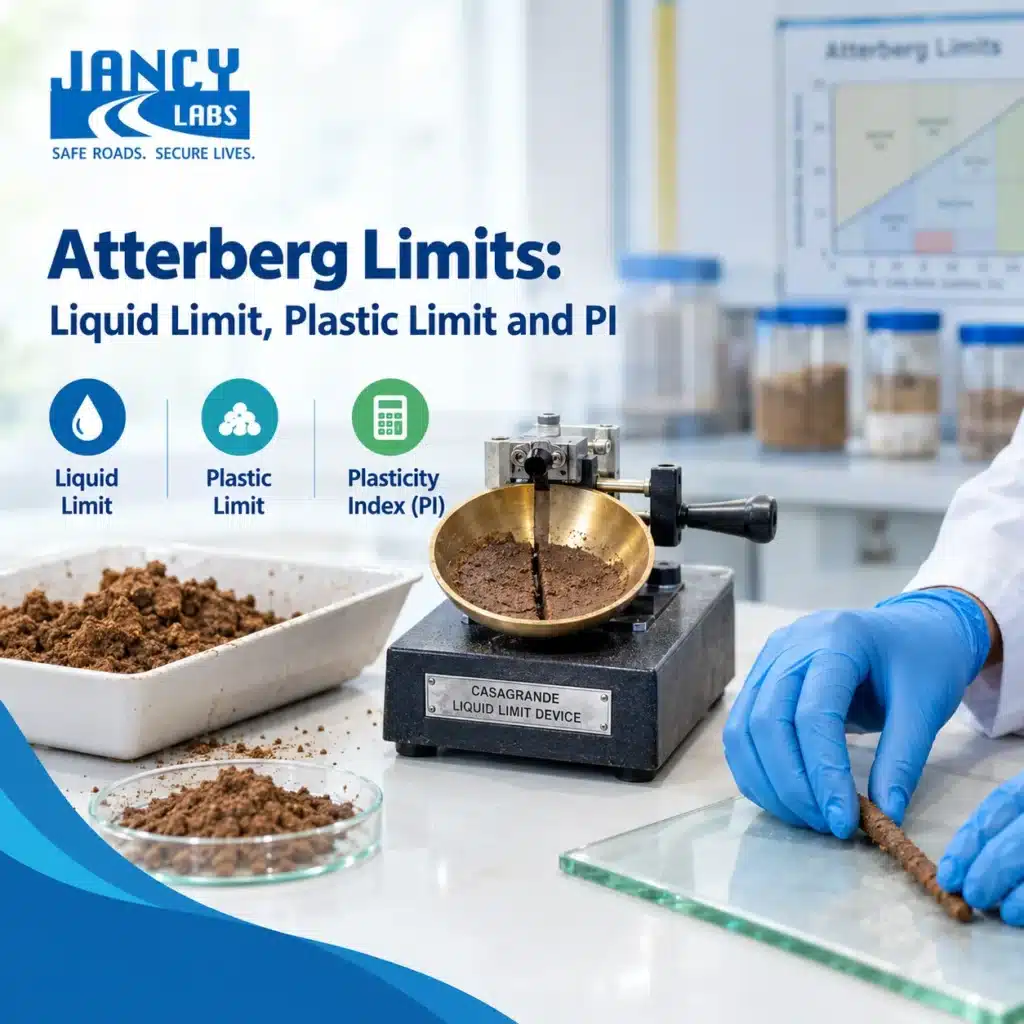
Atterberg limits tell you the moisture contents at which a fine-grained soil changes from solid to plastic to liquid. They decide whether that soil is safe to build on, and a geotechnical report that skips them is incomplete for any site with clay or silt. This guide covers the liquid limit, the plastic limit and the plasticity index calculated from them. It also covers the IS 2720 and ASTM D4318 procedures behind the numbers, and how to read the result on a real project.
Key takeaways
- Atterberg limits are the liquid limit, plastic limit and plasticity index of a fine-grained soil. PI equals LL minus PL.
- In India, the test method is IS 2720 (Part 5):1985, reaffirmed 2020. ASTM D4318-17e1 is the equivalent standard for American specifications.
- IS 1498:1970 classes soil with a liquid limit above 50% as high plasticity.
- A plasticity index above 17 signals a highly plastic, expansive clay that needs special foundation treatment.
- MoRTH road specifications cap subgrade liquid limit at 50% for embankment fill.
What are Atterberg limits?
Atterberg limits are the moisture-content boundaries that mark how a fine-grained soil behaves as it dries out or absorbs water. Below the plastic limit the soil is a stiff, brittle solid. Between the plastic limit and the liquid limit it behaves like a mouldable, plastic material. Above the liquid limit it behaves like a viscous liquid. The Swedish agronomist Albert Atterberg first defined these boundaries in 1911. Atterberg limits only apply to soil passing the 425-micron sieve, the silt and clay fraction, not sand or gravel. Coarse-grained soil has no liquid or plastic limit, because it lacks the fine clay particles that hold water between grains.
Every investigation for a foundation, embankment or pavement subgrade in clayey ground starts in our soil testing lab.
How the liquid limit and plastic limit are tested
A Casagrande grooving tool measures the liquid limit: a groove cut into a soil pat closes over a 12 mm length after a set number of blows, and that blow count converts to a moisture content on a flow curve. To find the plastic limit, you roll a soil thread by hand until it crumbles at exactly 3 mm diameter. IS 2720 (Part 5):1985 sets out both procedures, and so does ASTM D4318-17e1 for projects that specify it.
Jancy Labs runs the test in five steps:
- Air-dry the sample and sieve it through a 425-micron IS sieve.
- Mix the passed fraction with water into a paste and let it rest for 24 hours.
- Run the Casagrande test at four blow counts and plot the flow curve.
- Roll threads on a glass plate to find the plastic limit.
- Calculate the plasticity index and report both limits to the nearest whole number.
What the plasticity index tells you
The plasticity index is the difference between the liquid limit and the plastic limit, and it measures how wide a soil’s plastic range is. A wider range means a more workable, more moisture-sensitive soil. IS 1498:1970 groups fine-grained soil by liquid limit into low, intermediate and high plasticity bands, and the same plasticity chart plots PI against LL along the A-line, separating clay above the line from silt below it.
Liquid limit range | Plasticity group | Typical soil symbol |
Below 35% | Low | CL, ML |
35% to 50% | Intermediate | CI, MI |
Above 50% | High | CH, MH |
A-line: PI = 0.73 x (LL − 20)
Which standard applies: IS 2720 or ASTM D4318?
IS 2720 (Part 5):1985, reaffirmed 2020, is the standard Jancy Labs tests against by default, published by the Bureau of Indian Standards, and the reference named on most Indian PWD and NHAI project briefs. ASTM International‘s D4318-17e1 covers the same two limits for projects that follow American or international specifications, and the two methods give comparable results because both use the 425-micron sieve fraction and the same 3 mm thread criterion for the plastic limit. The main procedural difference is that ASTM allows a one-point liquid limit method as a shortcut; IS 2720 does not. If your project brief names a standard, say so when you send the sample, because a report written to the wrong standard gets rejected at review.
What goes wrong, and how to read a bad result
A plasticity index above roughly 40 flags an expansive clay that will shrink and swell across the seasons, and it usually rules out an ordinary strip footing in favour of a raft or piled foundation. A subgrade liquid limit above 50% breaches the MoRTH ceiling for embankment fill and needs stabilisation with lime or cement before use, and it is worth having the aggregate for the sub-base checked at the same time. The test itself can go wrong too: a soil pat mixed too dry gives an artificially low liquid limit, and a rushed rest period skews the flow curve. If an Atterberg limits report shows two very different plasticity index values from one borehole, ask for a re-test instead of averaging them, because the gap usually means the samples came from different soil layers.
Get Your Materials Tested at Jancy Labs
Jancy Labs Private Limited is an accredited civil material testing laboratory (ISO/IEC 17025:2017, Certificate No. TC-12176) in Madurai, Tamil Nadu. We collect samples across Tamil Nadu and accept courier samples from anywhere in India.
Or call +91 86800 49004 · jancylabsmdu@gmail.com · Request a quote
4.8★ · 100+ Google reviews · Mon–Sat, 10:00–18:00
Frequently Asked Questions
What is a good plasticity index value for construction?
A plasticity index under 17 is workable for ordinary foundations. Above 17, IS 1498:1970 and standard geotechnical practice treat the soil as highly plastic and expansive, which calls for a deeper or stiffened foundation.
What is the difference between liquid limit and plastic limit?
The liquid limit is the moisture content at which soil starts to flow like a liquid. The plastic limit is the lower moisture content at which it stops being mouldable and starts to crumble. Their difference is the plasticity index.
Is Atterberg limits testing done to IS or ASTM standards in India?
Indian labs test to IS 2720 (Part 5):1985, reaffirmed 2020, by default. ASTM D4318-17e1 is used only when a project specification calls for the American standard by name.
How long does an Atterberg limits test take?
The plastic limit can be reported within a day. The liquid limit needs a 24-hour soil-water rest period before testing, so turnaround typically runs 2 to 3 working days from sample receipt.