
Aggregate Impact Value Test: Procedure, AIV Limits and Results
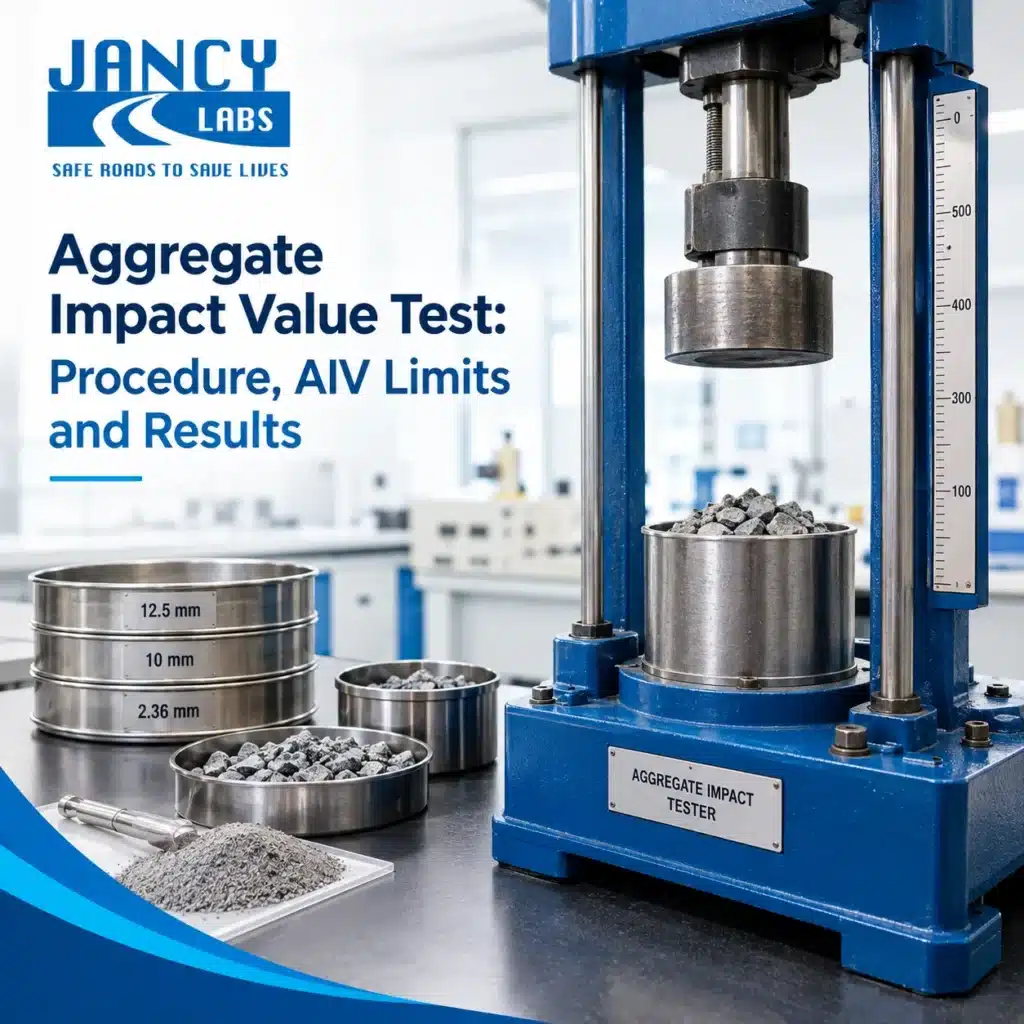
The aggregate impact value tells you how much a stone breaks down when something hits it suddenly, like a loaded truck wheel. A low number means tough stone. In contrast, a high number means the stone will turn to dust under traffic, so the layer fails early. This guide explains the test, so you can read an aggregate test report with confidence.
Key takeaways
- Aggregate impact value (AIV) is the share of fines passing a 2.36 mm sieve after 15 hammer blows.
- The method is IS 2386 (Part 4):1963, reaffirmed by BIS in 2016.
- Lower is better. An AIV of 10% means tougher stone than an AIV of 25%.
- IS 383:2016 caps AIV at 30% for wearing surfaces and 45% for other concrete.
- MoRTH sets tighter caps: 27% for DBM and 24% for bituminous concrete.
What is the aggregate impact value?
The aggregate impact value is a measure of toughness, which is the resistance of coarse aggregate to sudden shock. First, the lab crushes a standard sample with hammer blows. Then it weighs the fines as a percentage of the original mass.
However, toughness is not the same as strength. Some stones carry a steady load well but still shatter under a sharp blow. Because roads face this kind of impact every day, engineers check both.
Aggregate impact value test apparatus
The apparatus is simple, but IS 2386 (Part 4) fixes every dimension. You can find the code through the BIS standards portal. Even a small change in hammer mass or drop height shifts the result, so labs check machines against these figures.
Item | Specification |
Impact testing machine | Hammer of 13.5 to 14.0 kg, free fall of 380 ± 5 mm |
Hammer face | 100 mm diameter, 50 mm long, 2 mm chamfer |
Steel test cup | 102 mm internal diameter, 50 mm deep, wall at least 6.3 mm |
Measuring cylinder | 75 mm internal diameter, 50 mm deep |
Tamping rod | 10 mm diameter, 230 mm long, rounded at one end |
IS sieves | 12.5 mm, 10 mm and 2.36 mm |
Balance | Readable to 0.1 g |
Oven | Holds 100 to 110 °C |
Procedure of the aggregate impact value test
- Sieve the sample. Keep only the stone that passes the 12.5 mm sieve and stays on the 10 mm sieve.
- Dry it. Oven-dry this fraction at 100 to 110 °C for four hours, then let it cool.
- Measure the sample. Fill the measuring cylinder in three equal layers and tamp each layer 25 times with the rounded end of the rod. Strike off the surplus and weigh the sample (A).
- Tamp it in the cup. Move the whole sample into the steel cup on the machine and tamp it 25 more times.
- Apply 15 blows. Raise the hammer to 380 mm above the stone and let it fall freely. Give 15 blows, at least one second apart.
- Sieve the crushed stone. Sieve it all on the 2.36 mm sieve until no real amount passes in one minute. Weigh the fraction passing (B) and the fraction retained (C).
- Check the mass balance. If B plus C falls short of A by more than 1 g, discard the result and test again.
- Test a second sample and report the mean of the two results to the nearest whole number.
How to calculate the aggregate impact value
AIV (%) = (B ÷ A) × 100
Here, A is the oven-dry sample mass and B is the mass passing the 2.36 mm sieve.
For example, say a sample weighs 330.0 g. After 15 blows, 46.2 g passes the sieve and 283.4 g stays on it, so only 0.4 g is lost. Therefore the AIV is 46.2 ÷ 330.0 × 100, or 14.0%. If a second sample gives 15.1%, the lab reports 15%.
AIV limits: what result is acceptable?
The limit depends on where the stone will go. Because wearing surfaces take direct traffic, their limits are lower. The table below combines IS 383:2016 for concrete and the MoRTH Specifications for Road and Bridge Works (5th Revision), published by the Ministry of Road Transport and Highways.
Where the aggregate is used | Maximum AIV | Source |
Concrete wearing surfaces (roads, runways) | 30% | IS 383:2016 |
Concrete other than wearing surfaces | 45% | IS 383:2016 |
Concrete of grade M65 and above | 22% | IS 383:2016 |
Water bound macadam, base and surfacing | 30% | MoRTH |
Water bound macadam used as sub-base | 40% | MoRTH |
Dense bituminous macadam (DBM) | 27% | MoRTH |
Bituminous concrete (BC) wearing course | 24% | MoRTH |
Textbooks also use a rough scale, where 10 to 20% is strong and above 35% is weak for surfacing. However, the contract specification always governs.
What should you do if the aggregate impact value fails?
A failed result does not always mean the quarry is bad. So first rule out testing errors, and then look at the stone.
- Check the grading. Pieces outside the 10 to 12.5 mm band change the result.
- Check the sample. One bag from a stockpile top may not represent the source.
- Look at related tests. Also compare the Los Angeles abrasion and crushing values.
- Change the use. Stone that fails the 24% limit for a bituminous wearing course may still pass 45% for other concrete.
Finally, if a report confuses you, send it to our team and we will explain it.
Get Your Aggregate Tested at Jancy Labs
Jancy Labs Private Limited is an accredited civil material testing laboratory (ISO/IEC 17025:2017, Certificate No. TC-12176) in Madurai, Tamil Nadu. We collect samples across Tamil Nadu and accept courier samples from anywhere in India.
Or call +91 86800 49004 · jancylabsmdu@gmail.com · Request a quote
4.8★ · 100+ Google reviews · Mon–Sat, 10:00–18:00
Frequently Asked Questions
What is a good aggregate impact value?
Lower is better. IS 383:2016 sets a maximum of 30% for wearing surfaces, and MoRTH limits bituminous concrete to 24%. So a result of 10% to 20% points to tough stone.
Why does the test use 10 to 12.5 mm aggregate?
A single, narrow size band makes results comparable between labs and quarries. Mixed sizes would crush differently, so the limits would no longer apply.
Is the impact test the same as the crushing value test?
No. The impact test applies sudden hammer blows, while the crushing value test applies a slow 40-tonne load. However, IS 383:2016 accepts either one.
Can a lab test aggregate in wet condition?
Yes. For stone that softens in water, MoRTH requires a wet impact test under IS 5640. As a result, the value better reflects stone exposed to rain.