
Specific Gravity of Aggregate: IS 2386 Part 3 Test, Formulas and Values
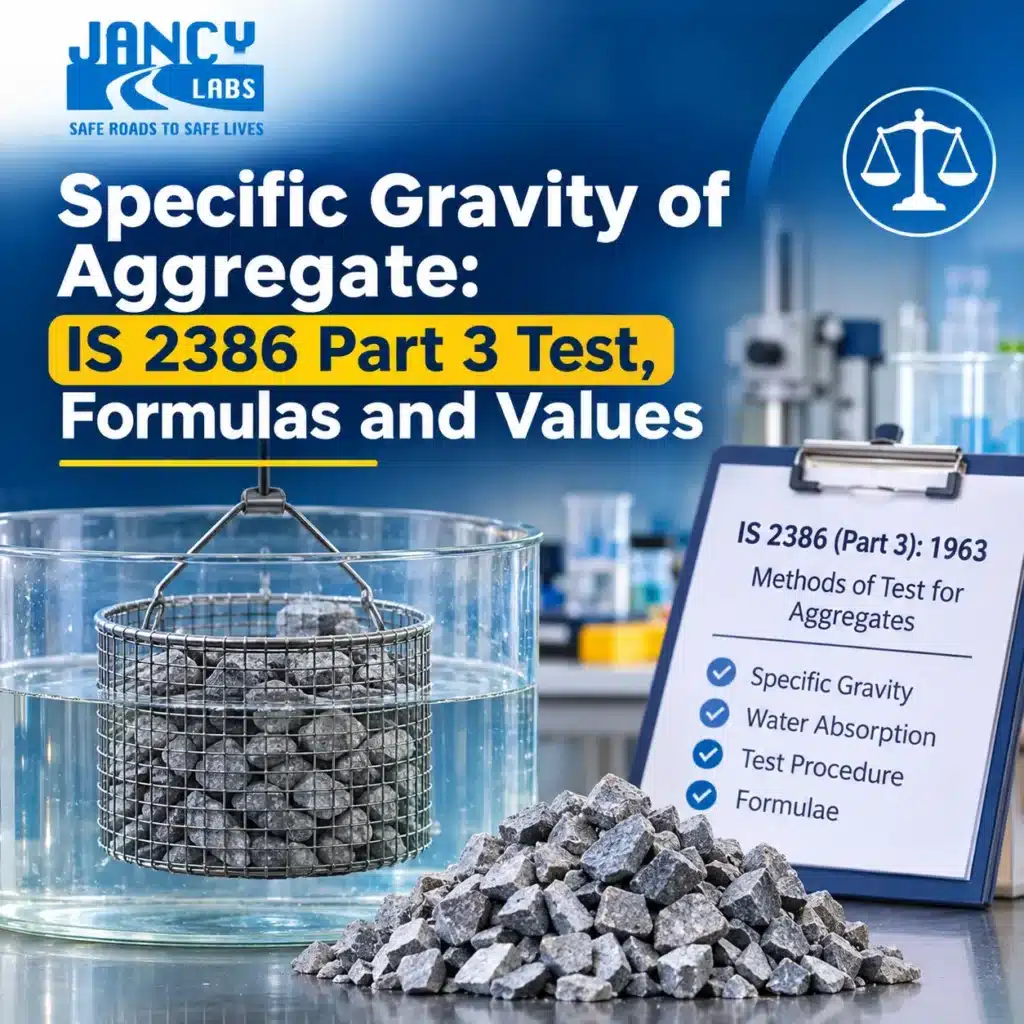
The specific gravity of aggregate tells you how heavy the stone is compared with the same volume of water, and every concrete mix design depends on it. Get it wrong and your cement, sand and water quantities are wrong too. In India, labs measure it to IS 2386 (Part 3):1963, the same test that gives water absorption.
Key takeaways
- Specific gravity of aggregate is the weight of the stone divided by the weight of an equal volume of water. It has no units.
- IS 2386 (Part 3):1963 sets the method. It was reaffirmed in 2016 and 2021, so it is still current.
- Crushed natural stone usually gives a value between 2.6 and 2.8.
- The same test gives water absorption, used to correct mix water under IS 10262:2019.
- MoRTH caps water absorption of coarse aggregate at 2% for DBM and bituminous concrete layers.
What is specific gravity of aggregate?
Specific gravity of aggregate is the weight of a given volume of stone divided by the weight of the same volume of water. Because stone has tiny pores, the Bureau of Indian Standards code, as amended, asks for three results:
- Oven-dry specific gravity, where the pores hold no water.
- SSD (saturated surface-dry) specific gravity, where the pores are full but the surface is dry.
- Apparent specific gravity, which leaves out the pores that water can enter.
Mix designers use the SSD value, because stockpiled aggregate sits closer to that state. It keeps the design mix realistic.
How the aggregate specific gravity test works
IS 2386 Part 3 picks the method for specific gravity of aggregate by particle size. Method I uses a wire basket for aggregate larger than 10 mm. Method II uses a glass jar for 40 mm to 10 mm, while Method III uses a pycnometer below 10 mm. For the specific gravity of 20mm aggregate, most labs use Method I:
- Wash at least 2 kg of aggregate to remove dust.
- Soak it in the wire basket in distilled water at 22 to 32 °C.
- Lift and drop the basket 25 mm, 25 times, to release trapped air, then soak for 24 ± ½ hours.
- Weigh the basket with the sample in water, then the empty basket in water.
- Dry the stone surfaces with cloths and weigh them in air. This is the SSD weight.
- Oven-dry the sample at 100 to 110 °C for 24 ± ½ hours, cool it and weigh it again.
The code calls for two tests, reported with their mean.
Fine aggregate specific gravity test
The fine aggregate specific gravity test follows Method III, using a 1-litre pycnometer and about 500 g of sand finer than 4.75 mm. First, the sand soaks for 24 hours. Then the technician dries it with warm air until it just turns free-running. That point is the SSD state for sand, and it is the hardest step to judge.
Specific gravity of aggregate formula
For Method I, let A be the weight of the saturated sample in water, B its SSD weight in air and C its oven-dry weight:
Specific gravity (oven-dry) = C ÷ (B − A)
SSD specific gravity = B ÷ (B − A)
Apparent specific gravity = C ÷ (C − A)
Water absorption (%) = 100 × (B − C) ÷ C
Example figures, not test data: A = 1,265 g, B = 2,010 g and C = 1,995 g. The NITK virtual lab walks through a similar calculation.
Result | Working | Value |
Oven-dry specific gravity | 1,995 ÷ 745 | 2.68 |
SSD specific gravity | 2,010 ÷ 745 | 2.70 |
Apparent specific gravity | 1,995 ÷ 730 | 2.73 |
Water absorption | 100 × 15 ÷ 1,995 | 0.75% |
What values should you expect?
Specific gravity of aggregate from crushed natural stone usually falls between 2.6 and 2.8. IS 2386 Part 3 is a method standard, so it sets no pass value. The result feeds mix design and confirms that a new load matches the approved source.
Use | What applies | Reference |
Concrete mix design | SSD specific gravity and absorption go into the calculation | IS 10262:2019 |
Concrete aggregate | Specific gravity and absorption are reported | IS 383:2016 |
DBM and BC layers | Water absorption 2% maximum | MoRTH Tables 500-8, 500-16 |
GSB and WMM layers | Above 2% absorption, a soundness test is needed | MoRTH Clauses 401, 406 |
These road limits come from the MoRTH road and bridge specifications. Porous stone soaks up binder in bitumen mix work, hence the cap.
Common mistakes that throw the result off
Most errors in a specific gravity of aggregate result come from four habits:
- Wrong surface drying. Shiny, wet stones push the SSD weight up, while over-dried stones push it down.
- Trapped air. Skipping the 25 drops leaves bubbles, so the weight in water reads low.
- Unwashed samples. Dust floats off during soaking, so the weights no longer match.
- A single test. The code asks for two, and a wide gap between them means a retest.
Low specific gravity with high absorption often points to weathered stone. In that case, add soundness and strength checks to your aggregate testing plan. For structural work, use an NABL-accredited lab so the report also backs your concrete testing.
Get Your Aggregate Tested at Jancy Labs
Jancy Labs Private Limited is an accredited civil material testing laboratory (ISO/IEC 17025:2017, Certificate No. TC-12176) in Madurai, Tamil Nadu. We collect samples across Tamil Nadu and accept courier samples from anywhere in India.
Or call +91 86800 49004 · jancylabsmdu@gmail.com · Request a quote
4.8★ · 100+ Google reviews · Mon–Sat, 10:00–18:00
Frequently Asked Questions
What is the specific gravity of 20mm aggregate?
Crushed natural stone of 20 mm size usually gives 2.6 to 2.8. The exact figure depends on the quarry, so a mix design should use the specific gravity of aggregate measured on your own source.
How long does the aggregate specific gravity test take?
The test needs at least two days: a 24-hour soak, then 24 hours in an oven at 100 to 110 °C before the final weighing.
Which specific gravity value is used in concrete mix design?
IS 10262:2019 mix design uses the SSD specific gravity of each aggregate. The water absorption from the same test then corrects the mixing water, so the water-cement ratio stays on target.
Is there a minimum specific gravity for aggregate?
IS 2386 Part 3 is a test method, so it sets no minimum. Specifications treat specific gravity as a reported value and set limits on related checks, such as the 2% absorption cap for bituminous layers.