
Core Cutting Test: Drilling and Testing Concrete Cores
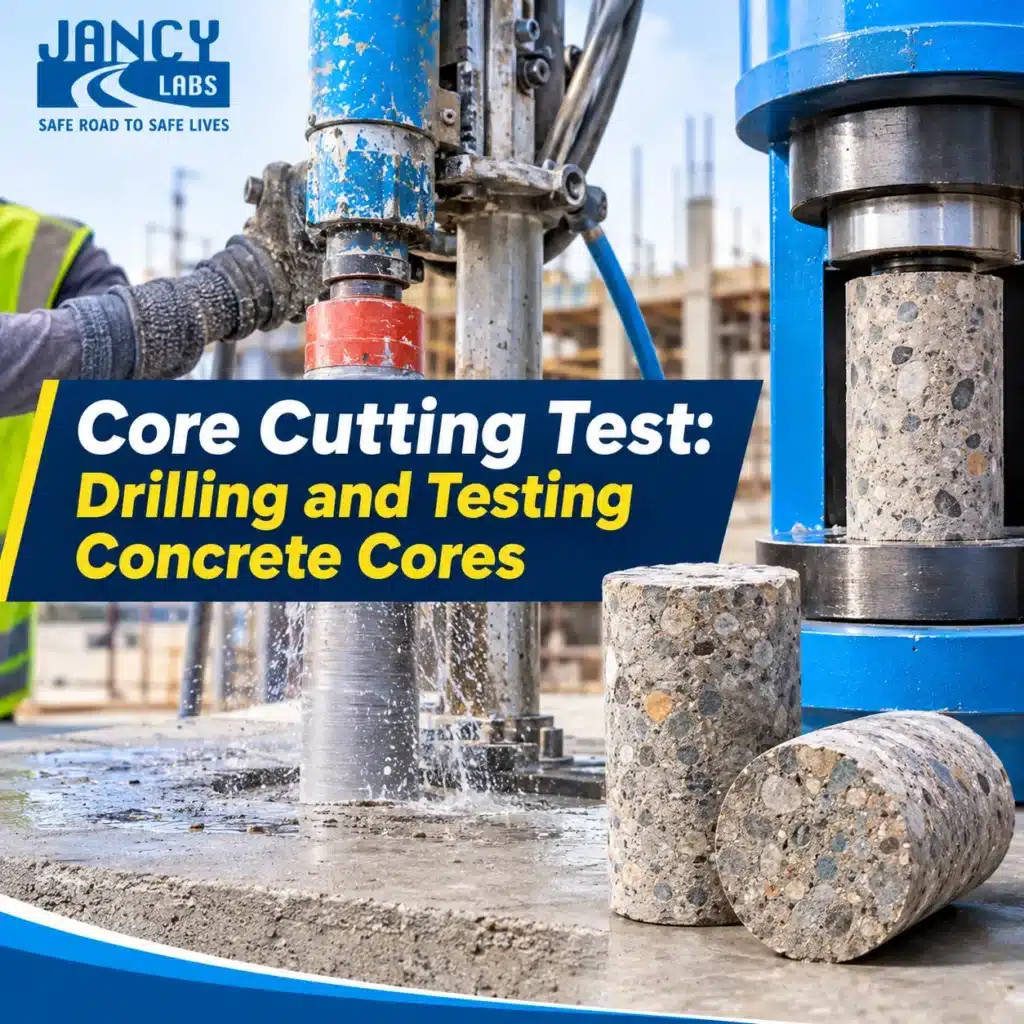
A core cutting test drills a cylinder of hardened concrete out of a slab, column or road. The lab then crushes it to find the strength that is actually in the structure. That differs from cube strength, which only reflects the concrete on the day of the pour. In India, the method is IS 516 (Part 4):2018, while the acceptance rule sits in IS 456:2000.
Key takeaways
- Cores give a direct measure of in-place concrete strength.
- IS 516 (Part 4):2018 covers drilling, preparing and testing the cores.
- Core diameter should be at least three times the nominal maximum aggregate size.
- Under IS 456, the core average must reach 85% of the grade strength. Also, no single core may fall below 75%.
- On roads, cores check the density and thickness of bituminous layers.
What is a core cutting test?
A core cutting test removes a cylinder of concrete with a water-cooled diamond drill, then tests it for compressive strength. People often call it an NDT core test. However, it is partly destructive, because it leaves a hole that needs repair. True non-destructive testing, such as rebound hammer and UPV, only gives an indication of strength. Cores, however, give the measured value.
For that reason, engineers usually run NDT first to map weak zones. Then they take a few cores where the readings look worst.
When do you need a core cutting test?
Most requests come from one of three situations.
- Cube results fail. IS 456 Clause 17 sends doubtful concrete for a core test before any load test.
- Records are missing, or the structure is old, damaged or under audit before a change of use.
- Road works need checks on the density and thickness of laid bituminous layers.
How to extract and test a concrete core
The Bureau of Indian Standards method in IS 516 Part 4 follows this sequence.
- Scan the member and mark core points clear of reinforcement bars.
- Drill with a water-cooled diamond core bit, held square to the surface.
- Choose a diameter at least three times the maximum aggregate size, such as 100 mm cores for 20 mm aggregate.
- When coring down into a slab, leave the top 15 to 20% of the depth out of the test length. That layer is usually weaker.
- Trim and cap the ends flat, then measure length and diameter.
- Crush the core in a compression testing machine and record the maximum load.
Finally, fill the hole with a non-shrink repair mortar so the member is not left weakened.
Core cutting compressive strength formula
A raw core result is not a cube result, so IS 516 Part 4 applies corrections.
Measured strength = Maximum load ÷ Core area
L/D factor F = 0.11 × (L/D) + 0.78
Equivalent cube strength = 1.25 × measured strength × F
Small cores get an extra factor too: 1.06 below 70 mm diameter and 1.03 for 75 ± 5 mm. Below is one 100 mm core with example figures, not test data.
Step | Working | Value |
Core area | π × 100² ÷ 4 | 7,854 mm² |
Measured strength | 180,000 N ÷ 7,854 | 22.92 N/mm² |
L/D factor (L = 150 mm) | 0.11 × 1.5 + 0.78 | 0.945 |
Equivalent cube strength | 1.25 × 22.92 × 0.945 | 27.07 N/mm² |
IS 456 acceptance criteria for cores
IS 456 accepts the concrete when the average equivalent cube strength of the cores reaches 85% of the grade strength. In addition, no single core may fall below 75%. The table applies this to common grades.
Grade | Average of cores (min) | Any single core (min) |
M20 | 17.0 N/mm² | 15.0 N/mm² |
M25 | 21.25 N/mm² | 18.75 N/mm² |
M30 | 25.5 N/mm² | 22.5 N/mm² |
So the example core above passes comfortably for M25. If cores fail, IS 456 allows a load test before any decision to strengthen or demolish. Ordinary concrete testing of cubes cannot settle that question.
Core cutting test for road
A core cutting test for road work checks bituminous layers rather than strength. Under the MoRTH specifications, DBM and BC layers need one density test per 700 m². Each core must then reach at least 92% of the mix’s maximum specific gravity.
To find volume, the lab weighs each core in air and in water, as the NDMC core density form shows. The same core also shows the real layer thickness. Those results tie back to bitumen mix tests on the plant mix.
What a core test report should show
A good report lets the engineer check every correction, so ask for these details.
- Core location, drilling direction and the member it came from.
- Length, diameter and L/D ratio after trimming.
- Maximum load, measured strength and each correction factor.
- Equivalent cube strength for every core and the average.
- Notes on voids, honeycombing or steel found in the core.
Get Your Concrete Tested at Jancy Labs
Jancy Labs Private Limited is an accredited civil material testing laboratory (ISO/IEC 17025:2017, Certificate No. TC-12176) in Madurai, Tamil Nadu. We collect samples across Tamil Nadu and accept courier samples from anywhere in India.
Or call +91 86800 49004 · jancylabsmdu@gmail.com · Request a quote
4.8★ · 100+ Google reviews · Mon–Sat, 10:00–18:00
Frequently Asked Questions
How many cores do you need?
IS 456 leaves the number and location of cores to the engineer-in-charge. In practice, three cores per doubtful zone is common. That way, the rule can check both the average and each single core.
Is a core cutting test an NDT test?
No. A core cutting test is partly destructive, because it removes concrete and leaves a hole. Rebound hammer and UPV are the non-destructive tests, and engineers often run them first to choose core points.
What core size should you use?
The core diameter should be at least three times the nominal maximum aggregate size. So for 20 mm aggregate, the core must be at least 60 mm wide, and 100 mm is a common choice.
What happens if the cores fail?
If the cores miss the IS 456 limits, a load test on the structure may follow. The structural engineer then decides on strengthening, a change of use or replacement.