
Bitumen Extraction Test: Checking Binder Content in Road Mixes
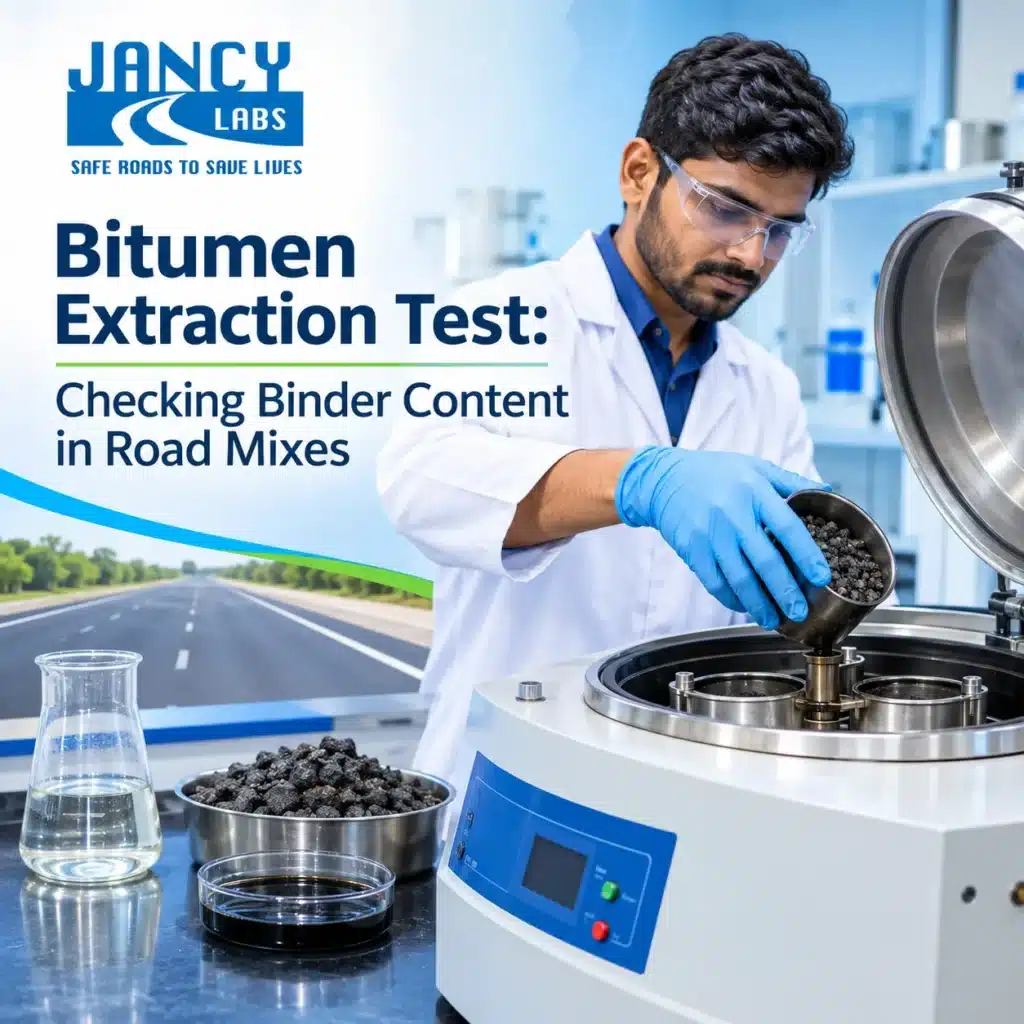
A bitumen extraction test tells you how much bitumen is really in a hot road mix, as a percentage of the total mix by mass. That figure decides whether a DBM or BC layer lasts. With too little binder, the surface ravels and cracks. With too much, it ruts and bleeds in summer heat. So highway contracts check binder content against the job mix formula every working day.
Key takeaways
- The bitumen extraction test measures binder content as a percentage of the total mix by mass.
- Indian road labs usually follow the centrifuge method of ASTM D2172, with trichloroethylene as the solvent.
- MoRTH allows field binder content to vary by only ±0.3% from the approved job mix formula.
- Minimum sample mass rises with aggregate size, from 0.5 kg for a 4.75 mm mix to 4.0 kg for a 37.5 mm mix.
- The clean aggregate left after extraction goes on to a sieve analysis, so one sample checks both binder and grading.
What is a bitumen extraction test?
A bitumen extraction test is a lab method that washes the bitumen out of a weighed sample of road mix and finds the binder content by difference. A solvent carries the bitumen away, while the stone and dust stay behind for weighing. Labs use it for plant control, layer acceptance and checks on failed roads. However, the method does not suit mixes that contain coal tar.
How does the centrifuge extraction test for bitumen work?
The centrifuge method spins the mix in a closed bowl while solvent flushes the binder out through a filter ring. ASTM D2172 lists it as Method A. The bitumen extraction machine is simply a motor-driven centrifuge with a bowl, clamped lid, filter ring and drain spout.
- Prepare the sample. Warm the mix to break it up, quarter it down to test size and weigh it. Measure moisture separately, because trapped water reads as bitumen.
- Soak in solvent. Cover the sample in the bowl with solvent until the binder softens.
- Spin the bowl. Fit a dried, weighed filter ring and clamp the lid. Then raise the speed slowly to a maximum of 3,600 rpm.
- Repeat the washes. Add fresh solvent and spin until the extract is no darker than light straw.
- Dry and weigh. Oven-dry the aggregate and filter ring at 110 ± 5 °C, then weigh both.
- Correct for fines. Measure the dust that passed into the extract, by ashing or high-speed centrifuge, and add it back.
Next, the clean aggregate goes through a sieve analysis in our aggregate testing lab to check grading.
How is binder content calculated?
Binder content equals the mass the moisture-free sample loses in extraction, expressed as a percentage of that sample.
Binder content (%) = [(W1 − W2) − (W3 + W4)] ÷ (W1 − W2) × 100
Here W1 is the sample mass, W2 the water in it, W3 the extracted aggregate including filter ring gain, and W4 the fines in the extract.
For example, a 1,500 g sample holds 5 g of water, gives 1,412 g of aggregate and leaves 14 g of fines. The binder is 1,495 − 1,426 = 69 g, so the content is 69 ÷ 1,495 × 100 = 4.6%. Against a 4.5% design, that sits inside the ±0.3% tolerance.
What binder content do Indian road mixes need?
The Ministry of Road Transport and Highways sets a minimum binder content for each bituminous layer in its Specifications for Road and Bridge Works (Fifth Revision). The Indian Roads Congress publishes these on the ministry’s behalf. In the field, the plant must then stay within ±0.3% of the approved job mix formula.
Mix | Grading (nominal max size) | Min. bitumen, % of total mix | Field tolerance |
DBM | Grading 1 (37.5 mm) | 4.0 | ±0.3% |
DBM | Grading 2 (26.5 mm) | 4.5 | ±0.3% |
BC | Grading 1 (19 mm) | 5.2 | ±0.3% |
BC | Grading 2 (13.2 mm) | 5.4 | ±0.3% |
The design figure comes from a Marshall mix design, which our design mix testing lab prepares before production.
Why does a bitumen extraction test fail?
Most failed results trace back to the plant, the sample or the lab method.
- Low binder: the plant pump has drifted, or the stone absorbs more bitumen than the design assumed.
- High binder: the plant is overdosing, or a wet sample reads as bitumen. Check moisture first.
- Incomplete washing: binder left on the stone makes the result read low.
- Missed ash correction: fines lost into the extract then count as binder.
- Old samples: aged mix tends to give slightly lower binder content, so test promptly.
If a result fails, test a fresh sample from the same lot before rejecting the layer. For disputes, use a lab accredited by NABL (see our accreditation details). Our bitumen testing lab runs this test alongside penetration, softening point and Marshall tests.
Get Your Bitumen Mix Tested at Jancy Labs
Jancy Labs Private Limited is an accredited civil material testing laboratory (ISO/IEC 17025:2017, Certificate No. TC-12176) in Madurai, Tamil Nadu. We collect samples across Tamil Nadu and accept courier samples from anywhere in India.
Or call +91 86800 49004 · jancylabsmdu@gmail.com · Request a quote
4.8★ · 100+ Google reviews · Mon–Sat, 10:00–18:00
Frequently Asked Questions
What standard is used for the bitumen extraction test in India?
Indian road projects run the test to ASTM D2172, usually Method A, the centrifuge method. The binder minimums and the ±0.3% field tolerance come from the MoRTH Specifications for Road and Bridge Works (Fifth Revision).
Which solvent is used in the extraction test of bitumen?
Trichloroethylene is the usual solvent for the centrifuge method. Because it is toxic, labs handle it under a fume hood and with gloves.
How much sample does the extraction test for bitumen need?
The minimum mass depends on the nominal maximum aggregate size. For example, ASTM D2172 asks for 1.5 kg for a 12.5 mm mix, 2.0 kg for 19 mm and 4.0 kg for 37.5 mm.
Why does the result show more bitumen than the plant added?
Water in the sample and dust lost into the extract both read as extra bitumen. So correct for moisture and mineral matter before comparing the result with the job mix formula.
Can I courier a road mix sample for a bitumen extraction test?
Yes. Jancy Labs accepts courier samples from anywhere in India and collects samples across Tamil Nadu. Seal the loose mix in a tin, and label it with the mix type, grading and target binder content.