
Construction Water Testing: What IS 456 Actually Demands
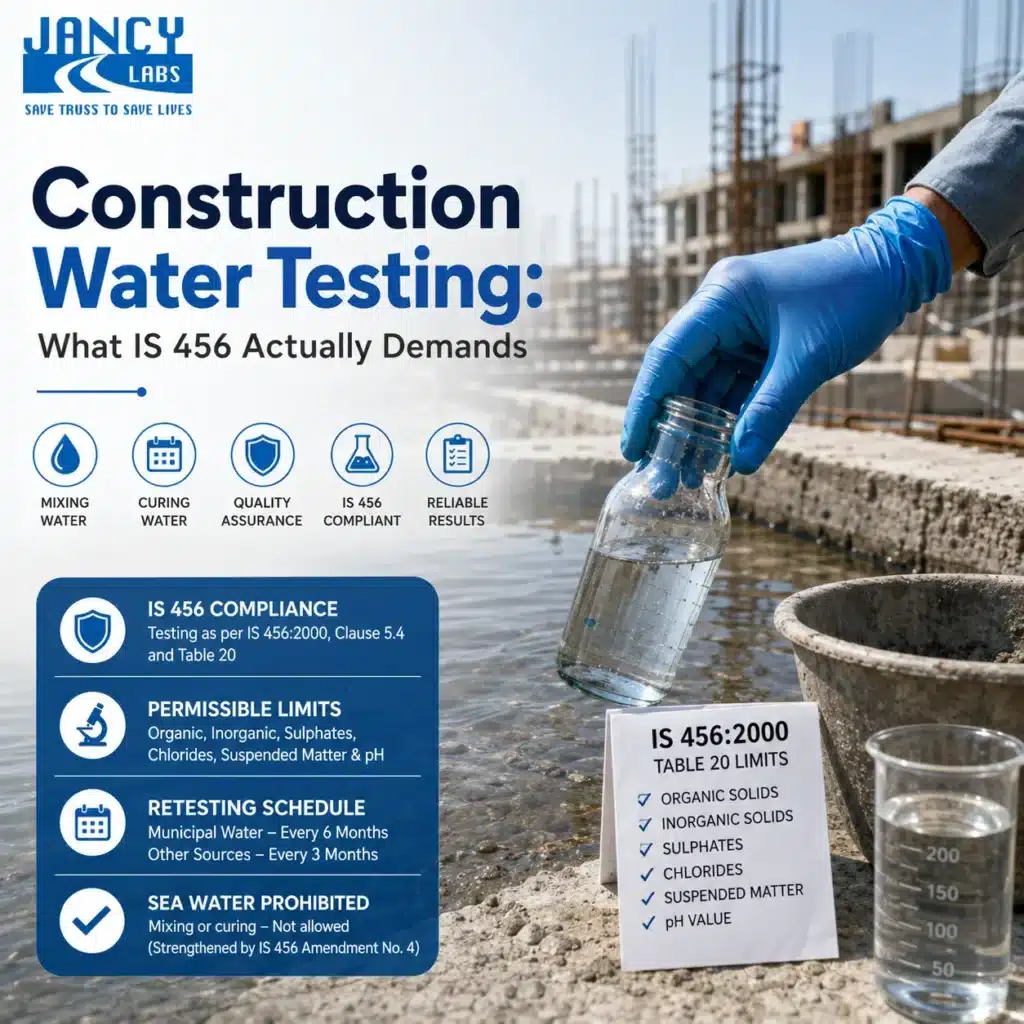
Most sites use whatever water is nearest, and most of the time that works out fine. But construction water testing exists precisely for the times it does not, since bad mixing water quietly weakens concrete without any visible sign until years later. Here is what IS 456 actually requires, which sources fail most often, and why sea water is now explicitly off the table.
Key takeaways
- Construction water testing is required under IS 456:2000, Clause 5.4, before water is used for mixing or curing concrete.
- IS 456 Table 20 sets permissible limits for organic solids, inorganic solids, sulphates, chlorides, and suspended matter.
- Sea water is explicitly prohibited for mixing or curing, a position IS 456 Amendment No. 4 further strengthened.
- Municipal water needs testing once every six months; other sources need testing every three months during ongoing work.
- If water quality is in doubt, IS 456 allows a compressive strength and setting time comparison against distilled water as the deciding test.
Why construction water testing matters
Water does more in concrete than most people assume. It drives the chemical hydration that gives cement its strength, and it also carries whatever dissolved salts, organic matter, or suspended solids the source contains straight into the mix. Excess chlorides accelerate reinforcement corrosion. Excess sulphates attack the hardened concrete over years. Organic matter interferes with setting time itself. None of these problems show up on the day of the pour. They show up as reduced service life, which is exactly why testing water before use costs far less than repairing the structure later.
What IS 456 Table 20 actually limits
IS 456:2000, Clause 5.4, sets out permissible limits for water used in both mixing and curing:
Parameter | Permissible limit (IS 456, Table 20) |
Organic solids | 200 mg/l max |
Inorganic solids | 3000 mg/l max |
Sulphates (as SO₃) | 400 mg/l max |
Chlorides (as Cl) | 2000 mg/l max (500 mg/l for prestressed/RCC) |
Suspended matter | 2000 mg/l max |
pH value | Not less than 6 |
The chloride limit tightens for prestressed and reinforced concrete in aggressive conditions, since chloride ions drive rebar corrosion.
Why sea water is explicitly prohibited
Sea water might look and behave like ordinary water, but its dissolved salt content alone disqualifies it. Bureau of Indian Standards IS 456:2000 already prohibited sea water for mixing or curing in its original text, and Amendment No. 4 to the code strengthens that position further, closing gaps some contractors had used to justify borderline coastal sources. On coastal projects, this makes verified freshwater sourcing a genuine logistical decision, not an afterthought.
How construction water testing actually works
- Collect a representative sample. Take it from the actual source proposed for construction, accounting for seasonal variation.
- Test against IS 3025 methods. Each parameter in Table 20 follows its own IS 3025 test procedure.
- Compare against the limits. Check organic solids, inorganic solids, sulphates, chlorides, suspended matter, and pH against IS 456.
- Run the strength check if in doubt. IS 456 permits a compressive strength and initial setting time comparison against distilled water as the deciding test when results sit close to the limit.
- Retest on a schedule. Municipal sources every six months, other sources every three months, for the duration of the work.
Internationally, ASTM International C1602 covers mixing water requirements for concrete on a broadly similar limit-based approach, though exact numeric limits differ from IS 456. A pass under one code does not guarantee a pass under the other.
Sources that fail most often
Borewell water is the most common offender, since groundwater in many regions carries dissolved salts and hardness that municipal supply does not. Water reused from site washdown or equipment cleaning can carry cement fines and contaminants that skew results. Even municipal water is not automatically exempt, since Table 20 still applies; it simply needs testing less frequently. For any source you are unsure about, a lab check before the pour is the only way to know. Our water testing lab runs the full Table 20 parameter set alongside project-specific checks like sulphate or chloride content when a consultant asks for them specifically. If you want to discuss your source before committing to a testing schedule, our team can walk through what your project actually needs.
When water quality affects a concrete result
Poor mixing water rarely shows up as an obvious failure. It shows up as a concrete cube test result that comes in lower than expected, with no other obvious explanation. If cube results disappoint and the mix design, curing, and sampling all check out, water quality is one of the first things worth ruling out, especially on sites drawing from a borewell or a source that has never actually been tested.
What to send when booking construction water testing
A quick checklist speeds up both sample collection and the eventual report:
- The source type — municipal, borewell, open well, or another source entirely.
- Whether the water is intended for mixing, curing, or both, since some limits differ by use.
- Any specific parameter your consultant has flagged, such as sulphate or chloride content.
- The project name and location, so retesting intervals can be tracked against your schedule.
None of this needs to be exact upfront — our team confirms details when scheduling.
Frequently Asked Questions
Is potable water automatically suitable for construction?
Usually, but not guaranteed. IS 456 treats drinking-water suitability as a helpful indicator, not a substitute for testing against Table 20, since some parameters relevant to concrete are not part of standard drinking-water checks.
How often does construction water need retesting?
Municipal water needs testing once every six months. Water from other sources, such as borewells, needs testing every three months for the duration of the work.
Can sea water be used for curing if not for mixing?
No. IS 456 prohibits sea water for both mixing and curing, and Amendment No. 4 reinforces this prohibition.
What happens if water fails the Table 20 limits?
The source should not be used as-is. Depending on the parameter that failed, treatment, blending with a compliant source, or switching sources entirely are the usual next steps.
Get Your Concrete Tested at Jancy Labs
Jancy Labs Private Limited is an accredited civil material testing laboratory (ISO/IEC 17025:2017, Certificate No. TC-12176) in Madurai, Tamil Nadu. We collect samples across Tamil Nadu and accept courier samples from anywhere in India.
Or call +91 86800 49004 · jancylabsmdu@gmail.com · Request a quote
4.8★ · 100+ Google reviews · Mon–Sat, 10:00–18:00