
Compressive Strength of Brick: Test Procedure and Class Limits
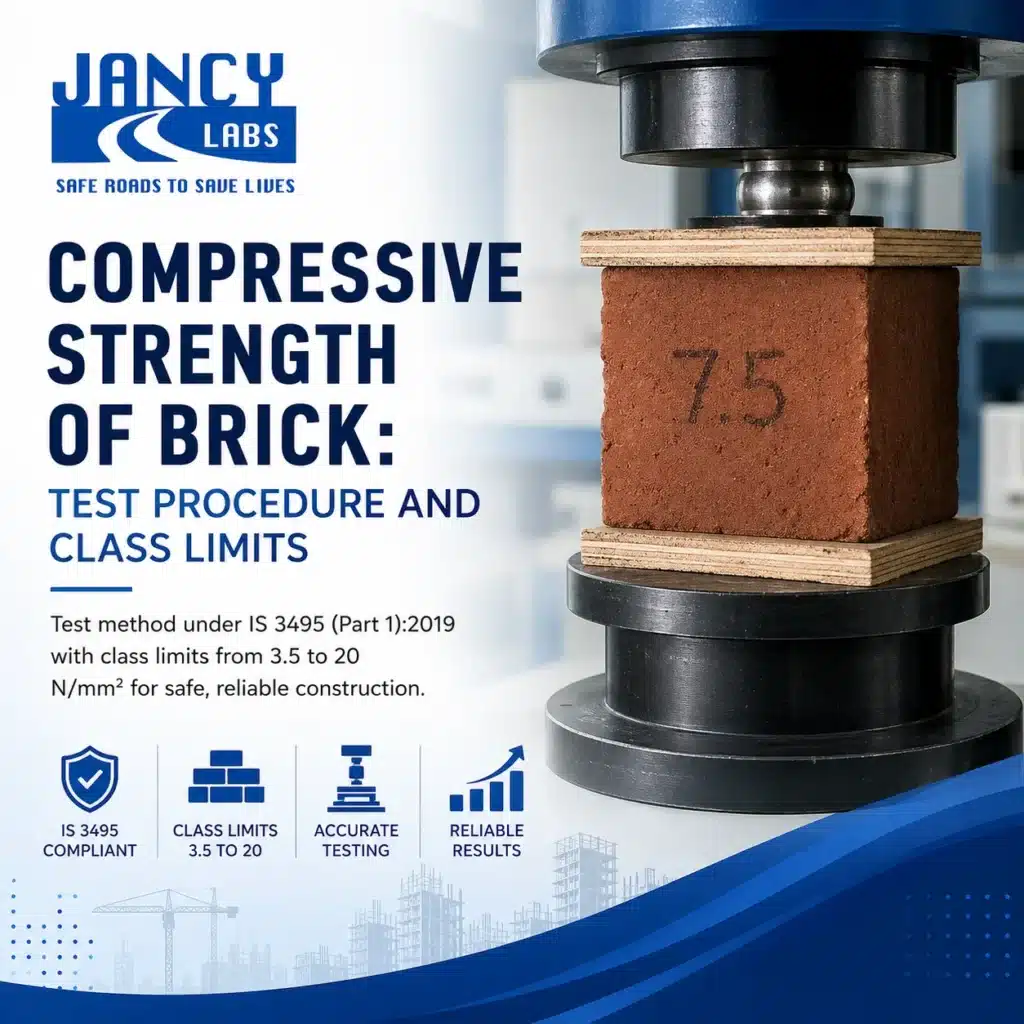
The compressive strength of brick decides which class it belongs to. That class, in turn, decides where it can legally go in a structure. A brick that fails under a load bearing wall was often approved for a boundary wall instead. Here is how a compressive strength of brick test actually works under IS 3495, what apparatus it needs, and where each class limit sits. For sample collection, our bricks and blocks testing lab covers this and every other brick and block test you need.
Key takeaways
- Compressive strength of brick is tested under IS 3495 (Part 1), current edition 2019, on six specimens per sample.
- Bricks are graded into classes from 3.5 to 20, each with its own minimum average strength requirement.
- Individual bricks, however, may vary by up to 20% below the class average without failing the batch.
- Fly ash bricks follow the same IS 3495 test method, but are specified separately under IS 12894.
- Load is applied at a fixed rate of 14 N/mm² per minute until the specimen fails.
Why compressive strength for bricks matters
Every brick carries load in the wall it sits in. Its crushing strength, therefore, sets the ceiling on what that wall can support. This matters most for load-bearing masonry, where the wall itself carries structural load rather than just infill between columns. It matters less, though still relevant, for partition walls, where durability and workability outweigh raw strength. Testing tells you which use a given batch actually suits, rather than assuming every brick performs the same.
Brick compressive strength test apparatus
- Compression testing machine — with a spherically seated bearing plate for even load distribution.
- Three-ply plywood sheets — 3 mm thick, placed on both bearing faces of the specimen.
- Cement-sand mortar — used to cap and fill the frog before testing.
- Immersion tank — for the 24-hour water soak that precedes testing.
Compressive strength of brick test procedure
- Select six bricks. Representative of the batch, free of visible defects.
- Immerse for 24 hours. Soak the bricks in clean water at room temperature. Then wipe off any surplus moisture.
- Fill the frog. Cap and fill the frog and any bed-face voids with cement-sand mortar. Then cure the specimen for three days.
- Grind the bed faces. Grind any uneven bed faces to make them smooth and parallel.
- Position the specimen. Place it flat-face horizontal, mortar-filled face up. Then centre it between plywood sheets in the machine.
- Apply load and record. Load at 14 N/mm² per minute until failure, and record the maximum load reached.
Calculating the result
To calculate compressive strength for bricks, divide the maximum load at failure by the average area of the bed face. This gives a result in N/mm². The lab tests six bricks per sample, and reports the average of all six as the final strength. This averaging matters. An individual brick can vary by 20% or more from the average without failing the batch, since load-bearing wall design already accounts for that natural spread across a masonry course.
Class limits: reading a compressive strength for bricks result
IS 3495 groups bricks into classes by minimum average strength. The class a batch actually achieves then decides where a project can specify it:
Class designation | Min. average compressive strength (N/mm²) | Approx. kg/cm² |
Class 3.5 | 3.5 | 35 |
Class 5 | 5.0 | 50 |
Class 7.5 | 7.5 | 75 |
Class 10 | 10.0 | 100 |
Class 12.5 | 12.5 | 125 |
Class 15 | 15.0 | 150 |
Class 20 | 20.0 | 200 |
Classes below 7.5 generally suit non-load-bearing partitions and boundary walls. Load-bearing structural masonry, by contrast, typically specifies Class 7.5 or above, depending on the number of storeys and local building code requirements. If you are unsure which class your project needs,
contact our team before ordering bricks in bulk, since a batch that tests below the required class has to be rejected on site, which is a far more expensive correction than confirming the class beforehand.
Where fly ash brick results differ
The compressive strength of fly ash brick follows the same test method under IS 3495 (Part 1), but Bureau of Indian Standards IS 12894:2002 specifies the brick itself separately. Fly ash-lime bricks report a wet compressive strength rather than a dry one, because the lab tests the specimen directly after soaking rather than after additional curing. Classes for fly ash bricks run from 3.5 up to 30, a wider range than the traditional clay brick classes, since fly ash bricks can use a broader range of manufacturing processes.
Where a project mixes brick masonry with concrete elements, a full quality picture usually pairs brick strength results with concrete cube testing on the surrounding structure, since different codes and different failure modes govern the two materials.
International equivalents
Outside India, ASTM International C67 covers compressive strength testing for clay masonry units, and it broadly follows the same crushing-to-failure principle as IS 3495. Apparatus tolerances and specimen preparation, however, differ in detail. So results from the two systems compare in concept but do not convert directly.
Frequently Asked Questions
How many bricks are tested in a single sample?
Six bricks per sample, with the reported strength being the average of all six results.
Can one weak brick fail an otherwise good batch?
Not necessarily. Individual bricks may fall up to 20% below the class average without failing the batch, since wall design already accounts for this natural variation.
Do fly ash bricks use the same test as clay bricks?
Yes, the test method under IS 3495 (Part 1) is the same, but fly ash-lime bricks are specified separately under IS 12894, with their own class range and a wet-strength basis.
What class of brick is needed for a load-bearing wall?
Typically Class 7.5 or above, though the exact requirement depends on the number of storeys and the applicable local building code.
Get Your Concrete Tested at Jancy Labs
Jancy Labs Private Limited is an accredited civil material testing laboratory (ISO/IEC 17025:2017, Certificate No. TC-12176) in Madurai, Tamil Nadu. We collect samples across Tamil Nadu and accept courier samples from anywhere in India.
Or call +91 86800 49004 · jancylabsmdu@gmail.com · Request a quote
4.8★ · 100+ Google reviews · Mon–Sat, 10:00–18:00