
Softening Point of Bitumen: The Ring and Ball Test Explained
What Is the Softening Point Test of Bitumen?
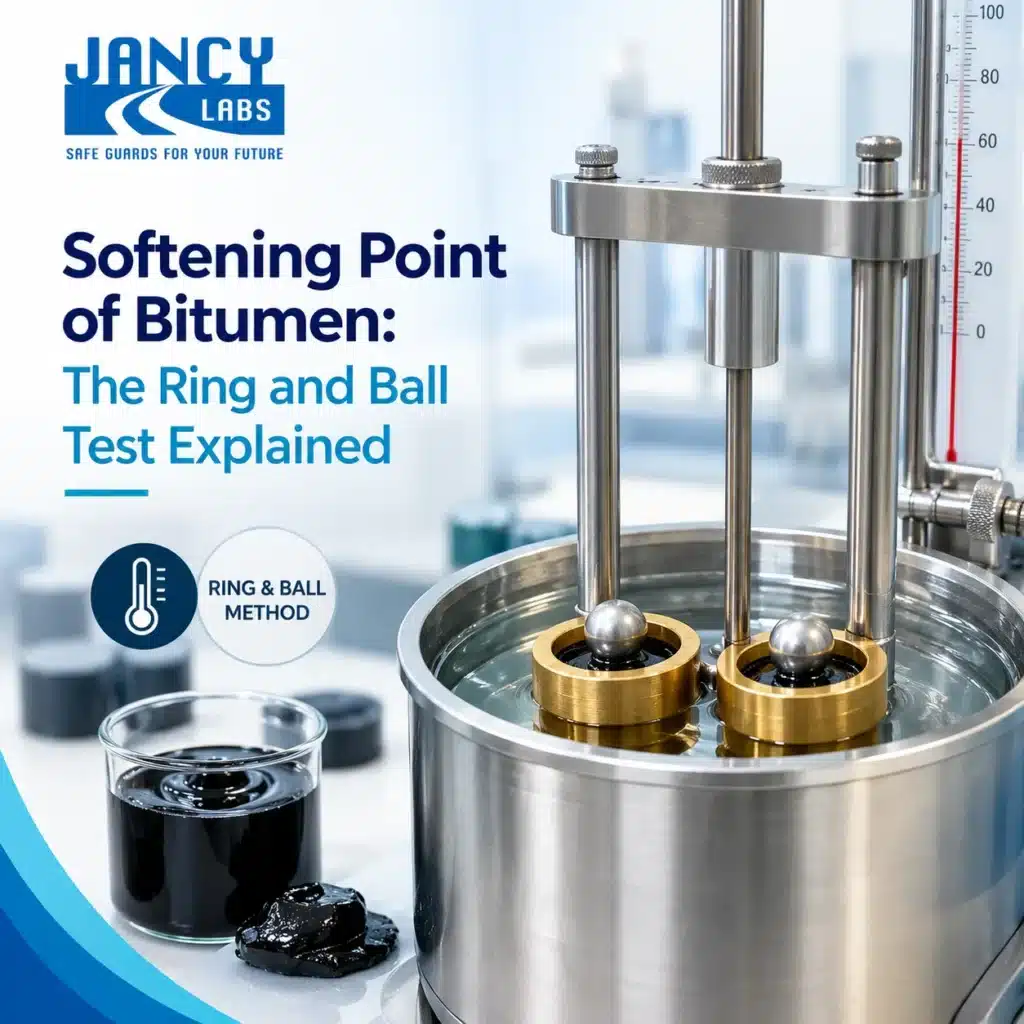
Bitumen has no fixed melting point — it softens gradually as it heats. The softening point test of bitumen fixes a repeatable temperature. At that point, a sample loaded with a steel ball inside a ring sags a defined 25 mm distance.
The test uses the Ring and Ball apparatus and reports a single temperature in degrees Celsius. A higher softening point means the bitumen stays firm at higher temperatures. That matters directly for how a pavement behaves on a hot day.
How the Softening Point Test of Bitumen Works
The current governing standard is IS 1205:2022 (Second Revision), superseding the withdrawn IS 1205:1978. The procedure runs as follows.
- Molten bitumen goes into two brass rings (depth 6.4 mm; top ID 17.5 mm; bottom ID 15.9 mm). The technician cools and trims them level.
- Each ring then sits in a bath — distilled water up to 80°C, or glycerine above — starting at 5°C.
- A steel ball sits centred on each disc as the bath heats at 5°C per minute.
- Each ball sinks as the bitumen softens, and the technician notes the temperature when it touches a reference plate 25 mm below.
- The result is the average of the two readings, to the nearest 0.5°C. If the readings differ by more than 1°C (40–60°C range) or 1.5°C (61–80°C range), the technician repeats the run.
For the companion consistency test, see our guide to the Penetration Test of Bitumen. For how the bitumen IS codes fit together, see IS 1203 to IS 1216: The Bitumen Test Code Family, Mapped.
Softening Point Limits by VG Grade
India grades paving bitumen by viscosity under IS 73:2013. Softening point is one of the acceptance criteria for each grade. A higher grade number carries a higher minimum:
VG Grade | Min. Softening Point (R&B) | Min. Penetration @25°C | Typical Use |
VG10 | 40°C | 80 (0.1 mm) | Cold/hilly regions, spray & tack coat, light traffic |
VG20 | 45°C | 60 (0.1 mm) | Moderate climate, medium traffic roads |
VG30 | 47°C | 45 (0.1 mm) | Standard grade for national/state highways |
VG40 | 50°C | 35 (0.1 mm) | Hot climates, heavy traffic, high-stress zones |
These minimums come from IS 73:2013, and MoRTH Specifications for Road and Bridge Works cites the same grading for highway acceptance.
Why the Softening Point Test of Bitumen Matters
Softening point is a proxy for how a binder behaves in service heat. A bitumen with too low a softening point for the local climate can soften on a hot afternoon. The pavement surface then ruts under heavy axle loads, or bleeds.
- Hot, high-traffic corridors need a higher softening point (VG30 or VG40) to resist deformation.
- Cold, hilly regions can use a lower-softening-point grade (VG10), since heat-driven rutting risk is lower there.
Labs therefore check the softening point test of bitumen alongside penetration, not on its own. One number describes fixed-temperature consistency; the other describes how that consistency shifts with heat.
Common Mistakes
- Using an uncalibrated or unlevel ring support, which lets the ball sink unevenly.
- Heating the bath faster or slower than 5°C per minute, which shifts the recorded value.
- Accepting a result where the two readings exceed the IS 1205 tolerance instead of repeating the run.
- Trusting a supplier’s grade label without confirming softening point against IS 73 limits.
- Citing the withdrawn IS 1205:1978 in a report instead of IS 1205:2022.
A Site Example
A contractor sourcing VG30 bitumen for a state highway job receives a supplier certificate showing 44°C — below the 47°C minimum IS 73:2013 sets for VG30. The site engineer sends a sample to Jancy Labs for an independent softening point test of bitumen rather than accepting the certificate as-is.
The lab confirms the low reading, and site engineers reject the batch before it reaches the paving crew — avoiding a binder that would have risked rutting through the first hot summer.
A Testing Checklist
- Confirm which bath liquid applies — distilled water up to 80°C, glycerine above.
- Verify the heating rate stays at 5°C per minute throughout the run.
- Check the two ball readings agree within the IS 1205 tolerance for that range.
- Cross-check the result against IS 73:2013 for the claimed VG grade.
- Confirm the report cites IS 1205:2022, not the withdrawn 1978 edition.
Key Takeaways
- The softening point test of bitumen finds the temperature at which a sample, loaded with a steel ball, sags 25 mm in a Ring and Ball apparatus.
- IS 1205:2022 (Second Revision) is current, superseding the withdrawn IS 1205:1978.
- IS 73:2013 sets minimum softening points of 40°C (VG10), 45°C (VG20), 47°C (VG30) and 50°C (VG40).
- The bath heats at 5°C per minute; readings must agree within 1°C or 1.5°C depending on range.
- Softening point and penetration together describe fixed-temperature consistency plus heat-driven softening.
Get Your Bitumen Softening Point Tested at Jancy Labs
Jancy Labs Private Limited is an accredited civil material testing laboratory (ISO/IEC 17025:2017, Certificate No. TC-12176) in Madurai, Tamil Nadu. We run the softening point test of bitumen along with penetration, ductility and viscosity grading against IS 73:2013 for every VG grade. We collect samples across Tamil Nadu and accept courier samples from anywhere in India.
Or call +91 86800 49004 · jancylabsmdu@gmail.com · Request a quote
4.8★ · 100+ Google reviews · Mon–Sat, 10:00–18:00
Frequently Asked Questions
What is the softening point of bitumen?
The softening point is the temperature at which a bitumen sample, held in a ring and loaded with a steel ball, softens enough to sag downward a defined 25 mm distance — a practical measure of temperature susceptibility, since bitumen has no true melting point.
How does the Ring and Ball test work?
The technician casts a bitumen disc into a brass ring, places a steel ball on top, and immerses the assembly in a heated liquid bath. As the bath temperature rises at a controlled rate, the softening bitumen lets the ball sink, and the temperature it touches a reference plate below becomes the softening point.
Which standard governs the softening point test of bitumen in India?
IS 1205:2022 (Second Revision) is the current governing standard, superseding the earlier IS 1205:1978. It specifies the ring and ball apparatus dimensions, bath liquids, heating rate and reporting method.
What liquid is used in the Ring and Ball apparatus?
Technicians use distilled water for softening points up to 80°C, and glycerine above 80°C, since water would boil before harder bitumen grades reach their softening temperature.
What heating rate does the test use?
Technicians heat the bath at a controlled rate of 5°C per minute from a starting temperature of 5°C, and take the softening point as the average of two ball readings, each recorded to the nearest 0.5°C.
What softening point is required for different VG grades of bitumen?
IS 73:2013 sets minimum softening point values of 40°C for VG10, 45°C for VG20, 47°C for VG30 and 50°C for VG40 — harder, higher-viscosity grades carry a higher minimum softening point.
Why does softening point matter for road construction?
A bitumen's softening point shows how well it resists flow at high pavement service temperatures. A binder with too low a softening point for the local climate can soften, rut, or bleed on hot days, so engineers match the value to expected pavement temperature and traffic loading.
What's the difference between the softening point test and the penetration test?
The penetration test measures consistency at a fixed 25°C by how far a needle sinks in five seconds, while the softening point test finds the temperature at which the bitumen itself softens. Together the two describe both a fixed-temperature consistency and a temperature-dependent softening behaviour.
How much difference between the two ball readings is acceptable?
IS 1205 allows a maximum difference of 1°C between the two readings for softening points between 40°C and 60°C, and 1.5°C for softening points between 61°C and 80°C. A larger spread means the technician must repeat the test.
Can softening point results vary between labs?
Yes — results are sensitive to bath heating rate, ring cleanliness and ball placement, which is why testing at an accredited laboratory following IS 1205 exactly, with calibrated apparatus, gives repeatable and defensible results.