
Slump Test of Concrete: Procedure, Slump Values and What They Mean
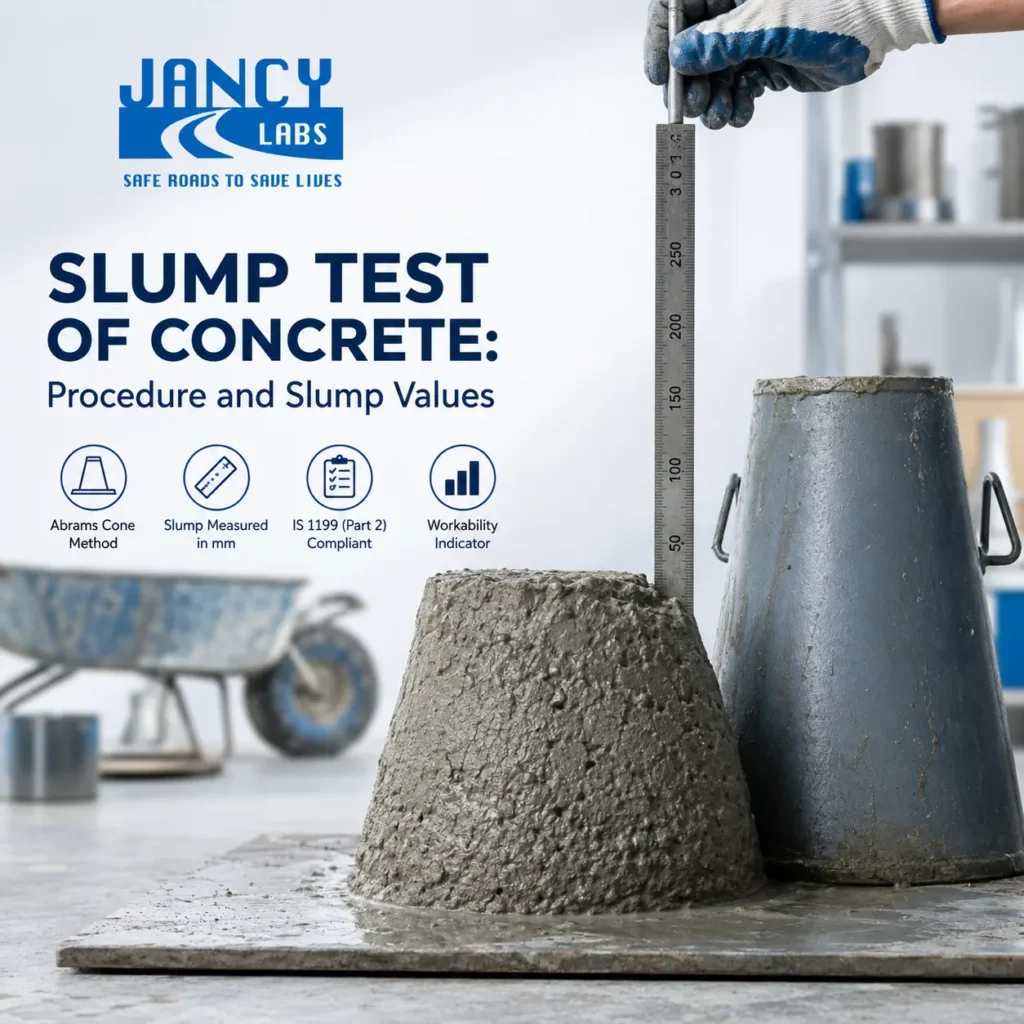
A slump test takes barely five minutes on site, yet it tells you more about a concrete batch than almost any other quick check available. Too dry, and it will not compact around reinforcement. Too wet, and strength suffers along with it. Here is the procedure, how to read the slump value, and what a failed test actually means.
Key takeaways
- A slump test measures the workability of fresh concrete using an Abrams cone, standardised under IS 1199 (Part 2):2018.
- Specifically, slump is reported in millimetres, calculated as the drop in height after lifting the cone.
- Notably, different applications need different slump ranges; there is no single universal target value.
- Importantly, a shear or collapse slump invalidates the test and requires a fresh sample, not a re-measurement.
- In fact, slump reflects workability alone, not strength, so a good slump reading never guarantees a good cube result later.
What the slump test actually measures
Workability describes how easily fresh concrete can be mixed, placed, compacted, and finished without segregating. Engineers needed a fast, repeatable way to quantify this on site, and the abrams cone slump test answered that need decades ago. The method is standardised by the Bureau of Indian Standards under IS 1199 (Part 2):2018. Rather than judging workability by eye, the test gives a single measurable number that crews across a project can compare consistently, batch to batch.
Slump cone apparatus
- The cone itself: 300 mm high, 200 mm base diameter, 100 mm top diameter, open at both ends.
- A steel tamping rod, 16 mm diameter, 600 mm long, with rounded ends.
- Also needed: a flat, rigid, non-absorbent base plate to rest the cone on.
- Finally, a ruler or scale to measure the slump once the cone is lifted.
Slump test procedure
- Dampen the cone and base. First, moisture prevents the concrete from sticking on the way up.
- Fill in three layers. Each layer gets 25 strokes with the tamping rod, distributed evenly across the cross-section.
- Strike off the top. Next, level the surface flush with the top of the cone using the tamping rod.
- Lift the cone vertically. Then, raise it steadily over 5 to 10 seconds, without twisting or jarring the concrete.
- Measure the slump. Finally, invert the cone beside the settled concrete and measure the vertical drop from the cone height.
Reading slump values by application
The correct slump depends entirely on where the concrete is going, not a fixed universal number:
Slump range | Workability | Typical application |
0–25 mm | Very low | Mass concrete, road pavements |
25–75 mm | Low | Lightly reinforced sections, hand compaction |
75–100 mm | Medium | Normal RCC work, machine vibration |
100–150 mm | High | Heavily reinforced sections, congested formwork |
150+ mm | Very high | Self-compacting or pumped concrete |
A pumped concrete mix generally needs a higher slump than one placed by chute, purely because pumping demands greater fluidity to move through the line without blocking.
True, shear, and collapse slump
Not every cone slump test produces a usable reading. Three outcomes are possible, and only one counts:
- True slump: in this case, the concrete settles evenly, retaining roughly its original shape. This is the only valid result.
- Shear slump: here, one side of the mass slides down and away, usually signalling a harsh or poorly proportioned mix.
- Collapse slump: alternatively, the concrete collapses completely, typically from excess water or a badly segregated mix.
Both shear and collapse results are invalid, not low readings to report. Instead, the correct response is a fresh sample and a repeat test, since the original attempt tells you nothing reliable about workability.
Why a good slump does not guarantee a good cube result
A slump cone test checks fresh-state behaviour only. It says nothing about how that concrete will perform once hardened. Excess water added purely to boost slump, for instance, often passes the slump test easily while quietly cutting into 28-day compressive strength. This is exactly why slump and concrete cube testing are tracked as separate, complementary checks, never as substitutes for each other.
Slump and mix design
Target slump is normally specified during concrete mix design, not decided on site by feel. If delivered concrete consistently misses the target slump, that points to a batching or water-dosing issue upstream, not a fault with the test itself. Where slump results are inconsistent across a project, our team can help trace whether the cause sits in mix design, batching, or transit time.
International equivalents
Internationally, ASTM International C143 covers the same slump test principle, using an identical cone geometry to IS 1199. The core method translates directly between the two standards, with only minor procedural differences in tamping and timing.
What to send when booking this test
A quick checklist speeds up scheduling and interpretation of results:
- First, the mix grade and intended application, since target slump depends on both.
- Also relevant: whether the concrete is pumped, chuted, or hand-placed, which affects the expected range.
- Finally, any specification document your consultant has referenced for target slump.
None of this needs to be exact upfront, however — our team confirms details when scheduling.
Frequently Asked Questions
What is a good slump value for concrete?
There is no single good value. The correct target depends on the application, ranging from 25 mm for mass concrete to over 150 mm for pumped or self-compacting mixes.
What does a shear slump mean?
It means the test is invalid, usually caused by a harsh or poorly proportioned mix. A fresh sample and repeat test are needed rather than reporting the shear result.
Is IS 1199:1959 still the correct standard to cite?
No. IS 1199 was revised in 2018 and split into parts. The slump test now falls under IS 1199 (Part 2):2018, though most reference content online still cites the superseded 1959 edition.
Does a good slump result guarantee good concrete strength?
No. Slump measures workability in the fresh state only. Strength depends on separate factors like water-cement ratio and curing, which is why cube testing remains necessary regardless of slump results.
Get Your Concrete Tested at Jancy Labs
Jancy Labs Private Limited is an accredited civil material testing laboratory (ISO/IEC 17025:2017, Certificate No. TC-12176) in Madurai, Tamil Nadu. We collect samples across Tamil Nadu and accept courier samples from anywhere in India.
Or call +91 86800 49004 · jancylabsmdu@gmail.com · Request a quote
4.8★ · 100+ Google reviews · Mon–Sat, 10:00–18:00