
Non Destructive Testing of Concrete: The Six Methods Explained
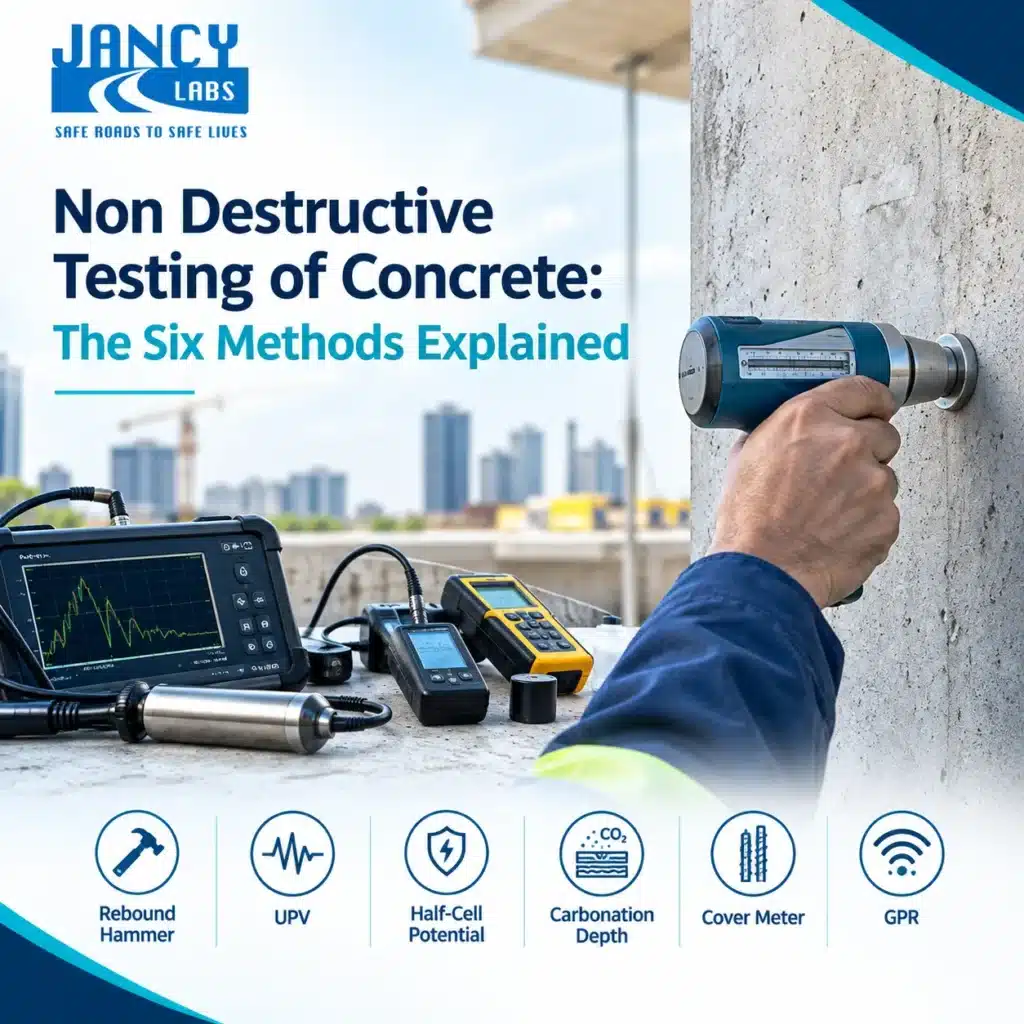
A structure doesn’t need to be damaged to be understood. Non-destructive testing (NDT) gives engineers a way to check concrete strength, durability, and hidden defects without drilling a single core or breaking a single cube.
This guide walks through the six NDT methods most commonly used on concrete structures — what each one measures, when to reach for it, and how it differs from destructive testing.
Non-Destructive vs Destructive Testing
Destructive testing gets a direct answer by damaging the sample. A crushed cube or an extracted core gives a precise strength value, but it leaves a hole in the structure and can’t be repeated at the same spot.
Non-destructive testing takes the opposite approach. It reads surface hardness, wave velocity, or electrochemical signals to estimate the same properties indirectly, leaving the structure fully intact. The trade-off is precision: NDT results are estimates, not exact values, which is why engineers often combine several NDT methods, or confirm a critical result with a small number of cores.
Method 1: Rebound Hammer Test
A spring-loaded hammer strikes the concrete surface, and the rebound distance correlates to surface hardness. IS 516 (Part 5/Sec 4):2020 governs the procedure in India.
This method works fast and needs no special site preparation, which makes it ideal for a first-pass survey across a large structure. Surface carbonation, moisture content, and aggregate type all influence the reading, so treat the result as an indication rather than a precise strength value.
.
Method 2: Ultrasonic Pulse Velocity (UPV)
A transmitter sends an ultrasonic pulse through the concrete, and a receiver on the other side measures how long it takes to arrive. IS 516 (Part 5/Sec 1):2018 sets out the current procedure.
Denser, more uniform concrete transmits the pulse faster. A sudden drop in velocity can flag an internal void, a crack, or honeycombing that a surface test alone would miss. Combining UPV with a rebound hammer reading — the widely used SonReb approach — narrows the strength estimate further than either method alone.
.
Method 3: Half-Cell Potential Test
A reference electrode measures the electrochemical potential between itself and the embedded rebar at points across a grid on the concrete surface. More negative readings point to a higher probability of active corrosion in that zone.
BIS lists this procedure under IS 516 (Part 5/Sec 2), and internationally the test follows ASTM C876. The result is a probability map, not a direct corrosion rate, so engineers interpret it alongside cover depth, carbonation, and chloride data rather than on its own.
Method 4: Carbonation Depth Test
A technician sprays phenolphthalein solution onto a freshly exposed concrete surface — usually from a small chipped area or a core face. IS 516 (Part 5/Sec 3) covers the procedure. Carbonated concrete stays colourless; concrete that hasn’t carbonated turns pink.
Carbonation gradually lowers the concrete’s natural alkalinity. Once the carbonation front reaches the rebar, the steel loses the protective layer that alkalinity provides, and corrosion risk rises sharply. This test shows exactly how close that front has come to the reinforcement.
Method 5: Cover Meter / Rebar Locator
A cover meter uses electromagnetic induction to locate embedded rebar and measure the concrete cover above it, all without drilling. Many practitioners reference the British Standard BS 1881-204 for this method.
Beyond checking whether cover meets the design specification, this test also guides where to place other NDT equipment — a UPV transducer or a half-cell grid works best when the operator already knows where the rebar sits.
Method 6: Impact Echo and Ground Penetrating Radar
Impact echo sends a mechanical shock wave into the concrete and analyses the reflected frequency to detect voids, delamination, or duct location at depth. Ground Penetrating Radar (GPR) sends electromagnetic pulses instead, building a cross-sectional image of what lies beneath the surface.
Both methods suit deeper or more complex investigations — mapping multiple rebar layers, locating post-tensioning ducts, or finding subsurface defects that rebound hammer or half-cell testing simply can’t reach.
Choosing the Right Method
Match the method to the question, not the other way around:
- Quick strength screening across a large area — rebound hammer, often paired with UPV.
- Internal voids or cracking — UPV, or impact echo for depth.
- Corrosion risk in an ageing structure — half-cell potential, carbonation depth, and cover meter together.
- Locating rebar or ducts before any other test — cover meter or GPR first.
- Disputed or high-stakes results — confirm with a small number of core samples.
Common Mistakes in NDT
- Treating a single rebound hammer reading as a precise strength value instead of an indication.
- Skipping carbonation and half-cell testing on older structures where corrosion is the real risk, not raw strength.
- Running UPV without first checking for rebar interference along the transmission path.
- Interpreting half-cell results as a standalone verdict rather than combining them with cover and carbonation data.
- Treating every NDT result as final instead of confirming borderline findings with a core check.
Reviewing results specifically against these gaps catches most misinterpretation before it reaches a repair decision.
A Quick NDT Checklist
- Define the question first — strength, voids, or corrosion risk — before picking a method.
- Start with rebound hammer or cover meter for a fast initial picture.
- Pair UPV with rebound hammer for a tighter strength estimate.
- Run half-cell and carbonation tests together on structures where corrosion is a concern.
- Reserve GPR and impact echo for depth or duct-mapping questions the surface methods can’t answer.
- Confirm any critical or disputed result with a core sample.
Get Non-Destructive Testing Done at Jancy Labs
Jancy Labs Private Limited is an accredited civil material testing laboratory (ISO/IEC 17025:2017, Certificate No. TC-12176) in Madurai, Tamil Nadu. We offer rebound hammer, UPV, half-cell potential, carbonation, cover meter, and GPR testing for concrete structures. We collect samples across Tamil Nadu and accept courier samples from anywhere in India.
Or call +91 86800 49004 · jancylabsmdu@gmail.com · Request a quote
4.8★ · 100+ Google reviews · Mon–Sat, 10:00–18:00
Frequently Asked Questions
What is non-destructive testing (NDT) of concrete?
Non-destructive testing evaluates the strength, condition, or durability of concrete without breaking, drilling, or otherwise damaging the structure — the element stays in service throughout the test.
What's the difference between destructive and non-destructive testing?
Destructive testing (like a core sample or a crushed cube) physically damages the concrete to get a direct strength reading. Non-destructive testing estimates the same properties indirectly, using surface hardness, wave velocity, or electrochemical signals, so the structure stays intact.
Which NDT method should I use first?
Rebound hammer testing usually comes first — it's fast, low-cost, and gives a quick surface-hardness reading across a structure before deciding whether deeper testing is needed.
Can rebound hammer alone estimate concrete strength?
It gives a useful indication, not a precise strength value. Surface carbonation, moisture, and aggregate type all affect the reading, so engineers typically pair it with UPV or a core check for critical structures.
What does UPV testing actually measure?
Ultrasonic Pulse Velocity measures how fast an ultrasonic pulse travels through the concrete. Faster velocity generally indicates denser, more uniform concrete, while a drop in velocity can flag voids, cracks, or honeycombing.
How does half-cell potential detect corrosion?
A reference electrode measures the electrochemical potential between itself and the embedded rebar at points across a grid. More negative readings indicate a higher probability of active corrosion in that zone.
Why test carbonation depth?
Carbonation gradually lowers the concrete's alkalinity, and once it reaches the rebar, the steel loses its natural protection against corrosion. The test shows how close carbonation has come to the reinforcement.
What is a cover meter used for?
A cover meter locates embedded rebar and measures the concrete cover over it using electromagnetic induction, without any drilling — useful for both quality checks and planning other NDT work.
When should I use GPR or impact echo instead of the other methods?
Ground Penetrating Radar and impact echo suit deeper or more complex investigations — mapping multiple rebar layers, locating post-tensioning ducts, or finding voids and delamination below the surface that surface-level methods can't reach.
Do NDT results ever require a follow-up core test?
Yes, for critical or disputed results. NDT methods estimate condition indirectly, so engineers often confirm borderline or high-stakes findings with a small number of core samples before finalising a decision.