
Standard Penetration Test for Soil (SPT): Procedure, N-Value and Corrections
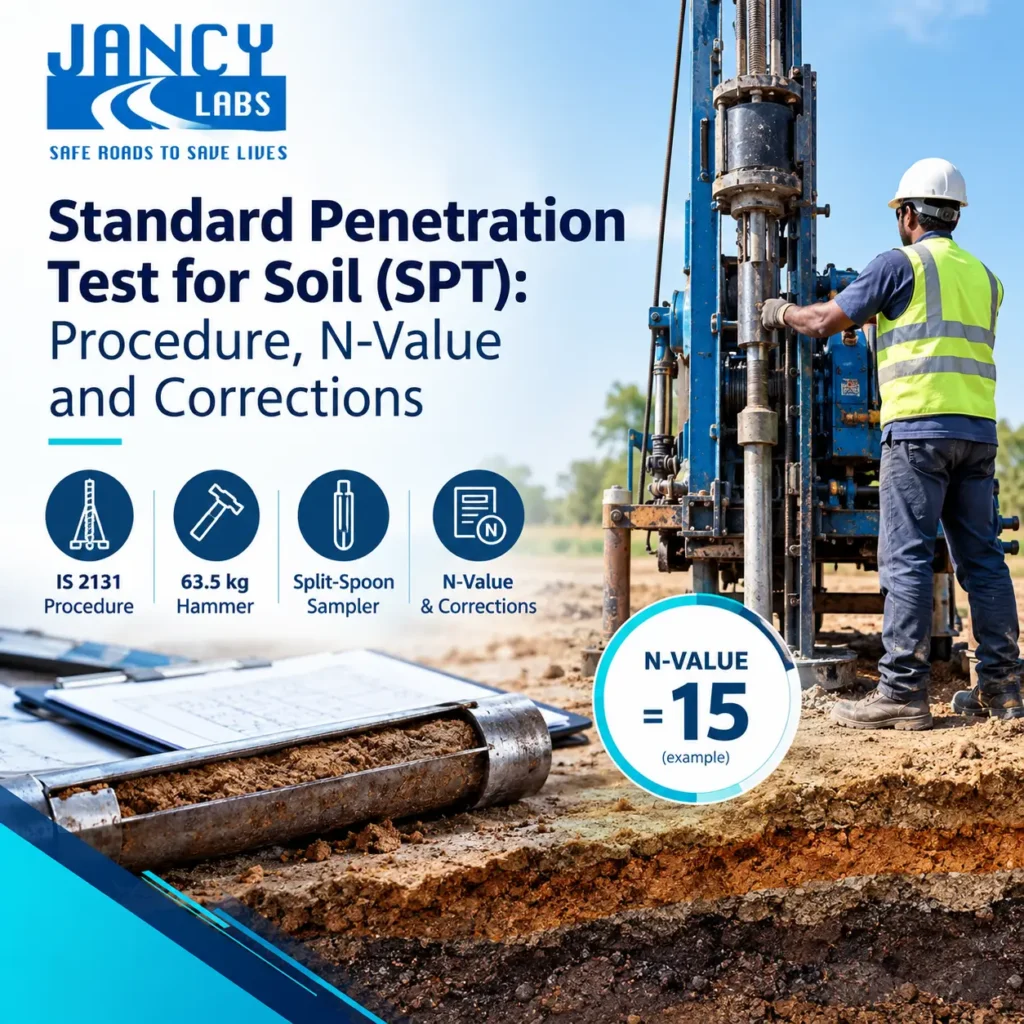
The standard penetration test for soil counts how many hammer blows it takes to drive a steel sampler 300 mm into the ground. That count, the N-value, is the most common number in Indian soil investigation reports. This guide explains how the test works, how to read N, and why the corrections matter.
Key takeaways
- The current Indian method is IS 2131:2025, published in July 2025, which replaced IS 2131:1981.
- A 63.5 kg hammer falls 750 mm to drive a split-spoon sampler at the bottom of a borehole.
- The N-value is the blow count for the last 300 mm of a 450 mm drive.
- Raw N-values need corrections for overburden, groundwater and hammer energy before design use.
- The sampler also brings up a disturbed soil sample for lab tests.
What is the standard penetration test for soil?
The standard penetration test for soil is a field test that measures how strongly the ground resists a driven sampler. Dense sand and stiff clay need many blows, while loose or soft soil needs few. So engineers use the N-value to judge density, strength and bearing capacity at each depth.
The Bureau of Indian Standards publishes the method as IS 2131. The 2025 edition, titled Standard Penetration Test of Soil – Method of Test, is now current.
How is the standard penetration test for soil done?
The test runs inside a borehole, usually 100 to 150 mm wide, at set depth intervals.
- Clean the borehole. First, clear loose soil from the bottom so the sampler rests on undisturbed ground.
- Lower the sampler. Then attach the split-spoon sampler to the drill rods and rest it at the base.
- Drive it 450 mm. Next, drop the 63.5 kg hammer from 750 mm and count blows for each 150 mm.
- Record N. Ignore the first 150 mm, since it only seats the sampler. N is the sum of the last two counts.
- Recover the sample. Finally, open the split spoon, log the soil and seal a sample for the lab.
Under the 1981 edition, tests were repeated every 1.5 m and at each change of soil layer. Driving also stopped at refusal, such as 50 blows within any 150 mm.
How do you read the N-value?
You read the N-value against the soil type, because the same count means different things in sand and clay. Engineers widely use the Terzaghi and Peck ranges below as a first guide.
N (sand) | Relative density | N (clay) | Consistency |
0–4 | Very loose | Below 2 | Very soft |
4–10 | Loose | 2–4 | Soft |
10–30 | Medium dense | 4–8 | Medium |
30–50 | Dense | 8–15 | Stiff |
Above 50 | Very dense | 15–30 | Very stiff |
— | — | Above 30 | Hard |
However, N in clay is a rough guide only. For design in clay, lab shear tests on undisturbed samples are more reliable.
Which corrections apply to N?
Raw N-values from a standard penetration test for soil need correcting because depth, groundwater and the rig itself all change the blow count. The 1981 edition of IS 2131 set out two corrections for sands.
- Overburden pressure: deeper sand reads higher simply because it is confined, so engineers apply a correction factor to N.
- Dilatancy: in fine sand or silt below the water table, engineers reduce N above 15 using N″ = 15 + 0.5(N′ − 15).
- Hammer energy: international practice normalises N to 60% of the theoretical energy, written N60.
Energy is the weak spot in Indian practice. A 2021 IISc review of SPT in India found that IS 2131:1981 had no energy correction, and that drop heights varied by 2 to 3 inches on site. So always check which edition and which corrections your report applies.
SPT vs cone and thumb penetration tests
The standard penetration test for soil is one of several penetration checks, and each suits a different job.
Test | How it works | Best for |
SPT (IS 2131) | Hammer drives a sampler; counts blows | Sand, gravelly soil, routine building sites |
Static cone (IS 4968 Part 3) | Pushes a cone at steady speed; reads resistance | Soft clay and silt, continuous profiles |
Thumb penetration | Thumb pressed into clay by hand | Quick field check of clay consistency only |
Unlike the cone test, SPT also recovers a sample. On the other hand, the cone gives a continuous profile with no gaps between test depths.
What happens to SPT samples after the test?
Samples from a standard penetration test for soil go to a lab for classification tests, since the blow count alone does not name the soil. Common tests include sieve analysis, water content and Atterberg limits. Jancy Labs runs these tests under IS 2720 at its soil testing lab. To see how N-values feed into foundation design, read our guide to soil bearing capacity and our note on reading soil investigation reports.
Get Your Soil Tested at Jancy Labs
Jancy Labs Private Limited is an accredited civil material testing laboratory (ISO/IEC 17025:2017, Certificate No. TC-12176) in Madurai, Tamil Nadu. We collect samples across Tamil Nadu and accept courier samples from anywhere in India.
Or call +91 86800 49004 · jancylabsmdu@gmail.com · Request a quote
4.8★ · 100+ Google reviews · Mon–Sat, 10:00–18:00
Frequently Asked Questions
What is the N-value in SPT?
The N-value is the number of blows needed to drive the sampler the last 300 mm of a 450 mm drive. The first 150 mm is a seating drive and is not counted.
Which IS code covers the standard penetration test?
IS 2131 covers the test. The current edition is IS 2131:2025, which replaced IS 2131:1981 in July 2025.
What hammer is used in SPT?
SPT uses a 63.5 kg hammer that falls freely through 750 mm onto the drill rods.
What N-value is good for a foundation?
There is no single pass mark. As a guide, N above 30 in sand means dense soil, while N above 15 in clay means very stiff soil. A geotechnical engineer sets the design value.
Is SPT the same as the cone penetration test?
No. SPT drives a sampler with hammer blows, while the static cone test pushes a cone at a steady speed. The cone test is covered by IS 4968 (Part 3).