
Half Cell Potential Test: Detecting Rebar Corrosion Before the Cracks
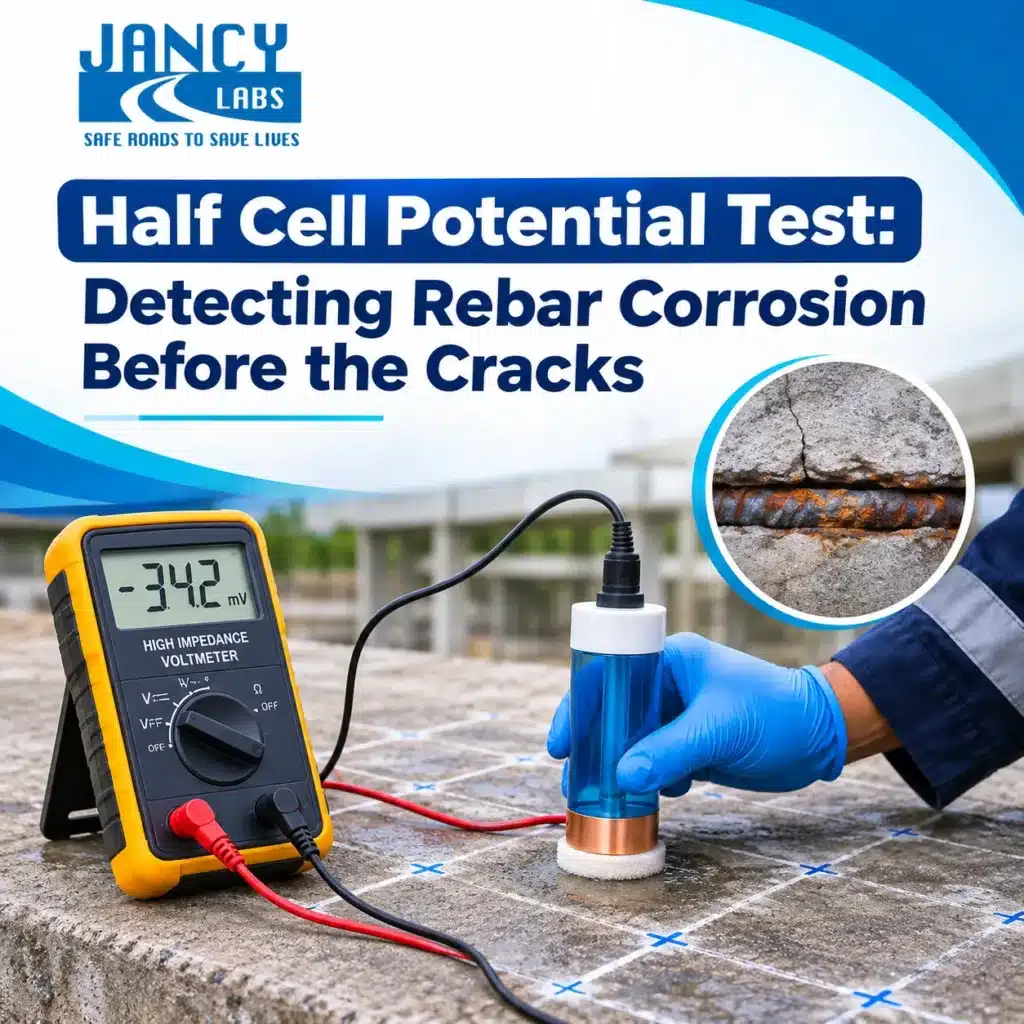
The half cell potential test shows where the steel inside concrete is likely to be rusting, often years before cracks or rust stains appear. Engineers use it on bridges, parking decks, water tanks and coastal buildings. This guide covers the procedure, how to read the millivolt values, and what can distort them.
Key takeaways
- The half cell potential test measures the voltage between the rebar and a reference electrode on the concrete surface.
- In India, the method is IS 516 (Part 5/Sec 2):2021, which covers uncoated reinforcing steel.
- Against a copper-copper sulphate electrode, readings more negative than −350 mV mean a greater than 90% chance of corrosion.
- The result is a probability map, not a corrosion rate.
- Engineers read it with cover depth, carbonation and chloride results, not on its own.
What is the half cell potential test?
The half cell potential test is a non-destructive method that maps the corrosion risk of steel bars in concrete. Steel that is actively rusting sits at a more negative voltage than steel that is still protected. So the test reads that voltage at many points and shows which zones need attention.
The kit is simple, but the setup needs care. It needs a reference electrode, usually copper in copper sulphate, and a high-impedance voltmeter. ASTM C876 asks for a voltmeter input impedance of at least 10 MΩ. The Indian method is published by the Bureau of Indian Standards as IS 516 (Part 5/Sec 2):2021.
Why does rebar corrosion matter?
Rebar corrosion matters because rust takes up more space than the steel it replaces. As a result, it pushes on the concrete cover from the inside. First, hairline cracks appear along the bar. Then the cover spalls, and the bar loses section. By that stage, repairs cost far more than they would have earlier.
So a half cell potential test on an ageing structure helps you plan repairs while the damage is still hidden. For example, coastal buildings, water tanks and bridges are worth surveying, because salts reach the steel faster there.
Half cell potential test procedure
The half cell potential test procedure has six steps, and the connection to the steel matters most.
- Mark a grid. First, locate the bars with a cover meter and mark test points. ASTM C876 notes that 1.2 m spacing works for bridge decks.
- Connect to the rebar. Expose one bar, clean it, and clamp the voltmeter lead to it. Then check that the bars are electrically continuous.
- Pre-wet the surface. Spray water mixed with a little detergent. Then wait until the reading holds within ±20 mV for 5 minutes.
- Take the readings. Next, place the electrode on each grid point and record the value in millivolts.
- Correct for temperature. Adjust each value by about 0.9 mV per °C away from 22.2 °C.
- Plot the map. Finally, draw contour lines through equal values to show the corrosion hot spots.
Half cell potential test range: how to read the results
The half cell potential test range is read in millivolts against the copper-copper sulphate electrode (CSE). Values for mild steel commonly fall between +50 mV and −600 mV CSE. The widely used ASTM C876 bands are below.
Reading (mV vs CSE) | What it suggests |
More positive than −200 | Greater than 90% probability of no corrosion |
−200 to −350 | Uncertain; corrosion may or may not be active |
More negative than −350 | Greater than 90% probability of active corrosion |
If the lab uses a silver chloride or calomel electrode, convert the values to the CSE scale before you compare them. Also, a zone that is much more negative than its neighbours is often more telling than any single number.
What can distort half cell readings?
Moisture, coatings and the state of the concrete can all shift the voltage, so the numbers need an experienced reader. For example, concrete that has dried out acts like an insulator and gives no stable reading.
- Paint, sealers or tiles block the circuit, so clean a test patch first.
- Epoxy-coated or galvanised bars fall outside the method, which covers uncoated steel.
- Fully saturated concrete can read very negative, even though little corrosion is present.
- Carbonation at bar depth also changes how the values should be read.
Which tests should go with it?
A half cell survey works best as one part of a condition check, because each test answers a different question.
Test | What it adds |
Cover meter | Bar position and cover depth |
Carbonation depth | Whether the alkaline protection around the bar is lost |
Chloride content | Whether salts have reached the steel |
Rebound hammer | Surface hardness and estimated strength |
Ultrasonic pulse velocity | Internal cracks, voids and uniformity |
Jancy Labs offers the rebound hammer test and the UPV test under its non-destructive testing service. For a wider view, read our guide to the six NDT methods for concrete. You can check any lab’s accreditation on the NABL website.
Get Your Concrete Tested at Jancy Labs
Jancy Labs Private Limited is an accredited civil material testing laboratory (ISO/IEC 17025:2017, Certificate No. TC-12176) in Madurai, Tamil Nadu. We collect samples across Tamil Nadu and accept courier samples from anywhere in India.
Or call +91 86800 49004 · jancylabsmdu@gmail.com · Request a quote
4.8★ · 100+ Google reviews · Mon–Sat, 10:00–18:00
Frequently Asked Questions
What is a good half cell potential reading?
A reading more positive than -200 mV against a copper-copper sulphate electrode is good. ASTM C876 links it to a greater than 90% probability that no corrosion is taking place.
Which Indian Standard covers the half cell potential test?
IS 516 (Part 5/Sec 2):2021 covers half-cell potentials of uncoated reinforcing steel in concrete. It is the first revision of the method.
Does a very negative reading always mean the bar is rusting?
No. Saturated concrete, carbonation and poor electrical contact can all push readings more negative. So engineers confirm hot spots with cover, carbonation and chloride tests.
Can the test be used on epoxy-coated bars?
No. The method covers uncoated steel. Epoxy or metallic coatings on the bars change the circuit, so the standard bands do not apply.
Does the test give the corrosion rate?
No. The test shows the probability of corrosion at each point. It does not show how fast the steel is losing section.