
Rebend Test of Steel: Procedure, IS 1786 Limits and Failures
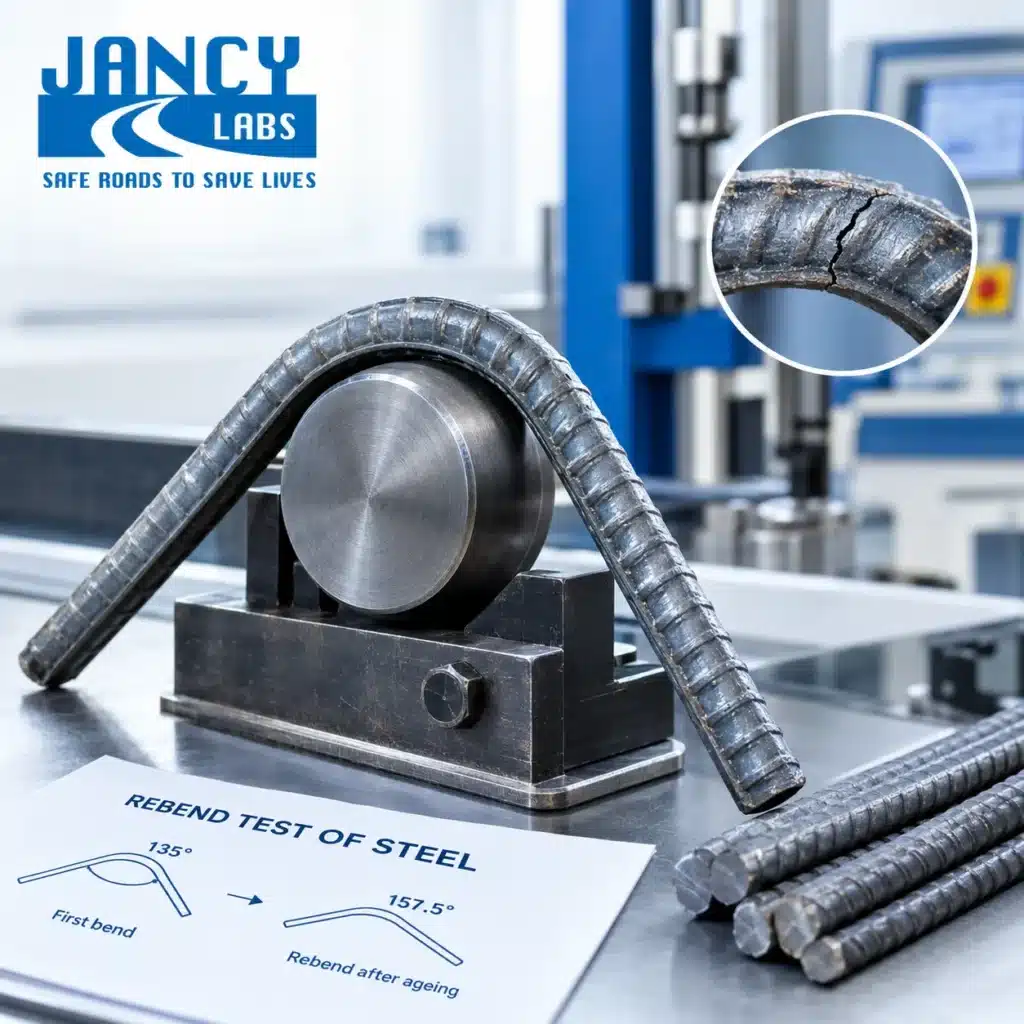
The rebend test of steel checks something the tensile test cannot: whether a TMT bar stays ductile after it has already been bent, boiled and bent back. A bar can pass every strength number on its mill certificate, and yet still crack at a stirrup hook on site. As a result, that failure shows up exactly where the reinforcement is doing the most work — at the bend.
Key takeaways
- The rebend test of steel first bends a sample to 135°, then boils it for 30 minutes to simulate ageing, cools it, and finally bends it back to 157.5° to check for cracks.
- The first-stage bend test is governed by IS 1599; however, the mandrel diameter and pass/fail limits for reinforcement come from IS 1786.
- Mandrel diameter scales with bar grade and diameter, so a Fe 500 bar up to 10 mm uses a 5d mandrel for the rebend test, while above 10 mm it jumps to 7d.
- Since 5 February 2024, BIS certification is mandatory for TMT bars under the Steel and Steel Products (Quality Control) Order, 2024, so a bar can look fine and still be non-compliant without it.
- Any visible crack in either the bend or the rebend test is an automatic fail, regardless of the tensile strength result.
What is the rebend test of steel?
The rebend test of steel is a ductility check under IS 1786 for TMT reinforcement bars. It goes further than a plain bend test because it artificially ages a bent sample before bending it back, which exposes a defect that ordinary bending misses: strain-ageing embrittlement, where cold-worked steel loses ductility over time. As a result, a bar that passes tensile strength but fails bend or rebend is not acceptable reinforcement, whatever the mill certificate says.
Bend test procedure
- First, select the mandrel diameter from IS 1786 Table 1, based on the bar’s nominal diameter and grade.
- Next, clamp the sample and apply continuous pressure to bend it around the mandrel until the two straight sides are parallel, roughly a 180° U-shape.
- Then, examine the outer, tension-side face of the bend for cracks or rupture.
- Finally, pass the bar if no cracks are visible; any crack, however small, counts as a fail.
In short, the bend test method itself follows IS 1599, while IS 1786 supplies the mandrel size and pass/fail rule specifically for reinforcement bars.
Rebend test procedure
- First, select the mandrel diameter from IS 1786 Table 2, since this is different, and generally larger, than the bend-test mandrel.
- Next, clamp one end of the sample and bend the other end to an included angle of 135°.
- Then, immerse the bent sample in boiling water at 100°C for 30 minutes, remove it, and let it cool to room temperature; this simulates the ageing a bar undergoes over months in a stockyard or on site.
- After that, fix the aged sample on the mandrel and bend it back to 157.5°.
- Finally, examine the bend for cracks: no cracks means a pass, while any crack means a fail.
Mandrel diameter and pass/fail limits
IS 1786 sets the mandrel size for the rebend test of steel by grade and bar diameter, where d is the bar’s nominal diameter. For example, the table below covers Fe 500 and Fe 500D, the grades most commonly sold as TMT bar in Tamil Nadu. However, Fe 415, Fe 550 and Fe 600 use different multiples set out in the same tables.
Grade | Bend mandrel (≤20mm) | Bend mandrel (>20mm) | Rebend mandrel (≤10mm) | Rebend mandrel (>10mm) |
Fe 500 | 4d | 5d | 5d | 7d |
Fe 500D / Fe 500S | 3d | 4d | 4d | 6d |
IS 1786 amendments worth checking
IS 1786:2008 remains the base standard, but it carries amendments that many references skip. For instance, Amendment 1 (2012) added the Fe415S/Fe500S corrosion-resistant-plus-seismic grades, and later amendments added dedicated corrosion-resistance classes plus the Fe600 grade. Therefore, checking which amendment a mill certificate references matters just as much as checking the grade itself.
Why bars fail the bend/rebend test
Most rebend test of steel failures trace back to a handful of causes:
- Chemistry outside limits: excess sulfur or phosphorus makes steel brittle, regardless of its rolled strength.
- An uneven thermo-mechanical treatment, which leaves a brittle quenched rim that cracks under bending even though the core tests fine.
- Mixing up mandrel sizes: using the bend-test mandrel for the rebend test, or vice versa, makes the result meaningless either way.
- Bars from uncertified or informal re-rolling mills, where the TMT process is not controlled closely enough to guarantee ductility batch to batch.
What to check before accepting delivery
Since the Steel and Steel Products (Quality Control) Order, 2024 came into force, TMT bars must also carry the BIS Standard Mark and a valid licence number. Therefore, check both on the mill test certificate before accepting a delivery, not after it is fixed in the slab.
Get Your TMT Bars Tested at Jancy Labs
Jancy Labs Private Limited is an accredited civil material testing laboratory (ISO/IEC 17025:2017, Certificate No. TC-12176) in Madurai, Tamil Nadu. We collect samples across Tamil Nadu and accept courier samples from anywhere in India.
Or call +91 86800 49004 · jancylabsmdu@gmail.com · Request a quote
4.8★ · 100+ Google reviews · Mon–Sat, 10:00–18:00
Frequently Asked Questions
What is the difference between the bend test and the rebend test of steel?
The bend test checks whether a bar can be bent without cracking, while the rebend test of steel adds ageing - boiling, cooling, then bending back - to check ductility after time, not just at the moment of manufacture.
What angle is used in the rebend test of steel?
The sample is first bent to 135 degrees, then bent back to 157.5 degrees after the boiling-water ageing step.
Which IS code governs the rebend test of steel?
IS 1786 sets the mandrel size and pass/fail rule for reinforcement bars, while the bend method itself follows IS 1599.
What mandrel size is used for the rebend test of a Fe 500 bar?
For bars up to 10 mm, a 5d mandrel; above 10 mm, a 7d mandrel, where d is the bar's nominal diameter.
Can a steel bar pass the tensile test and still fail the rebend test?
Yes, because tensile strength and ductility are separate properties, so a bar can meet strength limits and still crack at a bend.
Is BIS certification mandatory for TMT bars in India?
Yes. Since the Steel and Steel Products (Quality Control) Order, 2024 came into force, TMT bars must carry the BIS Standard Mark from a licensed manufacturer.