
Water Absorption Test on Bricks: The 24-Hour Immersion Method
What Is the Water Absorption Test on Bricks?
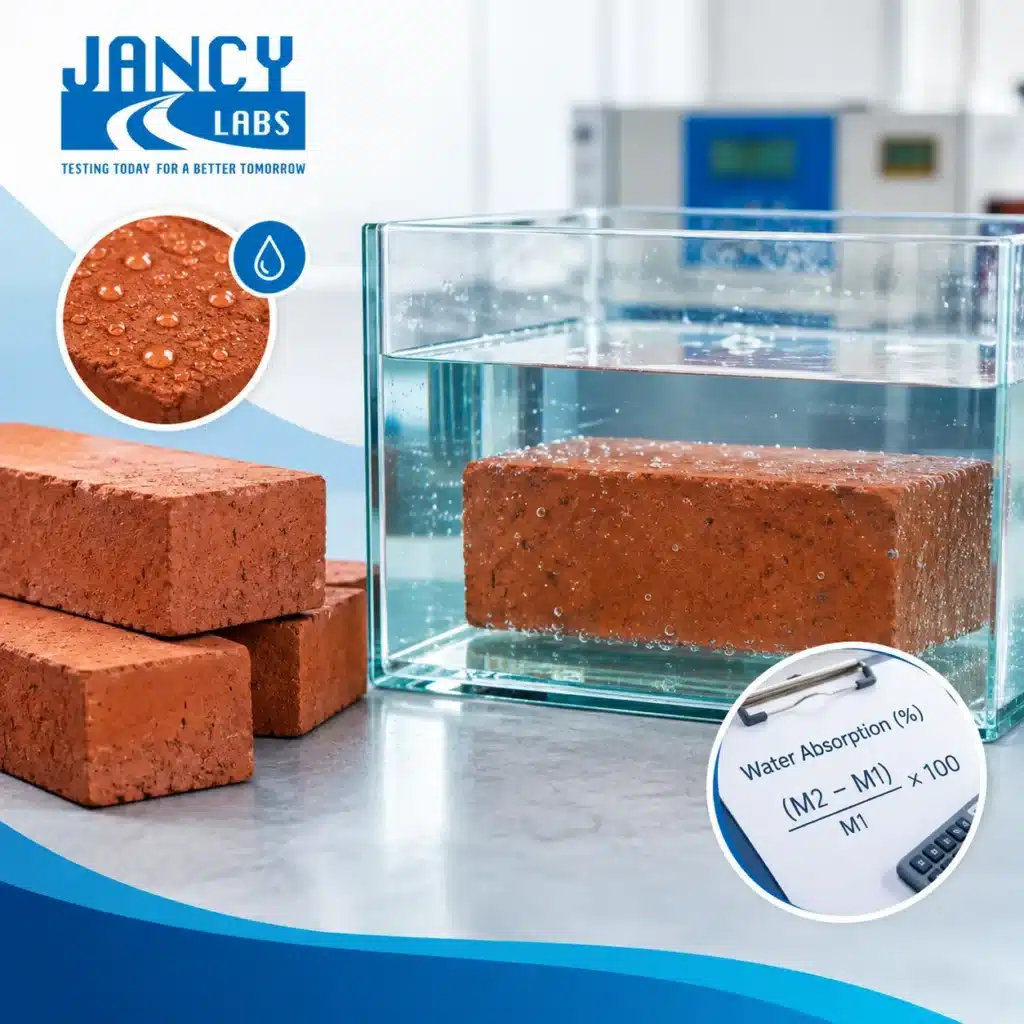
Burnt clay bricks are full of microscopic pores. The water absorption test on bricks measures exactly how much water those pores pull in. Results are reported as a percentage of the brick’s dry weight, taken after a standard 24-hour soak.
The method comes from IS 3495 (Part 2):2019. A lab oven-dries a brick, weighs it, soaks it, weighs it again, and calculates the percentage gain. The result becomes one of the main quality checks used to accept or reject a batch.
How the Water Absorption Test on Bricks Works
The current governing standard is IS 3495 (Part 2):2019 (Fourth Revision). The procedure runs as follows.
- Technicians oven-dry specimens at 105 to 115°C for not less than 24 hours. Two successive weighings two hours apart must show a loss no greater than 0.2 percent.
- The specimens cool to room temperature. Their mass is recorded as M1.
- Each dried brick then goes fully underwater — clean water at 15 to 30°C — for a full 24 hours.
- Technicians remove the brick, wipe off surface water with a damp cloth, and weigh it within 3 minutes. This mass is M2.
- Water absorption is calculated as (M2 − M1) / M1 × 100, reported to the nearest 1 percent.
The 2019 revision also added a 5-hour boiling water test and a saturation coefficient. That coefficient is the ratio of the 24-hour cold absorption to the 5-hour boiling absorption. It can flag an under-fired or over-fired brick even when the plain 24-hour figure looks acceptable on its own.
For the companion strength test on the same batch, see our guide to the Compressive Strength Test of Bricks. For the related surface-salts check, see the Efflorescence Test of Bricks.
Water Absorption Limits by Brick Class
IS 1077 sets the acceptance limits that pair with the IS 3495 test method, and the ceiling depends on the brick’s class:
Brick Class Band | Max Water Absorption (24 h) | Typical Grade |
Up to Class 12.5 | 20% by weight | Second/third class — general masonry |
Class 15 and above | 15% by weight | First class — load-bearing masonry |
These limits come from IS 1077, and the same brick classification underpins acceptance criteria in CPWD Specifications for government building works.
Why the Water Absorption Test on Bricks Matters
A brick that absorbs too much water pulls moisture deep into a masonry wall. That moisture raises the risk of efflorescence and frost damage in colder regions. It also risks strength loss whenever the wall stays wet for extended periods.
- High absorption bricks suit fewer applications and often need extra waterproofing or plaster protection.
- Very low absorption is not automatically better — it can point to over-vitrified, brittle bricks instead of a durable batch.
This is why labs check the water absorption test on bricks alongside compressive strength and efflorescence, not as a single standalone number.
Common Mistakes
- Weighing M1 before the brick has actually reached constant mass, skipping the two-hour re-weigh check.
- Letting a soaked brick drip-dry instead of wiping it and weighing M2 within the specified 3-minute window.
- Comparing a result against a flat 20 percent rule without confirming which class band the supplier is claiming.
- Citing the older IS 3495 (Part 2):1992 procedure instead of the current 2019 Fourth Revision.
- Treating one brick’s result as representative instead of testing and averaging a full IS 5454 sample.
A Site Example
A contractor buys bricks for a boundary wall, and the supplier’s docket lists them as Class 7.5 with roughly 18 percent absorption. An independent water absorption test on bricks at Jancy Labs, run on an averaged five-brick sample, returns 24 percent instead — above the 20 percent ceiling for that class band.
The engineer rejects the batch before the wall goes up, avoiding masonry that would have stayed damp long after rain and run a higher risk of efflorescence and frost damage.
A Testing Checklist
- Confirm the oven-dry mass has actually stabilised before recording M1.
- Confirm the immersion bath sits between 15 and 30°C for the full 24 hours.
- Weigh M2 within 3 minutes of removal, after wiping with a damp cloth.
- Cross-check the result against the IS 1077 limit for the claimed brick class.
- Confirm the report cites IS 3495 (Part 2):2019, not the withdrawn 1992 procedure.
Key Takeaways
- The water absorption test on bricks compares oven-dry mass (M1) to soaked mass (M2) after 24 hours in water, using (M2 − M1) / M1 × 100.
- IS 3495 (Part 2):2019 (Fourth Revision) is current, and added a 5-hour boiling test plus a saturation coefficient.
- IS 1077 caps absorption at 20 percent for bricks up to Class 12.5, and 15 percent for Class 15 and above.
- Weighing has a fixed window on both ends: after drying to constant mass, and within 3 minutes of removal from water.
- One brick is not a sample — IS 5454 governs how many specimens to test and average.
Get Your Water Absorption of Bricks Tested at Jancy Labs
Jancy Labs Private Limited is an accredited civil material testing laboratory (ISO/IEC 17025:2017, Certificate No. TC-12176) in Madurai, Tamil Nadu. We run the water absorption test on bricks along with compressive strength and efflorescence testing against IS 3495 and IS 1077. We collect samples across Tamil Nadu and accept courier samples from anywhere in India.
Or call +91 86800 49004 · jancylabsmdu@gmail.com · Request a quote
4.8★ · 100+ Google reviews · Mon–Sat, 10:00–18:00
Frequently Asked Questions
What is the water absorption test on bricks?
The water absorption test on bricks measures the increase in a brick's mass after oven-drying, then soaking it in water for 24 hours, expressed as a percentage of the dry mass — a direct measure of the brick's pore structure and durability.
What is the formula for the water absorption test on bricks?
Water absorption (%) equals (M2 − M1) divided by M1, multiplied by 100, where M1 is the oven-dried mass and M2 is the mass after 24 hours of immersion and surface wiping.
Which IS code governs the water absorption test on bricks?
IS 3495 (Part 2):2019 (Fourth Revision) is the current standard for the test method. This revision also added a 5-hour boiling water test and a saturation coefficient.
How long are bricks dried before the test?
Technicians oven-dry bricks at 105 to 115°C for not less than 24 hours, until two successive weighings two hours apart show a mass loss no greater than 0.2 percent.
What is the maximum allowed water absorption for bricks?
Per IS 1077, water absorption should not exceed 20 percent by weight for bricks up to Class 12.5, and 15 percent for Class 15 and above.
What is the difference between the 24-hour and 5-hour boiling tests?
The 24-hour test soaks the brick in room-temperature water; the 5-hour boiling test immerses it in boiling water instead, giving a more severe reading that feeds into the saturation coefficient alongside the 24-hour figure.
What is the saturation coefficient?
The saturation coefficient is the ratio of the 24-hour cold-water absorption to the 5-hour boiling-water absorption. It flags bricks that absorb water differently under mild versus severe conditions, a sign of firing quality.
Why does water absorption matter for masonry durability?
Bricks with high water absorption pull in more moisture, raising the risk of efflorescence, frost damage, and strength loss when masonry stays wet, so contractors set an upper limit rather than judging bricks on strength alone.
Can a single brick represent the whole batch?
No — IS 5454 governs sampling, and labs test and average multiple specimens from a batch rather than relying on one brick, since absorption can vary between individual units even from the same kiln.
Does low water absorption always mean a better brick?
Not necessarily — very low absorption can indicate over-vitrification, which can make bricks brittle, so labs check water absorption alongside compressive strength and efflorescence rather than as a standalone quality signal.