
Soil Bearing Capacity: How SBC Is Calculated and Why It Matters
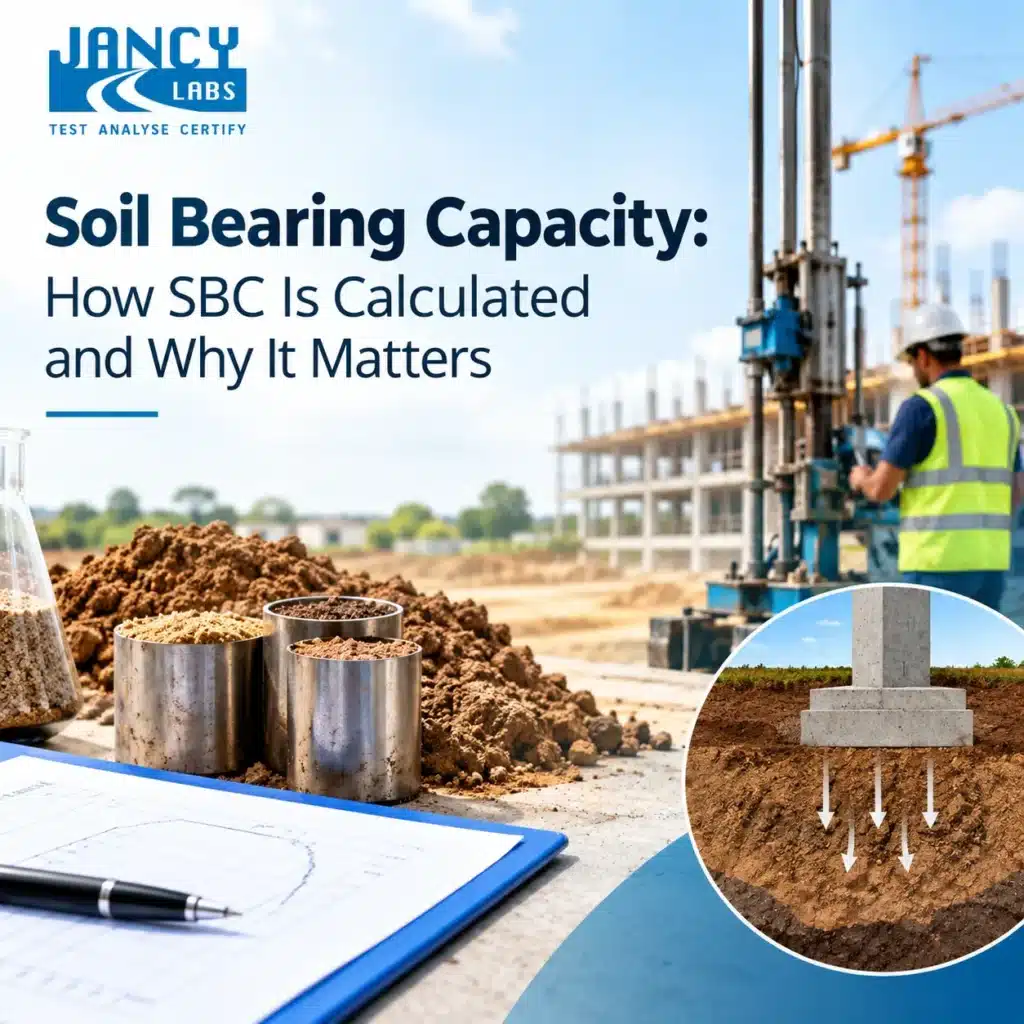
Every building, road, or tank ever constructed rests on one number the site owner rarely sees but every structural engineer designs around: the safe bearing capacity of soil. Get this number wrong and a structure can crack, tilt, or settle unevenly years after handover — long after the concrete has cured and everyone has moved on. Get it right, and the foundation quietly does its job for the life of the building.
This test-explainer walks through what soil bearing capacity actually means, how SBC is calculated using the governing Indian Standard, how it is determined in the field on an actual site, and why it matters enough to test properly rather than assume from a neighbouring plot.
What Bearing Capacity Actually Means
Bearing capacity is the ability of soil to carry the load from a foundation without failing in shear or settling more than the structure can tolerate. Engineers distinguish between two related numbers: ultimate bearing capacity (qu) — the pressure at which the soil shears and fails catastrophically — and safe bearing capacity (SBC), the ultimate value divided by a factor of safety, so the soil is loaded well within its failure limit.
Bearing capacity of soil is always expressed as a pressure — typically in kN/m², with older reports still using kg/cm² — never as a plain value without a unit, since that unit is what turns a lab number into an actual design pressure the structural engineer can use.
How SBC Is Calculated
The standard methodology in India comes from IS 6403:1981 (Code of Practice for Determination of Bearing Capacity of Shallow Foundations), which extends the classical Terzaghi approach with Meyerhof/Hansen-style correction factors for foundation shape, embedment depth, and load inclination:
qu = c·Nc·sc·dc·ic + q·(Nq − 1)·sq·dq·iq + 0.5·B·γ·Nγ·sγ·dγ·iγ
Where c is cohesion, q is the overburden pressure, B is the footing width, γ is the unit weight of soil, and Nc, Nq, Nγ are bearing capacity factors that depend on the soil’s angle of internal friction. The safe bearing capacity of soil formula then applies a factor of safety to this ultimate value: SBC = qu / FOS.
IS 6403 recommends an FOS of 3.0 for general shear failure and 2.5 for local shear failure in loose or soft soils. Even when the shear check passes comfortably, the foundation must also satisfy settlement limits, which IS 1904:2021 (Fourth Revision, superseding the long-standing 1986 edition) governs, alongside minimum foundation depth and site-investigation requirements.
This system-level relationship between bearing capacity and settlement is also why a proper geotechnical soil investigation report checks both, rather than stopping once the shear number looks acceptable.
Determining SBC on an Actual Site
The formula above is only as good as the soil parameters fed into it, so labs determine those parameters through field and laboratory testing:
- Plate Load Test (IS 1888:1982) — a rigid steel plate (300–750 mm) is loaded incrementally at the actual founding level, and the load-settlement curve is used to back-calculate bearing capacity directly at the site.
- Standard Penetration Test / SPT — a split-spoon sampler is driven into a borehole and the blow count (N-value) is correlated to bearing capacity and density.
- Laboratory shear tests (direct shear, triaxial) — used to derive cohesion and friction angle directly from undisturbed or remoulded soil samples for input into the IS 6403 formula.
Note that the governing standard for SPT changed recently: IS 2131:2025 now supersedes the widely-cited IS 2131:1981 — a fair amount of reference material online still points to the withdrawn 1981 edition, so it’s worth confirming which version a report is following. For the correlated field test itself, see our companion guide to the Standard Penetration Test (SPT), and for the closely related road-subgrade test, CBR Test of Soil.
Typical SBC Values by Soil Type
Presumptive values give a rough starting point for estimation, never a substitute for site-specific testing. Per IS 1904:2021’s presumptive-value guidance:
- Dense sand: roughly 300–450 kN/m²
- Compact to dense gravel: roughly 300–450 kN/m², over 450 kN/m² for very dense gravel
- Hard rock: 3300 kN/m² or more
Softer and looser soils — soft clay, loose fill, or made-up ground — carry considerably less than these figures and vary sharply from plot to plot, which is exactly why a presumptive table is a starting point for a preliminary estimate, not a substitute for testing before foundation design is finalised.
Why SBC Matters
A soil investigation report exists to answer one practical question before design even begins: what pressure can this specific site safely carry? Skipping it, or relying on presumptive values from a neighbouring plot, is where problems start:
- Under-design risks shear failure or long-term differential settlement — the more common and more expensive failure mode, since differential settlement between columns causes structural cracking well before total settlement becomes visually obvious.
- Over-design wastes concrete and steel on a foundation sized for soil conditions worse than what’s actually there.
- Variable strata — clay lenses, filled ground, or a shallow water table — can change the safe bearing capacity of soil across a single plot, which is exactly what a proper bore-log and multiple test locations are meant to catch.
Soil conditions vary sharply even within Tamil Nadu — coastal fill, black cotton soil, and weathered rock all behave differently under load — which is precisely why site-specific testing matters before foundation design is finalised.
Common Mistakes in Bearing Capacity Assessment
- Using a presumptive SBC value from a neighbouring or similar-looking plot instead of testing the actual site.
- Relying on a single SPT borehole result when strata vary across the plot.
- Citing the withdrawn IS 2131:1981 SPT standard instead of the current IS 2131:2025.
- Checking only the shear factor of safety and skipping the separate settlement check under IS 1904.
- Ignoring the water table depth, which can significantly reduce effective bearing capacity.
Reviewing an assessment specifically against these known gaps catches most bearing capacity problems before they reach the design stage.
A Site Example
Consider a two-storey residential building planned on what looks like firm ground. A single shallow trial pit suggests stiff clay, and the owner is tempted to use a presumptive SBC value and skip formal testing to save time. A proper SPT-based investigation across three borehole locations, however, reveals a soft clay lens roughly 1.5 m below the surface at one corner of the plot — invisible from the trial pit alone, and enough to cause differential settlement if the foundation had been designed uniformly across the site.
With the actual soil profile in hand, the structural engineer adjusts the foundation design locally at that corner rather than discovering the problem as a crack in the wall two years later. The cost of the additional borehole was a small fraction of the cost of underpinning a settled foundation after the fact.
A Soil Testing Checklist
- Confirm whether the project needs presumptive values, SPT correlation, or a full plate load test.
- Test at multiple locations across the plot, not just one trial pit.
- Check the water table depth and its effect on bearing capacity.
- Confirm which edition of IS 2131 the SPT report is following.
- Verify both the shear factor of safety and the settlement limit, not just one of the two.
- Get a proper bore-log covering the full depth of influence below the founding level.
Working through this checklist before finalising a foundation design catches the failure modes that are otherwise invisible until the structure has already settled. This sits alongside the broader geotechnical soil investigation report, which covers what a complete site investigation should contain beyond bearing capacity alone.
Key Takeaways
- Safe bearing capacity (SBC) is the ultimate bearing capacity divided by a factor of safety, expressed in kN/m².
- IS 6403:1981 gives the calculation methodology; IS 1904:2021 governs the accompanying settlement limits.
- SBC is determined on site via plate load test (IS 1888:1982), SPT correlation, or laboratory shear tests.
- IS 2131:2025 now supersedes IS 2131:1981 for the Standard Penetration Test — check which edition a report cites.
- Presumptive SBC values are a starting estimate only; site-specific testing is what an actual design should rely on.
- Variable strata across a single plot is the most common reason bearing capacity assessments go wrong.
Get Your Soil Tested at Jancy Labs
Jancy Labs Private Limited is an accredited civil material testing laboratory (ISO/IEC 17025:2017, Certificate No. TC-12176) in Madurai, Tamil Nadu. We run SPT, Plate Load Testing, and laboratory soil testing to determine safe bearing capacity for your site. We collect samples across Tamil Nadu and accept courier samples from anywhere in India.
Or call +91 86800 49004 · jancylabsmdu@gmail.com · Request a quote
4.8★ · 100+ Google reviews · Mon–Sat, 10:00–18:00
Frequently Asked Questions
What is safe bearing capacity (SBC) of soil?
Safe bearing capacity is the pressure a soil can support without shear failure or excessive settlement, calculated by dividing the ultimate bearing capacity by a factor of safety, typically 2.5 to 3.0 as per IS 6403.
What is the formula for calculating soil bearing capacity?
IS 6403:1981 gives the ultimate bearing capacity as qu = c·Nc·sc·dc·ic + q·(Nq − 1)·sq·dq·iq + 0.5·B·γ·Nγ·sγ·dγ·iγ, and the safe bearing capacity of soil formula then divides this by the factor of safety: SBC = qu / FOS.
What unit is bearing capacity of soil measured in?
Bearing capacity of soil is expressed as a pressure, in kN/m² in current practice, though older reports sometimes use kg/cm². Always confirm which unit a report uses before applying the value in design.
How is SBC determined on an actual site?
SBC is determined through a Plate Load Test (IS 1888:1982) at the actual founding level, or through a Standard Penetration Test correlated to bearing capacity, backed by laboratory shear tests on collected soil samples.
What factor of safety is used for bearing capacity of soil?
IS 6403 recommends a factor of safety of 3.0 for general shear failure and 2.5 for local shear failure in loose or soft soils, applied to the calculated ultimate bearing capacity.
What are typical safe bearing capacity values for different soil types?
Presumptive values in IS 1904:2021 cite roughly 300 to 450 kN/m² for dense sand and compact gravel, over 450 kN/m² for very dense gravel, and 3300 kN/m² or more for hard rock — softer and looser soils carry considerably less, which is exactly why site-specific testing matters.
Does SBC change across a single plot?
Yes. Clay lenses, filled ground, or a shallow water table can change the safe bearing capacity of soil across a single plot, which is why multiple test locations and a proper bore-log are part of a complete soil investigation.
What's the difference between ultimate and safe bearing capacity?
Ultimate bearing capacity is the pressure at which the soil shears and fails; safe bearing capacity divides that value by a factor of safety so the foundation is loaded well within the failure limit.
Why isn't an SPT correlation enough on its own?
SPT correlations estimate bearing capacity from blow counts but can miss thin firm or weak layers between test intervals, so they work best combined with a plate load test or laboratory shear data rather than used alone for critical structures.
Do I need a plate load test for every project?
Not always — for small, low-load structures, presumptive values combined with SPT correlation may be sufficient, but a plate load test gives the most site-specific and reliable SBC for important or heavily loaded structures.