
Los Angeles Abrasion Test: Procedure, Limits and IS 2386 Part 4
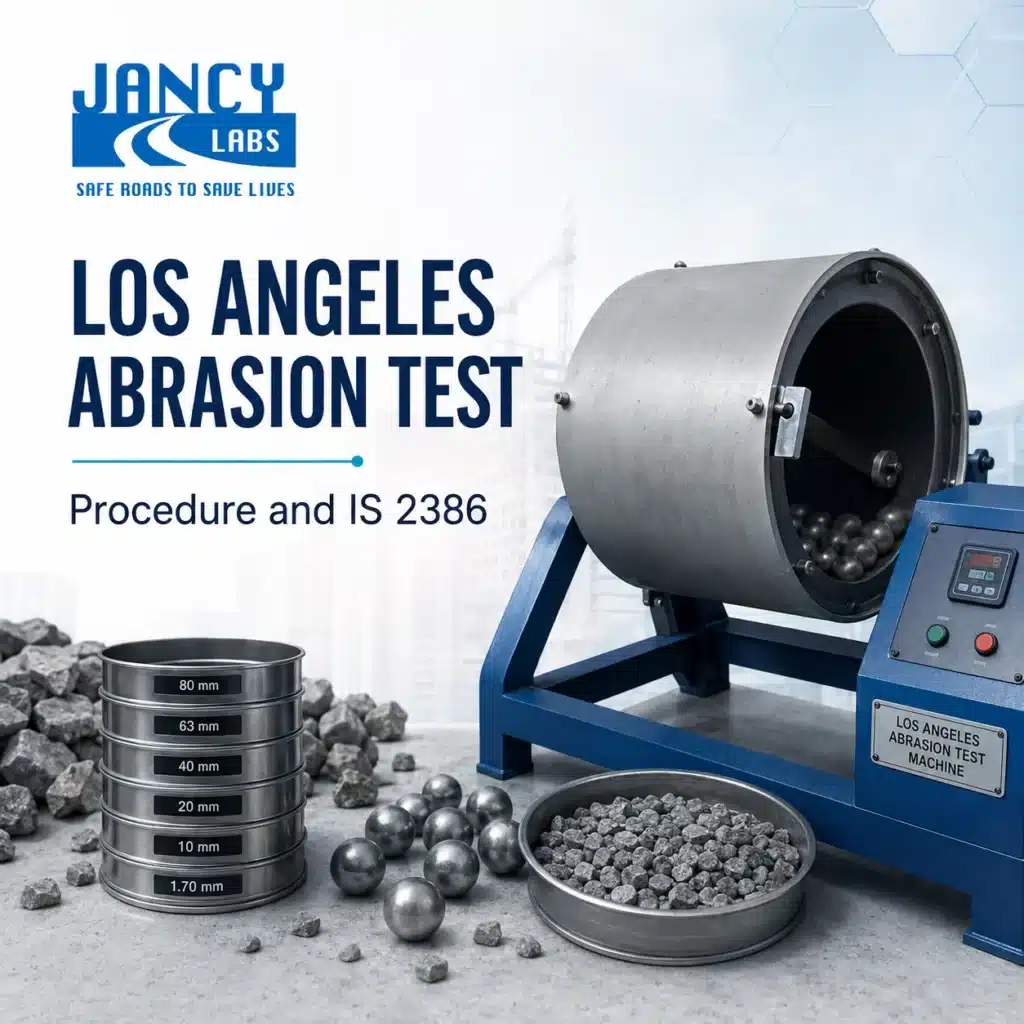
A road surface takes a beating long before traffic wears it down: aggregate grinds against aggregate inside the mix itself. The los angeles abrasion test measures exactly how much wear an aggregate can take before it starts breaking down. Here is how the test works, what apparatus it needs, and which limit applies to your specific pavement layer.
Key takeaways
- The Los Angeles abrasion test, in short, measures aggregate resistance to wear, impact, and grinding under IS 2386 Part 4.
- A rotating steel drum with abrasive steel balls, specifically, simulates the wear aggregate faces in service.
- The result, consequently, is reported as a percentage weight loss; lower values mean tougher, more durable aggregate.
- Notably, acceptable limits vary sharply by pavement layer, from 30% for concrete surfaces to 60% for sub-base material.
- Remarkably, the test remains genuinely unchanged since 1963, reaffirmed as recently as 2016, unlike several other IS codes.
What the Los Angeles abrasion test actually measures
Aggregate inside a road layer is never static. Traffic loading, compaction, and vibration all grind particles against each other continuously. A los angeles abrasion test machine simulates this wear under controlled, repeatable conditions, rather than waiting years to see how a real road performs. The result is a single number: the percentage of aggregate lost to abrasion. This figure, in turn, correlates directly with how long that aggregate will hold up under real traffic. The method itself is standardised by the Bureau of Indian Standards under IS 2386 (Part 4).
Apparatus for the Los Angeles abrasion test
- The machine itself: a hollow steel drum, 700 mm internal diameter, 500 mm long, rotating at 30–33 rpm.
- Abrasive charge: steel balls roughly 48 mm in diameter, weighing 390–445 g each. The number of balls used depends on aggregate grading.
- Also required: IS sieves from 1.70 mm through 80 mm, used to grade the sample and separate the abraded fines afterward.
- Finally, a drying oven, held at 105–110°C, and a balance accurate to at least 1 gram.
Test procedure
- Prepare the sample. First, select aggregate grading matching the intended construction use, then wash and oven-dry it.
- Load the machine. Then, place the graded sample and the correct abrasive ball charge into the drum together.
- Run the drum for 500 or 1000 revolutions depending on grading, at 30–33 rpm.
- Sieve the result. Next, pass the discharged material over a 1.70 mm IS sieve.
- Weigh and calculate. Finally, wash, dry, and weigh the retained fraction, then calculate the percentage loss against the original weight.
Standard value of the Los Angeles abrasion test, by pavement layer
The standard value of los angeles abrasion test results depends entirely on where the aggregate is going. There is no single universal pass mark:
Pavement layer | Max. LA abrasion value |
WBM sub-base course | 60% |
WBM base course with bituminous surfacing | 50% |
Bituminous macadam base course | 50% |
Dense bituminous macadam / bituminous concrete | 30% |
Cement concrete pavement | 30% |
These limits come from MoRTH Specifications for Road and Bridge Works. MoRTH, in turn, references IS 2386 Part 4 directly for the test method itself, while setting the acceptance thresholds by layer. If you are unsure which layer applies to your project, our team can help match the test to the specification.
Significance and use of the Los Angeles abrasion test
The significance of los angeles abrasion test results lies in what they predict, not just what they measure. A low abrasion value indicates aggregate that resists degradation under repeated loading. This, in turn, translates directly into pavement service life. The use of los angeles abrasion test data goes beyond a simple pass or fail. Engineers use it to select which quarry source suits which pavement layer, since sending premium low-abrasion aggregate to a sub-base wastes quality that layer does not need.
Why aggregate testing matters before, not after, construction
An aggregate that fails Los Angeles abrasion limits will not show visible problems on day one. It shows up years later as premature rutting, ravelling, or pothole formation as weaker particles break down under traffic. Our aggregate testing lab runs this test alongside impact value and crushing value testing, since the three properties together give a fuller picture than any one result alone. For bituminous road layers specifically, abrasion results should also be read alongside bitumen testing results, since a weak aggregate undermines even a correctly specified binder.
International equivalents
Internationally, ASTM International C131 covers the same principle for particle sizes under 37 mm, with ASTM C535 covering larger sizes. Both follow the same rotating-drum concept as IS 2386 Part 4, with differences in ball charge and drum dimensions between the systems.
What to send when booking this test
A quick checklist speeds up sample collection and the eventual report:
- The intended pavement layer or application, since the acceptance limit depends entirely on this.
- Also useful: an approximate sample quantity, so the correct grading and ball charge can be prepared in advance.
- Finally, any specification document, such as a MoRTH clause, your consultant has referenced.
None of this needs to be exact upfront — our team confirms the details when scheduling collection.
Frequently Asked Questions
What is a good Los Angeles abrasion value?
It depends on the application. Below 30% suits high-quality pavements like cement concrete or bituminous concrete, while values up to 50-60% are acceptable for base and sub-base layers.
Why does the abrasion limit change by pavement layer?
Surface layers face direct traffic wear and need tougher aggregate, while sub-base layers are protected by the layers above them and can tolerate a higher abrasion value.
Is the Los Angeles abrasion test still IS 2386 Part 4 from 1963?
Yes. The standard was reaffirmed in December 2016 without a substantive revision, making it one of the more stable IS codes still in active use today.
Can Los Angeles abrasion value alone confirm aggregate quality?
Not alone. It is typically read alongside aggregate impact value and crushing value, since each test reveals a different aspect of aggregate toughness.
Get Your Aggregate Tested at Jancy Labs
Jancy Labs Private Limited is an accredited civil material testing laboratory (ISO/IEC 17025:2017, Certificate No. TC-12176) in Madurai, Tamil Nadu. We collect samples across Tamil Nadu and accept courier samples from anywhere in India.
Or call +91 86800 49004 · jancylabsmdu@gmail.com · Request a quote
4.8★ · 100+ Google reviews · Mon–Sat, 10:00–18:00