
Tensile Test of Steel: Yield Strength, UTS and Elongation
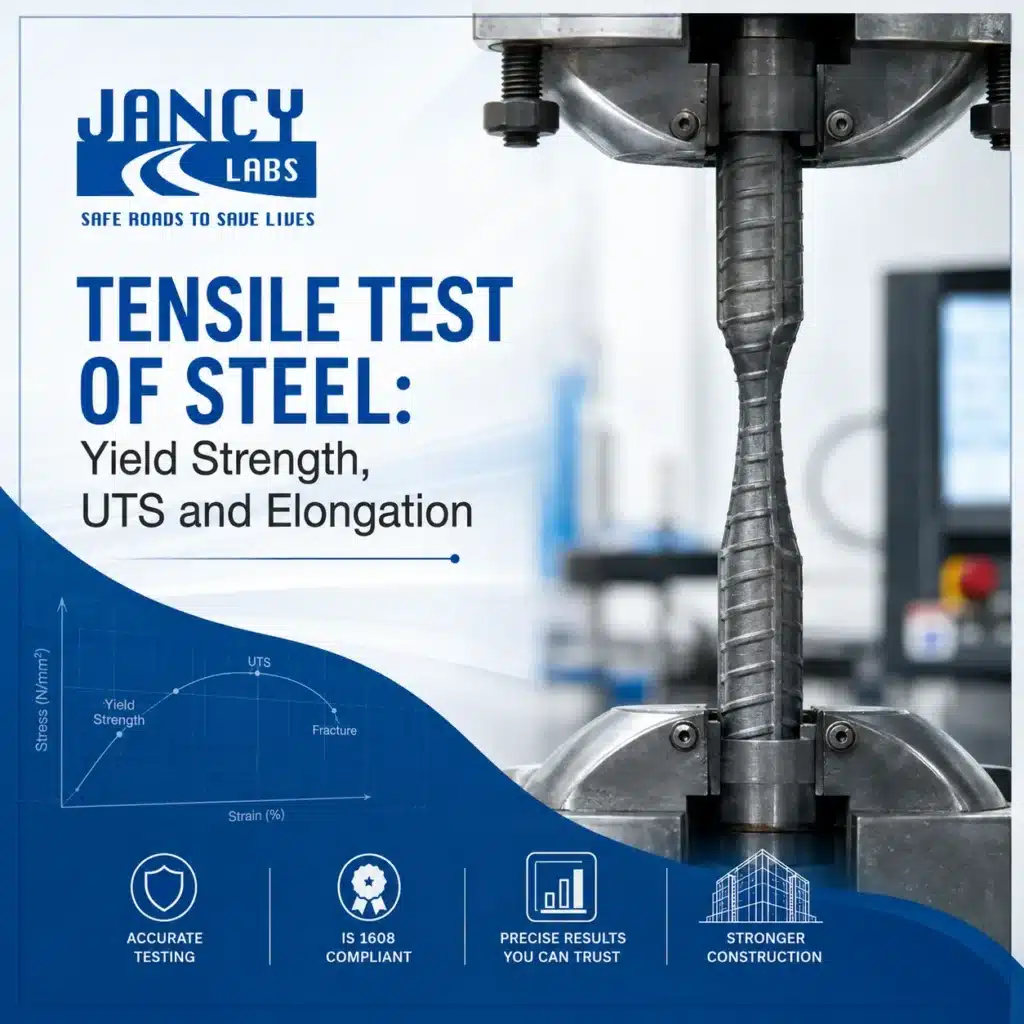
A tensile test of steel pulls a sample apart until it breaks. Three numbers come out the other side: yield strength, ultimate tensile strength, and elongation. Together, these decide whether a bar can be trusted in a structural design. They also decide whether a mill test certificate is telling the truth. Here is what each number means, and how the tensile test of steel actually produces them.
Key takeaways
- A tensile test of steel measures yield strength, ultimate tensile strength (UTS), and percentage elongation from one pull to failure.
- Yield strength, in short, is when the steel stops returning to its original shape; UTS is the maximum load it carries before necking begins.
- Elongation, meanwhile, measures ductility — how much the bar stretches before it snaps, expressed as a percentage of gauge length.
- The method is standardised under IS 1608; TMT reinforcement bars are additionally checked against IS 1786 grade limits.
- A mill test certificate reports these numbers, but independent testing is what confirms the bar in your hands matches the paper.
How a tensile test of steel is performed
The lab grips the specimen — a bar, plate section, or machined test piece — at both ends in a universal testing machine, then pulls it at a controlled rate until it fractures. Throughout the pull, the machine records load and elongation, producing a stress-strain curve. Three points on that curve matter most, and the Bureau of Indian Standards standardises them under IS 1608. In turn, ASTM International A370 gives the international equivalent.
Yield strength: where steel stops being elastic
Up to a point, steel stretches elastically. Remove the load, and it returns to its original length. Yield strength is the stress at which that stops being true, and permanent deformation begins instead. For steels with a clear yield point, this shows as a flat step on the stress-strain curve. However, cold-worked bars without a sharp step report a 0.2% proof stress instead — the stress at which permanent strain reaches 0.2%, treated as the yield point for design purposes.
Ultimate tensile strength: the ceiling
Ultimate tensile strength (UTS) is the highest stress the specimen reaches during the pull, calculated on the original cross-sectional area. Beyond this point, the bar starts to neck, visibly thinning at one location. As a result, the load it can carry actually falls, even though the true stress at that thinning point keeps rising until fracture. In every tensile test of steel, UTS is higher than yield strength — that gap is what gives a structure warning before failure, rather than a sudden snap.
Elongation: what ductility means on paper
A mild steel tensile test or a TMT bar test both report elongation as the increase in gauge length at fracture, expressed as a percentage of the original length. A low elongation value, however, signals a brittle bar. That bar may meet strength numbers on paper, yet still fail suddenly and without visible warning on site. For this reason, elongation is always checked alongside strength, never instead of it.
The tensile test procedure as per IS 1608
The steps below apply to a standard round bar specimen. Plate and section specimens, in turn, follow the same principle with a machined test piece.
- Mark the gauge length. Typically 5.65 times the square root of the cross-sectional area for a proportional specimen.
- Measure the original diameter and area. Recorded before any load is applied.
- Grip the specimen. Both ends seated in the universal testing machine’s jaws, aligned axially.
- Apply load at a controlled rate. Slow enough that the yield point is captured accurately, not overshot.
- Record load at yield and at maximum. These give yield strength and UTS once divided by the original area.
- Measure the fractured length. Fit the broken pieces together and remeasure the gauge length to calculate elongation.
Reading a tensile test of steel result: TMT grade limits
For reinforcement steel, the steel tensile strength test result is checked against IS 1786 grade minimums:
TMT Grade | Min. yield strength (N/mm²) | Min. UTS (N/mm²) | Min. elongation (%) |
Fe 415 | 415 | 485 | 14.5 |
Fe 500 | 500 | 545 | 12.0 |
Fe 500D | 500 | 565 | 16.0 |
Fe 550 | 550 | 585 | 8.0 |
Higher-grade bars trade some elongation for strength. For example, Fe 550 carries more load but stretches less before it fails. Consequently, grade selection is a design decision, not simply “higher is better”.
Why an independent tensile test still matters
A mill test certificate already states yield strength, UTS and elongation for the batch. A certificate, however, travels with the batch, not with the specific bars delivered to your site. Mismatches between certificate and delivery happen often enough that independent verification is now standard practice on serious projects. Consequently, an independently run procedure of tensile test on mild steel confirms the bars actually in hand, not just the paperwork that came with them. Where a result is borderline, our steel testing lab can also run hardness and bend checks alongside the tensile test. Non-destructive checks such as rebound hammer and ultrasonic testing on the finished structure, or concrete cube testing on the surrounding pour, complete the picture of what was actually built.
Frequently Asked Questions
What is the difference between yield strength and UTS?
Yield strength is where permanent deformation begins; UTS is the highest stress the bar reaches before it starts necking. UTS is always the higher number.
Why do cold-worked bars use 0.2% proof stress instead of yield strength?
Cold-worked bars deform gradually rather than showing a sharp yield point, so a 0.2% permanent-strain offset is used as the practical equivalent for design purposes.
What does low elongation mean for a steel bar?
It signals brittleness - the bar may carry the stated load but fail suddenly, with little visible warning, which is a safety concern independent of its strength numbers.
Is a mill test certificate enough on its own?
Not for critical work. The certificate describes the batch, not necessarily the specific bars delivered, so independent tensile testing verifies what actually arrived on site.
Get Your Cement Tested at Jancy Labs
Jancy Labs Private Limited is an accredited civil material testing laboratory (ISO/IEC 17025:2017, Certificate No. TC-12176) in Madurai, Tamil Nadu. We collect samples across Tamil Nadu and accept courier samples from anywhere in India.
Or call +91 86800 49004 · jancylabsmdu@gmail.com · Request a quote
4.8★ · 100+ Google reviews · Mon–Sat, 10:00–18:00