
Bitumen Testing is Critical for
High-Temperature Zones
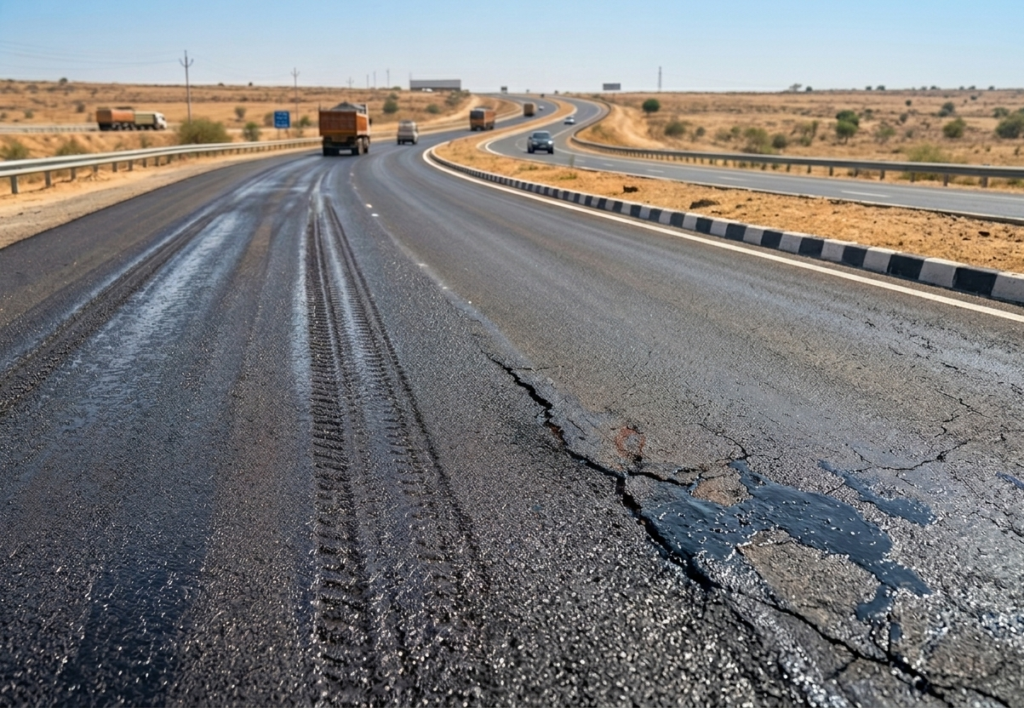
Extreme heatwaves in India are now a direct threat to transportation. As reported by The Times of India, rising temperatures in Gujarat recently caused bitumen surfaces to melt in Surat, trapping vehicles and pedestrians. This is a classic example of why bitumen softening point testing is no longer optional—it is a safety necessity.
For civil engineers and infrastructure contractors in High Temperature Zones, the summer months bring more than just heatwaves—they bring a significant threat to road integrity. As ambient temperatures soar, the asphalt underfoot begins to lose its rigidity. We often see the visual symptoms: bleeding surfaces, deep rutting, and in extreme cases, the “melting” of bitumen binders.
The Molecular Physics of "Melting" Roads
Bitumen is a visco-elastic material. This means its behavior is entirely dependent on temperature. At low temperatures, it behaves like a brittle solid; at high temperatures, it acts like a viscous liquid.
When we talk about roads “melting,” we are referring to the Softening Point. This is the temperature at which bitumen can no longer support the weight of the aggregate or the traffic loads above it. In high-temperature zones, if the bitumen selected has a softening point too close to the peak ground temperature (which can often exceed 60°C on sun-exposed asphalt), the pavement loses its structural bond.
Why Roads Fail in the Heat:
Viscosity Drop: As heat increases, the binder becomes too fluid to hold the aggregate in place.
Rutting: Under heavy wheel loads, the softened bitumen allows the aggregate to shift, creating permanent depressions.
Bleeding: Excess bitumen rises to the surface, creating a slick, hazardous film that reduces skid resistance.
Why Roads Melt Despite Following Contract Specs
Even when a contractor strictly adheres to the volumetric requirements and mix designs specified in a contract, infrastructure failure can still occur in high-temperature zones. This discrepancy often arises because traditional calculations may rely on historical average temperatures rather than the extreme peak pavement temperatures now common in regions like Tamil Nadu.
If the “Design High Temperature” used in the initial calculations is even 5 Degrees lower than the actual solar radiation heat absorbed by the asphalt, the bitumen’s viscosity drops exponentially. This leads to a catastrophic loss of the binder’s shear strength. Furthermore, calculations often overlook the cumulative heat retention—where the road base stores thermal energy throughout a heatwave, preventing the bitumen from cooling and “re-setting” overnight.
How to Prevent Bitumen Failure in Future Projects
Avoiding thermal deformation requires a proactive, multi-layered strategy during the planning and execution phases:
Upgrade to Polymer Modified Bitumen (PMB): For high-traffic corridors in heat-prone zones, switching from standard VG-30 or VG-40 grades to PMB is highly effective. The addition of polymers significantly raises the softening point and improves the elastic recovery of the binder.
Site-Specific Thermal Mapping: Instead of using regional averages, project managers should use infrared sensors to map actual peak pavement temperatures during the design phase. This ensures the selected bitumen grade has a softening point at least 10°C to 15°C higher than the maximum recorded surface temperature.
Batch-Level Laboratory Verification: Never assume every tanker of bitumen is identical. Implementing a rigorous “test-before-lay” protocol—specifically focused on bitumen softening point testing and penetration—ensures that sub-standard or aged batches are rejected before they are integrated into the pavement.
Optimize Aggregate Gradation: Increasing the proportion of fractured, angular aggregates can improve internal friction. This “stone-on-stone” contact provides a secondary structural skeleton that supports heavy loads even if the bitumen binder softens slightly during extreme noon-day peaks.
By combining these advanced testing protocols with climate-aware material selection, contractors can deliver roads that don’t just meet contract requirements today but remain “Safe Roads to Save Lives” for decades to come.
Critical Bitumen Tests for High-Temperature Resilience
To prevent premature pavement failure, rigorous laboratory testing is essential. The following tests, conducted under ASTM D36 guidelines, are the benchmarks for quality assurance.
1. Softening Point Test
This is arguably the most critical parameter for hot climates. The bitumen softening point testing determines the temperature at which the substance attains a particular degree of softening. For roads in high-heat zones, engineers must specify bitumen with a higher softening point to ensure the binder remains stable even during peak noon-day heat.
2. Penetration Test
This measures the hardness or softness of bitumen by measuring the depth (in tenths of a millimeter) to which a standard loaded needle will penetrate vertically in 5 seconds. In warmer regions, a lower penetration grade (harder bitumen) is typically preferred to combat softening.
3. Ductility Test
While we want bitumen to be hard enough to resist rutting, it must remain ductile enough to withstand expansion and contraction without cracking. This test measures the distance a standard briquette of bitumen will stretch before breaking
4. Viscosity Test
Viscosity defines the fluid resistance of the bitumen. Testing at various temperatures allows project managers to determine the correct mixing and laying temperatures for the site.
Why Choose Jancy Labs Pvt Ltd?
Located in the heart of Madurai, Jancy Labs Pvt Ltd understands the specific environmental challenges of South India. We provide accurate, unbiased, and timely testing reports that empower Civil Engineers to make informed decisions on-site.
Whether you are working on a State Highway or a commercial industrial yard, our laboratory is equipped to handle comprehensive bitumen and soil analysis.
Contact Information
Address: No.6, Ganesh Nagar 3rd Street, Surya Nagar, Alagar Kovil Main Road, K.Pudur, Madurai – 625007
Phone: +91-8680049004 / +91-9994421275
Email: jancylabsmdu@gmail.com
Website: www.jancylabs.com
Operating Hours: Monday to Saturday | 10:00 AM – 6:00 PM