
Soil Water Content Test Lab | NABL Accredited | Jancy Labs
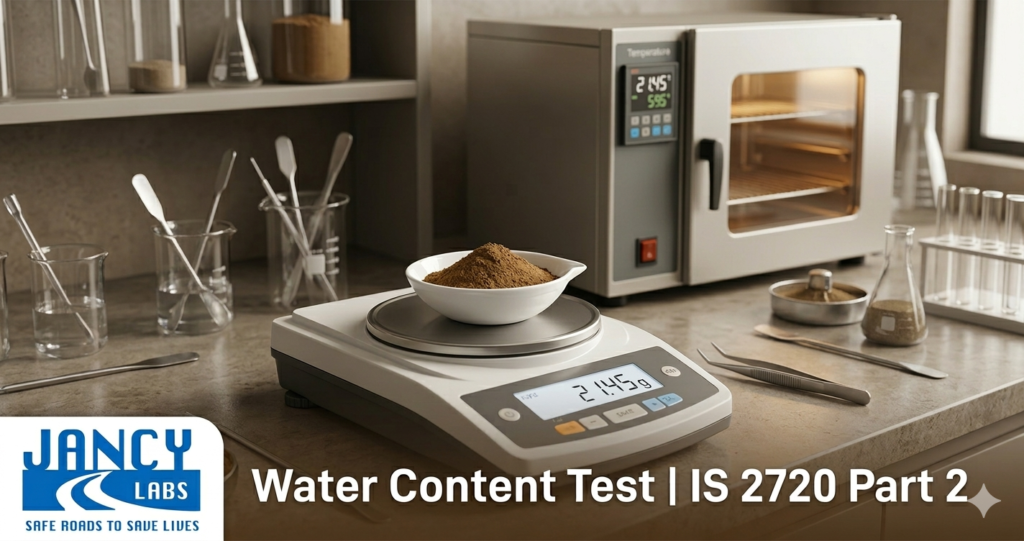
Your road embankment or foundation compaction depends on knowing the exact moisture in your soil. Jancy Labs provides the water content test as per IS 2720 Part 2 — from our NABL accredited facility (TC-12176) in Madurai. Furthermore, our certified reports are directly accepted by NHAI, PWD, and PMGSY for project approvals.
Page contents-Quick Links
What Is Water Content of Soil?
The water content test tells you the exact percentage of moisture in a soil sample relative to its dry weight — therefore, it is a critical input for compaction control, earthwork design, and foundation load calculations. Without this value, your field density results are meaningless and your compaction effort is unverifiable. As a result, contractors who skip this test risk failed quality audits, rejected earthworks, and costly rework on active project sites.
Applicable Standards
Jancy Labs conducts this test strictly as per IS 2720 Part 2; consequently, results are consistent and reproducible across all project submissions. Moreover, this standard guarantees that the oven-drying procedure, weighing precision, and reporting format meet Bureau of Indian Standards requirements. Therefore, your report is submission-ready for NHAI, PWD, and PMGSY without any further verification.
Why This Test Matters
- Compaction quality control: Earthwork layers cannot be approved without verified water content — therefore, every fill layer on NHAI or PWD projects requires this test.
- OMC determination: The water content value is essential for proctor compaction tests; furthermore, without it, you cannot determine optimal moisture content for maximum dry density.
- Embankment and subgrade design: PWD and PMGSY road projects mandate moisture content data; consequently, embankment stability assessments and subgrade classification depend entirely on this result.
- Foundation soil investigation: Structural engineers require water content data for consolidation analysis; moreover, the foundation type and depth recommendation follows directly from this test.
- Monsoon earthwork monitoring: Because soil moisture fluctuates seasonally in Tamil Nadu, therefore ongoing water content checks protect your compaction schedule during rains.
- Site acceptance testing: NHAI, PWD, and PMGSY quality engineers inspect water content records during audits; as a result, missing data causes stage-payment delays.
Skipping this test leaves your earthwork quality undocumented and your project vulnerable to rejection at any inspection stage.
Why Choose Jancy Labs for Water Content Testing?
Jancy Labs delivers IS 2720 Part 2 water content results you can submit directly for NHAI and PWD approvals — without re-testing.
- Calibrated precision analytical balance and temperature-controlled drying oven — specifically dedicated to IS 2720 Part 2 water content testing; therefore, no cross-contamination with other test procedures.
- Water content test conducted exactly as per IS 2720 Part 2 — furthermore, no approximations or shortcuts are permitted at any stage.
- Every water content report is signed by a qualified Materials Engineer; consequently, your report carries the professional authority required for departmental submission.
- NABL accredited laboratory — TC-12176 | ISO 17025:2017 — therefore, our technical competence is independently verified, not self-declared.
- Water content reports accepted by NHAI, PWD, and PMGSY; moreover, our accreditation eliminates re-testing requirements at quality audits.
- Trusted for water content testing by road and highway project engineers across Tamil Nadu; as a result, our reports have a proven track record in infrastructure project approvals.
Additionally, our accreditation is independently verified. See our NABL accreditation → /nabl-accredited-lab
How to Get Your Water Content Test Done
1st Step: send samples along with covering letter (Via Courier / Transport / Direct Delivery)
2nd Step: We test within the commited date
3rd Step: you get the test report (Courier / Direct collection)
Note: Reports accepted by NHAI, PWD, PMGSY, and other Tamil Nadu infrastructure departments.
Our Water Content Testing Process — as per IS 2720 Part 2
- Sample receipt and registration — furthermore, a unique ID is assigned to each sample for full traceability.
- Visual inspection of sealed sample condition — therefore, any moisture loss during transit is flagged before testing begins.
- Pre-drying weighing — consequently, the tare and wet soil mass are recorded on a calibrated analytical balance.
- Sample placed in temperature-controlled drying oven at 105–110°C as per IS 2720 Part 2; moreover, oven temperature is verified before every batch.
- Oven drying continued until constant mass is achieved — therefore, a minimum of 24 hours drying time is always observed per the standard.
- Post-drying weighing — as a result, the dry soil mass is recorded immediately on cooling to prevent moisture re-absorption.
- Water content calculation: (mass of water ÷ mass of dry soil) × 100; furthermore, all values are entered into the test record sheet at this stage.
- Result cross-checked against project acceptance criteria by Materials Engineer — consequently, no report leaves the lab without a qualified review.
Every water content result is reviewed and signed by a Materials Engineer before dispatch.
Frequently Asked Questions
1. How long does a water content test take at Jancy Labs?
Jancy Labs completes the soil water content test following the IS 2720 Part 2 oven-drying procedure, which requires a minimum drying period; therefore, reports are typically dispatched within one working day after sample receipt. For urgent project requirements, contact us at +91-8680049004 so we can confirm the exact timeline for your submission.
2. Can I send soil samples by courier to Jancy Labs?
Yes — Jancy Labs accepts soil samples via courier, transport vehicle, or direct drop-in at our Madurai facility. However, because water content results are directly affected by moisture loss during transit, you must seal samples in airtight polythene bags immediately after collection. Label each sample clearly with your project details before dispatch to avoid any processing delay.
3. Is your water content test report accepted by NHAI and PWD?
Jancy Labs is NABL accredited under certificate TC-12176 (ISO 17025:2017), and consequently our IS 2720 Part 2 water content reports meet the documentary requirements of NHAI, PWD, PMGSY, and other major Tamil Nadu infrastructure departments. Our reports carry the NABL stamp and Materials Engineer signature required for stage-payment and quality audit submissions.
4. Do you conduct both natural and compacted soil water content testing?
Jancy Labs tests water content for natural undisturbed samples, remoulded/compacted specimens, and bulk field-collected samples — all as per IS 2720 Part 2. Moreover, multiple samples from a single project can be batched and tested together, reducing overall turnaround for large earthwork contracts. Contact us to discuss your testing programme.
5. How much soil sample do I need for a water content test?
The minimum sample quantity is governed by IS 2720 Part 2 based on the maximum particle size in your soil. In practice, a representative specimen collected from the test location is sufficient for the oven-drying determination. For specific guidance on your project soil type, call Jancy Labs at +91-8680049004 before dispatch.
Get Your Water Content Test Report Today
Need your water content test report fast for NHAI or PWD submission? Therefore, send your sample to Jancy Labs today — we process IS 2720 Part 2 tests with NABL TC-12176 certification. Furthermore, every report is signed and stamp-ready, so you avoid delays in your project quality milestone.
| Contact | Details |
|---|---|
| Phone | +91-8680049004 / +91-9994421275 |
| +91-8680049004 | |
| jancylabsmdu@gmail.com | |
| Address | No.6, Ganesh Nagar 3rd Street, K.Pudur, Madurai — 625007 |
| Hours | Monday to Saturday, 10:00 AM – 6:00 PM |
Related Services
You May Also Need These Tests
- Proctor Compaction Test (IS 2720 Part 7/8) — Determines the optimum moisture content and maximum dry density for earthwork compaction control.
- Atterberg Limits Test — Liquid Limit & Plastic Limit (IS 2720 Part 5) — Classifies fine-grained soil behaviour and moisture susceptibility for subgrade and embankment design.
- Field Density Test (IS 2720 Part 28) — Verifies compaction achievement on site; always paired with water content for quality control compliance.