
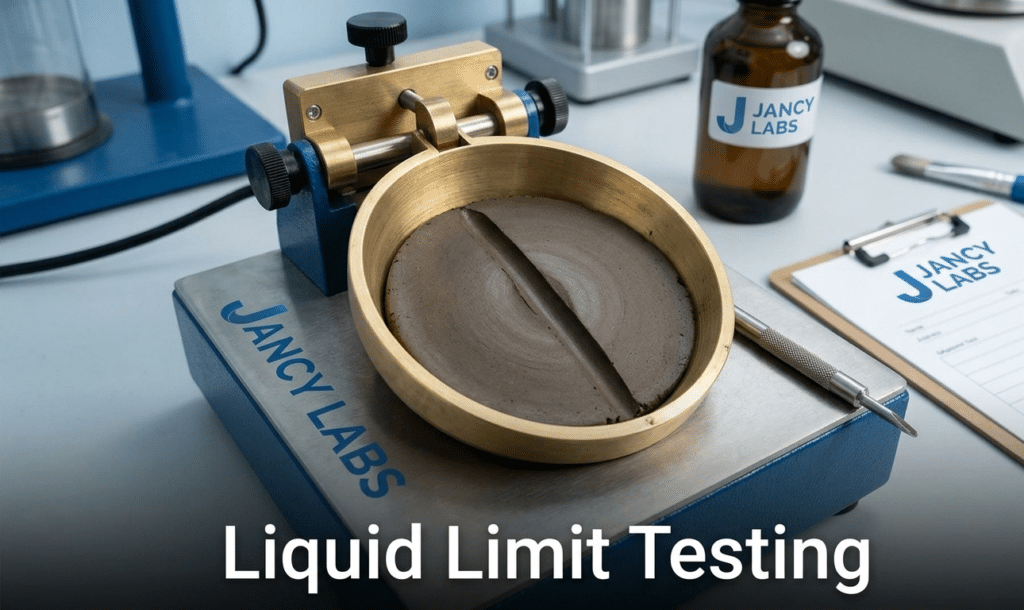
Liquid Limit Test Lab — NABL Certified | Jancy Labs

Designing a subgrade or foundation on clay soil without knowing the Liquid Limit? That’s a settlement failure you won’t see coming.

Jancy Labs provides accurate liquid limit testing as per IS 2720 Part 5 — Casagrande Method and Cone Penetrometer Method — with NABL-certified reports ready for NHAI, PWD, and PMGSY submissions.

Every Liquid Limit test is conducted on calibrated Casagrande apparatus by a qualified Materials Engineer. Your report carries NABL symbol TC-12176 — accepted at every site approval desk.

Get your Liquid Limit test done today → contact-us

Add Your Heading Text Here

What Is a Liquid Limit (Atterberg Limit) Test?

The Liquid Limit test tells you the exact moisture content at which your soil transitions from plastic to liquid behaviour — critical for classifying soil and designing safe road subgrades, embankments, and foundations on cohesive ground.

Your soil sample is prepared and tested on a Casagrande apparatus or Cone Penetrometer to find this boundary moisture content per IS 2720 Part 5.

Therefore, if you get this value wrong — or skip it entirely — Replace with: this invalidates your soil classification, puts your pavement design at risk, and forces your DPR submission back to you.

Applicable Standards

IS 2720 (Part 5): 1985 Methods of Test for Soils — Determination of Liquid and Plastic Limit 

IS 2720 Part 5 standardises both the Casagrande and Cone Penetrometer methods — ensuring your Liquid Limit result is consistent, reproducible, and accepted by all approving authorities.

At Jancy Labs, every Liquid Limit test is conducted strictly as per IS 2720 (Part 5): 1985 — no shortcuts, no omissions.

Download IS 2720 Part 5 from BIS → bis.gov.in

Why the Liquid Limit Test Matters

  • NHAI / PWD Road Projects: Your DPR soil investigation demands Liquid Limit as a mandatory input for soil classification and subgrade design. Your DPR soil investigation report cannot be submitted without it.
  • PMGSY Rural Roads: Atterberg limits including Liquid Limit are required for all PMGSY soil reports in cohesive soil zones across Tamil Nadu.
  • Embankment and Fill Design: Liquid Limit determines whether your fill material is suitable for compaction — a wrong value leads to embankment instability.
  • Foundation Engineering: Structural engineers use Liquid Limit along with Plasticity Index to classify clay soils and select appropriate foundation types.
  • Soil Stabilisation: Lime and cement treatment dosage for black cotton soil is directly linked to Atterberg limit values — Liquid Limit is the starting point.
  • Project Compliance: NHAI, PWD, and PMGSY field engineers routinely verify Atterberg limit data in NABL-certified test reports before clearing construction stages.

⚠️ Submitting a soil report without a valid NABL-certified Liquid Limit value is the fastest way to get your DPR rejected at the first technical review.

View all Soil Testing Services → 

Why Choose Jancy Labs for Liquid Limit Testing?

When your road project’s soil classification depends on Liquid Limit data, one incorrect result invalidates your entire Atterberg limits report.

  • ✅ Calibrated Casagrande apparatus and Cone Penetrometer — both dedicated to IS 2720 Part 5 Liquid Limit procedure
  • ✅ Liquid Limit test conducted by both Casagrande and Cone Penetrometer methods as per IS 2720 (Part 5): 1985
  • ✅ Every test reports will be signed by a qualified Materials Engineer — not a technician
  • ✅ NABL accredited laboratory — Certificate TC-12176 | ISO 17025:2017
  • ✅ Reports accepted by NHAI, Tamil Nadu PWD, and PMGSY field offices
  • ✅ Trusted for Liquid Limit and Atterberg limit testing by highway and infrastructure project engineers across Tamil Nadu

Jancy Labs has been built on one principle: every result you receive must hold up at a site inspection, a DPR review, or a client audit. Our NABL accreditation guarantees that. 

See our NABL accreditation → 

Talk to our team today →

How to Get Your Liquid Limit Test Done

Step 1 — Send Your Sample (COurier / Transport / Direct Delivery)

Step 2 — We Test It

Certified Report Delivery (Step 3) You Get Your Certified Report (Courier / Collect Directly)

Our Liquid Limit Test Process — as per IS 2720 (Part 5): 1985

Casagrande Method:

  1. Air-dry the soil sample and pulverise. Sieve through 425 micron IS sieve.
  2. Mix sieved soil with distilled water to form a uniform paste at high moisture content.
  3. Place soil paste in the Casagrande brass cup. Cut a groove using the standard grooving tool.
  4. Drop the cup at 2 drops per second. Record the number of blows for groove closure.
  5. Collect soil from the closed groove zone. Determine moisture content.
  6. Repeat trials at different moisture contents — minimum 4 data points across 10–40 blows range.
  7. Plot flow curve: number of blows vs moisture content on semi-log graph.
  8. Read Liquid Limit as moisture content corresponding to 25 blows on the flow curve.

Every Liquid Limit result is reviewed and signed by a Materials Engineer before dispatch.

View our NABL accreditation →

Frequently Asked Questions

1. How long does a Liquid Limit test take at Jancy Labs?

The Liquid Limit test at Jancy Labs requires multiple trial runs on the Casagrande apparatus to establish a reliable flow curve as per IS 2720 Part 5. After all trials are complete, our Materials Engineer reviews, computes, and certifies the result. Call or WhatsApp us at +91-8680049004 before dispatching your sample to confirm the current turnaround for your project deadline.

2. Can I send soil samples by courier to Jancy Labs for Liquid Limit testing?

Yes. The key requirement for Liquid Limit samples is moisture preservation — Therefore, seal your soil sample immediately after collection in an airtight container or double zip-lock bag before couriering to No.6, Ganesh Nagar 3rd Street, K.Pudur, Madurai — 625007. Send a WhatsApp message to +91-8680049004 with the AWB number and a photo of the labelled sample before dispatch. Jancy Labs receives cohesive soil samples from project sites across Tamil Nadu regularly.

3.Is your Liquid Limit test report accepted by NHAI and PWD?

Jancy Labs is NABL accredited under Certificate TC-12176 with ISO 17025:2017 compliance — so your report will be accepted without question. Furthermore, every Liquid Limit test is conducted strictly as per IS 2720 (Part 5): 1985, so our certified Atterberg limit reports are accepted by NHAI, Tamil Nadu PWD, and PMGSY authorities. For projects requiring specific format documentation, email jancylabsmdu@gmail.com and our team will assist.

4. Do you conduct both Casagrande Method and Cone Penetrometer Method for Liquid Limit testing?

In Lab we conduct Liquid Limit testing by both the Casagrande Method and the Cone Penetrometer Method as per IS 2720 Part 5. Mention your preferred method on your sample label or test request letter when dispatching. However, If your project specification does not specify a method, call us at +91-8680049004 and our Materials Engineer will advise the appropriate method for your soil type and authority requirement.

5. How much soil sample do I need to send for a Liquid Limit test?

As per IS 2720 Part 5, approximately 200–300g of soil passing 425 micron sieve is the minimum requirement per method.However, Jancy Labs recommends sending at least 500g to comfortably cover both methods, account for sieving losses, and allow a re-test if needed. Pack the sample airtight to preserve moisture and label it with your full project details.

Request Your Liquid Limit Test Today

Your Liquid Limit report is the foundation of accurate soil classification — don’t let missing Atterberg data delay your project approval.

Submit your sample today and receive a NABL-certified Liquid Limit report so that NHAI, PWD, and PMGSY will accept, first time and everytime

Contact MethodDetails
📞 Phone+91-8680049004 / +91-9994421275
💬 WhatsApp+91-8680049004
📧 Emailjancylabsmdu@gmail.com
🏢 AddressNo.6, Ganesh Nagar 3rd Street, Surya Nagar, Alagar Kovil Main Road, K.Pudur, Madurai — 625007
⏰ HoursMonday to Saturday | 10:00 AM – 6:00 PM

You May Also Need These Soil Tests

1. Plastic Limit Test (IS 2720 Part 5) Plastic Limit is the companion test to Liquid Limit — both are needed to calculate Plasticity Index, which is mandatory in every soil classification report.

2. Free Swell Index (FSI) Test (IS 2720 Part 40) For black cotton soil sites, FSI testing alongside Liquid Limit gives a complete picture of expansive soil behaviour for foundation and pavement design.

3. Proctor Compaction Test — OMC & MDD (IS 2720 Part 7) Once soil is classified using Atterberg limits, Proctor Compaction gives the optimum moisture content and maximum dry density — both required for subgrade and embankment design.

Scroll to Top