
Slump Test for Concrete Workability-The Ultimate Guide To Understand Slump
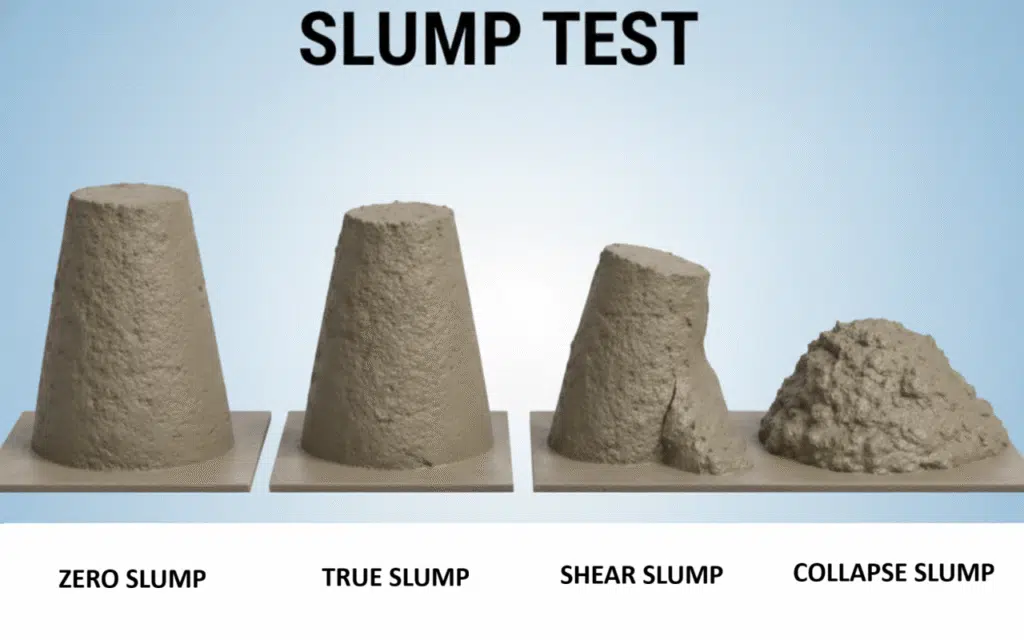
Concrete is undeniably the foundation of all strong buildings. Consequently, workability—or how easily concrete can be placed and compacted—is crucial for on-site control. Therefore, the slump test for concrete workability offers a simple, yet highly effective, way to measure this key feature . Furthermore, learning this quick test is absolutely necessary for all builders who want high-quality, lasting results. Ultimately, controlling the slump ensures your concrete performs exactly as planned, thus protecting the structural integrity of your entire construction project.
What Exactly is the Concrete Slump Test?
To begin with, the concrete slump test is a global standard for checking how consistent fresh concrete is. Specifically, the test uses a cone-shaped mold, called the slump cone, which is filled with concrete in three layers , tamping each layer carefully. Subsequently, the cone is lifted straight up, allowing the concrete to settle or ‘slump’ because of its own weight.
Moreover, the slump is officially the measured vertical distance between the original height and the settled concrete’s top. Therefore, this measurement quickly tells us how wet or stiff the mix is, providing immediate information about its fitness for pouring.
The Critical Importance of Workability in Construction
Indeed, concrete workability controls how easily the mix is handled, moved, poured, and compacted without the materials separating (segregation). Consequently, a mix with low workability is extremely hard to use, possibly causing voids or honeycombing in the finished structure.
Conversely, a mix that is too wet, shown by a high slump, risks the heavy stones (coarse aggregate) sinking to the bottom. Therefore, a correct, controlled workability is necessary to get a solid, uniform density and the highest concrete strength. Ultimately, controlling workability is crucial for the long-term durability of any building project
Why is Checking the Slump Test Vital for Quality Control?
Furthermore, performing the routine concrete slump test is the main tool for quality control during all concrete pouring. In essence, the test quickly confirms if every batch of concrete arriving at the site meets the engineer’s exact mix recipe.
Consequently, if the measured slump is far from the required number, it immediately shows an issue with the water amount or the stone mix. Therefore, site managers can instantly reject bad batches or fix them with controlled changes before pouring, thus avoiding expensive structural flaws. Moreover, having consistent slump results for every batch is crucial paperwork for all official quality reports.
Ensuring Mix Consistency and Uniformity
In addition, a core benefit of the slump test is making sure the concrete is uniform across different truckloads. Specifically, even small changes in the water held by the stones (aggregates) can greatly change the final mix consistency. Consequently, by doing a slump test on several truckloads, building teams confirm that all the concrete handles in the exact same way.
Therefore, this uniformity is vital when pouring concrete over large areas, thus guaranteeing a consistent performance in the final building. Ultimately, this check minimizes the risk of weak points caused by using uneven concrete mixes.
How the Slump Test Directly Helps a Construction Project?
Moreover, beyond simple quality control, the slump test for concrete workability offers several direct, tangible benefits that substantially aid the construction process itself. For instance, knowing the precise slump allows the site crew to anticipate the flow characteristics of the concrete, which is vital for pouring into complex formwork.
Therefore, proper slump selection directly minimizes placement time and reduces the labor required for spreading and vibrating the mix. Consequently, this efficiency gain not only accelerates the construction schedule but also ensures better consolidation and a superior surface finish. Ultimately, the test transforms a high-risk placement operation into a controlled, predictable engineering activity.
Optimizing Placement and Compaction Efficiency
Certainly, the slump level must exactly match the job on your construction site. Specifically, lower slump concrete works best for pavements and mass concrete pours . Conversely, a higher slump is often needed for heavily reinforced structures.
Therefore, the mix must easily flow around tightly packed steel bars. Consequently, project teams adjust the water to control the slump, which optimizes the compaction effort. Thus, proper compaction, achieved with the right slump, removes trapped air. Ultimately, this boosts the final load-bearing capacity and density of the structure.
Achieving Specified Concrete Strength and Durability
Finally, the main long-term benefit is achieving the concrete’s target strength and durability. Indeed, the measured slump indicates the crucial water-cement ratio. Consequently, a high slump, meaning too much water, lowers the concrete’s final strength. Therefore, excess water also greatly increases concrete permeability.
Moreover, keeping the slump within set limits ensures the water-cement ratio stays correct. Ultimately, this correct ratio means the concrete will meet its required compressive strength. Thus, close attention to workability safeguards the entire structure’s long service life.
Slump Test as a Cornerstone of Quality Assurance
In conclusion, the slump test is more than just a routine check. Furthermore, this test is a mandatory step in responsible construction practice. Consequently, the results give immediate, practical data on concrete quality and consistency.
Therefore, carefully checking the slump helps professionals control mix uniformity. Moreover, this diligence ensures smooth concrete placement and guaranteed project strength and durability. Ultimately, prioritizing the slump test remains essential for superior quality assurance at Jancy Labs and all committed firms.
Contact Information
Registered Office & Laboratory Address
Jancy labs Pvt Ltd,
No.6,Ganesh Nagar 3rd street, Surya Nagar, Alagar kovil main road, K.Pudur, Madurai-625007
Phone Numbers :
+91-8680049004 , +91-9994421275
Email : jancylabsmdu@gmail.com
Working Hours :
Monday to Saturday : 10:00 AM – 6:00 PM