
Material Testing Lab in Theni: Nine Material Categories, One Lab
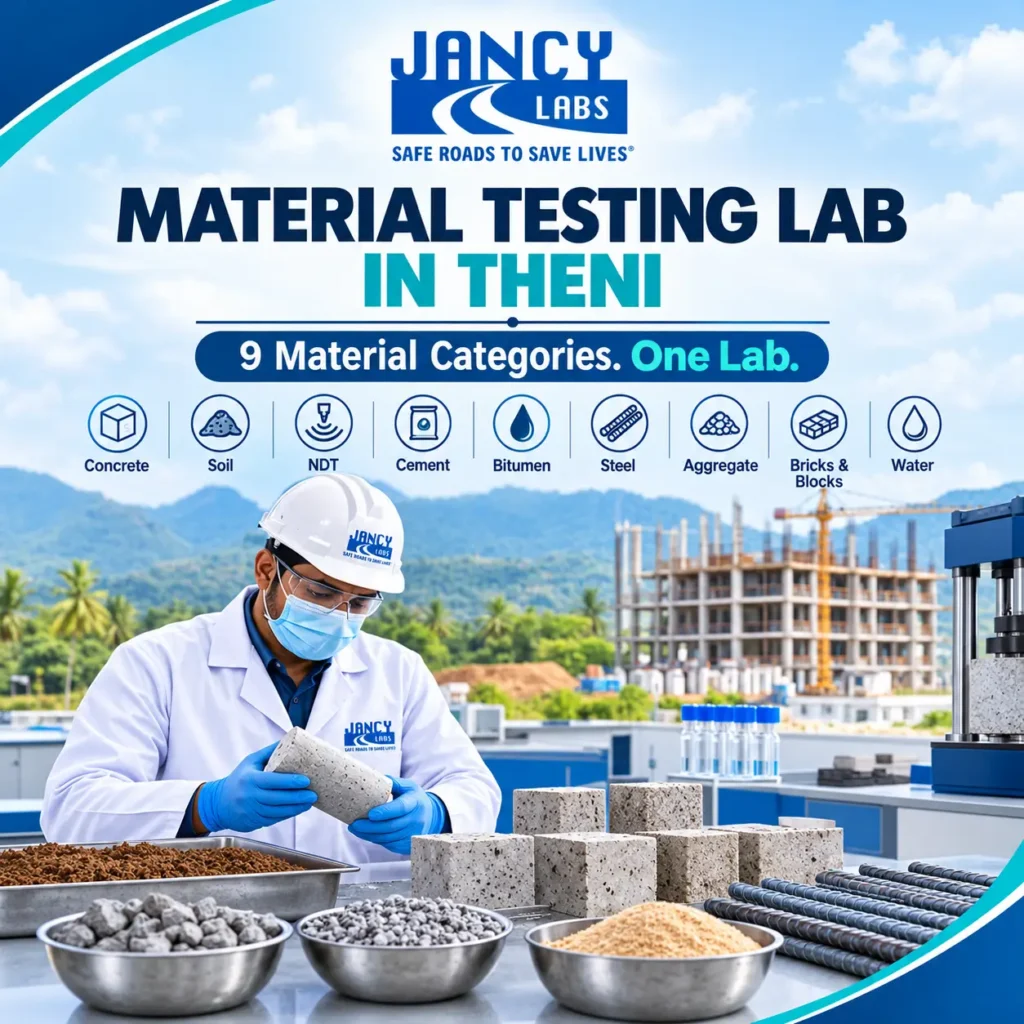
A material testing lab in Theni should test the soil, concrete, steel and water on your site and report every result against the right Indian Standard. Jancy Labs is an accredited lab in Madurai, the district Theni was carved out of in 1996. This guide covers the tests Theni projects need, the water limits that matter, and how to send samples.
Key takeaways
- Jancy Labs tests nine material categories: concrete, soil, NDT, cement, bitumen, steel, aggregate, bricks and blocks, and water.
- The lab holds ISO/IEC 17025:2017 accreditation from NABL, Certificate No. TC-12176.
- Theni lies west of Madurai district, and the team collects samples across Tamil Nadu.
- Mixing water for reinforced concrete must have a pH of at least 6 and no more than 500 mg/l of chlorides, as per IS 456.
- The rebound hammer test now follows IS 516 (Part 5/Sec 4):2020, because IS 13311 (Part 2) was withdrawn.
What does a material testing lab in Theni need to handle?
A material testing lab in Theni has to handle both plains and hill sites, because the district lies at the foot of the Western Ghats. Bodinayakanur is a major market for cardamom, coffee, tea and pepper. Meanwhile, the Cumbum Valley grows grapes through the year, so stores and packing sheds keep going up.
Cotton spinning mills and sugar mills are the main industries. The district also holds the Vaigai Dam and several other reservoirs, plus the hill roads towards Meghamalai and Bodi Mettu. So one project list can include mill floors, farm stores, hill houses and road work.
Which tests match common Theni projects?
Before you book a material testing lab in Theni, match the tests to the type of work. Use this table as a starting point, then confirm the final list with your engineer or the tender document.
Project type | Materials to test | Typical tests |
Spinning and sugar mill sheds | Soil, concrete, steel | Soil bearing capacity, cube test, TMT tensile and rebend |
Cardamom and grape stores | Concrete, bricks, cement | Cube test, brick compressive strength, setting time |
Houses on hill slopes | Soil, concrete | Direct shear, cube test, rebound hammer |
Hill and village roads | Soil, aggregate, bitumen | CBR, Los Angeles abrasion, penetration |
Canal and borewell water | Water | pH, chlorides, sulphates, solids |
Most hill sites start with soil testing, while mills with heavy machines also need steel testing for the TMT bars.
Which nine material categories does the lab test?
Jancy Labs covers all nine categories under one accreditation, so a Theni site can send every sample in one batch. Each test cites the current edition of its standard.
Category | Example tests | Standard |
Concrete | Cube test, slump test | IS 516; IS 1199 (Part 2):2018 |
Soil | CBR, direct shear, Proctor | IS 2720 (Parts 7, 8, 13 and 16) |
NDT | Rebound hammer, UPV | IS 516 (Part 5/Sec 4):2020; IS 516 (Part 5/Sec 1):2018 |
Cement | Soundness, setting time | IS 4031 |
Bitumen | Penetration, softening point | IS 1203:2022; IS 73:2013 |
Steel | Tensile, rebend | IS 1786:2008 |
Aggregate | LA abrasion, impact value | IS 2386 (Part 4):1963 |
Bricks and blocks | Compressive strength | IS 3495 (Part 1):2019 |
Water | Construction water quality | IS 456:2000, Clause 5.4 |
You can check any standard and its edition on the Bureau of Indian Standards website, and any lab’s status on the NABL website.
Why should you test water before mixing concrete?
You should test water first, because salts in it can rust the steel inside reinforced concrete. Many Theni sites draw water from canals or borewells, and its quality can change from one source to the next.
Parameter | IS 456 limit for mixing water |
pH | Not less than 6 |
Chlorides (reinforced concrete) | Not more than 500 mg/l |
Chlorides (plain concrete) | Not more than 2,000 mg/l |
Sulphates (as SO3) | Not more than 400 mg/l |
Suspended matter | Not more than 2,000 mg/l |
If a sample fails, change the source or treat the water before the pour. Ask any material testing lab in Theni to report each value against these limits, as Jancy Labs water testing does.
How do you send samples from Theni?
Sending samples from Theni takes five steps, and you can start them on WhatsApp.
- Share the scope. Send the project type, materials and tests on WhatsApp, call +91 86800 49004, or use the contact page.
- Agree on quantity. The lab tells you how much sample each test needs.
- Book pickup or courier. The team collects samples across Tamil Nadu, so towns such as Theni, Periyakulam, Bodinayakanur and Cumbum are covered.
- Label each sample. Mark the site, date, and the grade or brand on every bag or cube.
- Get the report. The lab tests each sample and issues a report against the standard you named.
For district details, the Theni district website is the official source. Clients in the city itself can see the testing lab in Madurai page.
Why use one material testing lab for a Theni project?
One lab for all nine categories gives you one report format, one accreditation and one point of contact. As a result, your engineer reads every result the same way. When you compare any material testing lab in Theni or Madurai, ask for the accreditation certificate and scope first.
Get Your Materials Tested at Jancy Labs
Jancy Labs Private Limited is an accredited civil material testing laboratory (ISO/IEC 17025:2017, Certificate No. TC-12176) in Madurai, Tamil Nadu. We collect samples across Tamil Nadu and accept courier samples from anywhere in India.
Or call +91 86800 49004 · jancylabsmdu@gmail.com · Request a quote
4.8★ · 100+ Google reviews · Mon–Sat, 10:00–18:00
Frequently Asked Questions
Is there a material testing lab in Theni?
Jancy Labs is based in Madurai, not Theni. However, the team collects samples from sites across Tamil Nadu, including Theni district, and accepts courier samples from anywhere in India.
Which tests do houses on hill slopes need?
Hill houses usually need soil tests such as direct shear for retaining walls, plus the concrete cube test. For older buildings, the rebound hammer test checks concrete without breaking it.
Can canal or borewell water be used for concrete?
Only after testing. IS 456 Clause 5.4 requires a pH of at least 6, and limits chlorides to 500 mg/l for reinforced concrete and sulphates to 400 mg/l.
Is Jancy Labs accredited?
Yes. Jancy Labs holds ISO/IEC 17025:2017 accreditation from NABL, Certificate No. TC-12176.
When is the lab open?
The lab is open Monday to Saturday, 10:00 to 18:00.