
IS 13311: NDT of Concrete, Part 1 and Part 2 Explained
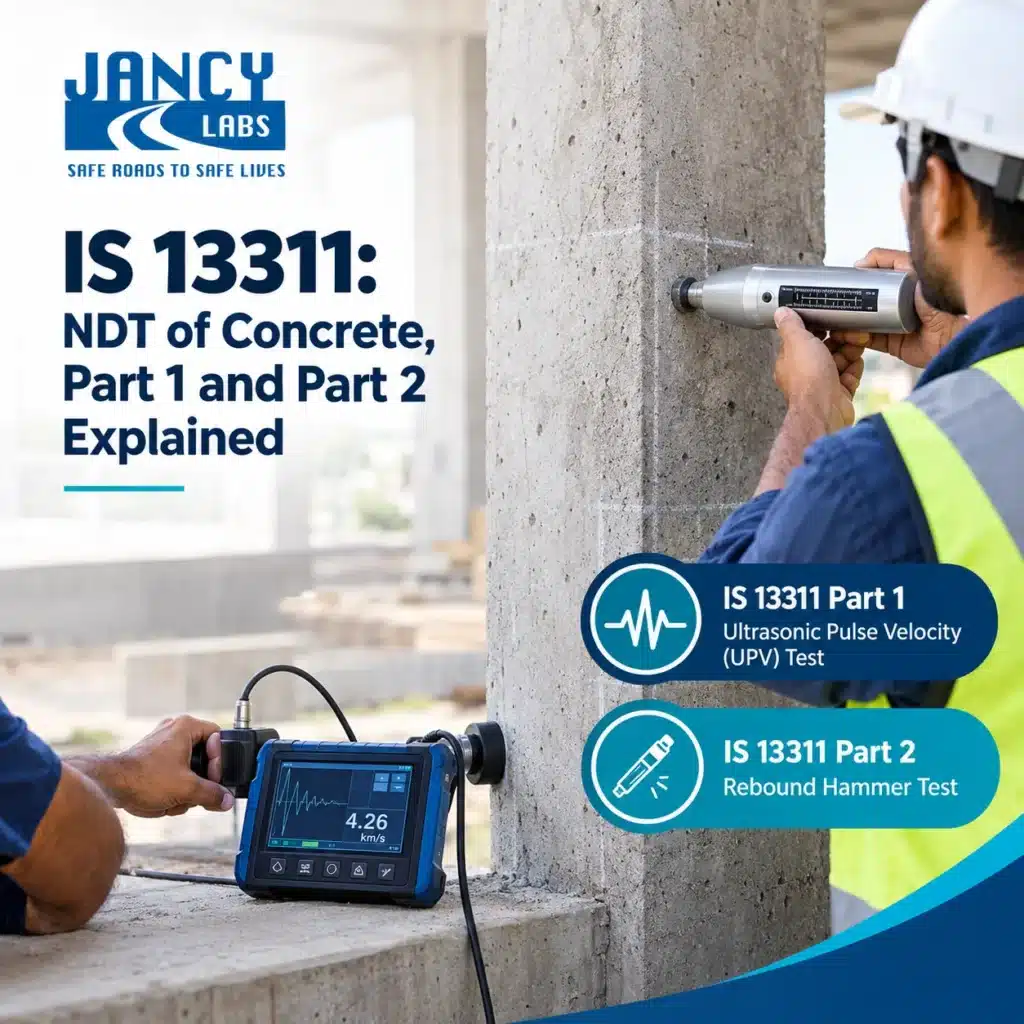
IS 13311 is the Indian standard most engineers still quote for non-destructive testing (NDT) of concrete. Short answer first: both parts are now withdrawn. The Bureau of Indian Standards replaced Part 1 (ultrasonic pulse velocity) with IS 516 (Part 5/Sec 1):2018 and Part 2 (rebound hammer) with IS 516 (Part 5/Sec 4):2020. This guide explains what each part covered, what changed, and how to read an NDT report correctly.
Key takeaways
- IS 13311 (Part 1):1992 covered the ultrasonic pulse velocity (UPV) test on hardened concrete.
- IS 13311 (Part 2):1992 covered the rebound hammer test on hardened concrete.
- BIS has withdrawn both parts; new reports should cite the IS 516 Part 5 sections.
- Neither test measures compressive strength directly, so doubtful zones need core or cube confirmation.
- UPV reads the full depth of a member, while the rebound hammer reads only the surface layer.
What is IS 13311?
IS 13311 is a two-part code of practice for non-destructive testing of hardened concrete that the Bureau of Indian Standards published in 1992. In short, it let engineers assess concrete in a finished structure without cutting or breaking it.
Engineers used it for condition surveys, quality audits of new work, and disputes over suspected weak concrete. However, the code never set a pass or fail limit on its own. Instead, it gave a method to compare zones, locate defects and decide where to drill cores.
Is IS 13311 still valid in 2026?
No. Both parts are withdrawn, and the IS 516 series now holds every concrete test method. The table below maps each old part to its current standard.
Test | Old standard (withdrawn) | Current standard |
Ultrasonic pulse velocity | IS 13311 (Part 1):1992 | IS 516 (Part 5/Sec 1):2018 |
Rebound hammer | IS 13311 (Part 2):1992 | IS 516 (Part 5/Sec 4):2020 |
This matters in practice. If a tender specifies the old code but the lab reports to IS 516, the two parties may argue over which criteria apply. So update your specifications and check the edition on every report you accept.
IS 13311 Part 1: ultrasonic pulse velocity test
Part 1 measures how fast an ultrasonic pulse travels through concrete between two transducers. We explain the full method in our ultrasonic pulse velocity test guide. Dense, uniform concrete carries the pulse quickly. In contrast, cracks, honeycombing and voids slow it down.
The code describes three transducer layouts. Direct transmission places the probes on opposite faces and gives the most reliable reading. Semi-direct transmission uses adjacent faces, and indirect transmission uses the same face when only one side is reachable. The grading table below comes from the old Part 1 and still appears in many older reports.
Pulse velocity (km/s) | Concrete quality grading (IS 13311-1) |
Above 4.5 | Excellent |
3.5 to 4.5 | Good |
3.0 to 3.5 | Medium |
Below 3.0 | Doubtful |
Note that IS 516 (Part 5/Sec 1):2018 revised this grading and ties it to concrete grade. So a report you receive today should use the new criteria, not this table.
IS 13311 Part 2: rebound hammer test
Part 2 is the section most engineers remember. For the full method, read our rebound hammer test guide. A spring-loaded hammer strikes the concrete surface, and the rebound number shows surface hardness.
A typical site procedure looks like this:
- Select a smooth, dry area and grind off loose laitance or plaster.
- Check the hammer on its calibration anvil before use.
- Next, take a set of readings at spaced points, away from edges and exposed aggregate.
- Record the hammer angle, because horizontal, upward and downward impacts read differently.
- Finally, average the valid readings and convert them using the calibration curve.
Several factors change the rebound number without any change in strength. These include surface smoothness, moisture, carbonation, concrete age and aggregate type. For this reason, a good report states the surface condition alongside the numbers.
UPV vs rebound hammer: which test do you need?
Use both where possible, because each test covers the blind spot of the other. The comparison below shows how they differ.
Factor | UPV test | Rebound hammer |
What it measures | Pulse velocity through concrete | Surface hardness |
Depth assessed | Full member thickness | Outer surface layer |
Best at finding | Internal cracks, voids, honeycombing | Weak or poorly cured surfaces |
Main limitation | Rebar and moisture affect readings | Surface condition affects readings |
Current standard | IS 516 (Part 5/Sec 1):2018 | IS 516 (Part 5/Sec 4):2020 |
What a reliable NDT report should show
A report carries weight only when an accredited lab issues it. So first check that the lab holds NABL accreditation to ISO/IEC 17025 with NDT in its scope. Jancy Labs holds accreditation under certificate TC-12176.
- The standard and edition used, such as IS 516 (Part 5/Sec 4):2020
- A test grid drawing that marks every location
- Hammer orientation, calibration check and surface condition
- Raw readings, not only averages
- A clear recommendation on where cores are needed
Common mistakes when citing the old code
The biggest mistake is treating a rebound number as compressive strength. Instead, it gives an estimate only. A second mistake is quoting a withdrawn code in new specifications. When NDT results look doubtful, confirm them with core tests through a concrete testing lab. For wider background on these methods, see the American Concrete Institute.
How to get NDT done to the current standard
First, share drawings, the concrete grade and the areas of concern. Next, agree on the test grid and whether cores are needed. Jancy Labs carries out non-destructive testing across Tamil Nadu. To plan a survey, contact our team.
Get Your IS 13311 NDT Tested at Jancy Labs
Jancy Labs Private Limited is an accredited civil material testing laboratory (ISO/IEC 17025:2017, Certificate No. TC-12176) in Madurai, Tamil Nadu. We collect samples across Tamil Nadu and accept courier samples from anywhere in India.
Or call +91 86800 49004 · jancylabsmdu@gmail.com · Request a quote
4.8★ · 100+ Google reviews · Mon–Sat, 10:00–18:00
Frequently Asked Questions
Is IS 13311 still valid?
No. BIS has withdrawn both parts of IS 13311. IS 516 (Part 5/Sec 1):2018 now replaces Part 1, and IS 516 (Part 5/Sec 4):2020 replaces Part 2. You can still read old reports that cite IS 13311, but new tests should quote IS 516.
What is IS 13311 Part 2?
Part 2 (1992) was the Indian standard for the rebound hammer test on concrete. It measures surface hardness and relates the rebound number to an estimated compressive strength. Today, IS 516 (Part 5/Sec 4):2020 takes its place.
What is IS 13311 Part 1?
Part 1 (1992) was the Indian standard for the ultrasonic pulse velocity test. It measures how fast a sound pulse crosses concrete to judge uniformity, cracks and voids. Today, IS 516 (Part 5/Sec 1):2018 takes its place.
Can a rebound hammer test replace cube testing?
No. A rebound hammer gives an estimate of surface hardness, not a measured strength. So use it to compare areas and find weak zones, then confirm doubtful areas with core tests or cube results.
Why combine UPV and rebound hammer tests?
Each test has blind spots. For example, a rebound hammer reads only the outer 30 mm or so, while UPV reads the full depth. Therefore, using both together gives a more reliable picture of concrete quality than either test alone.