
IS 456 Explained: The Code Behind Every Concrete Decision
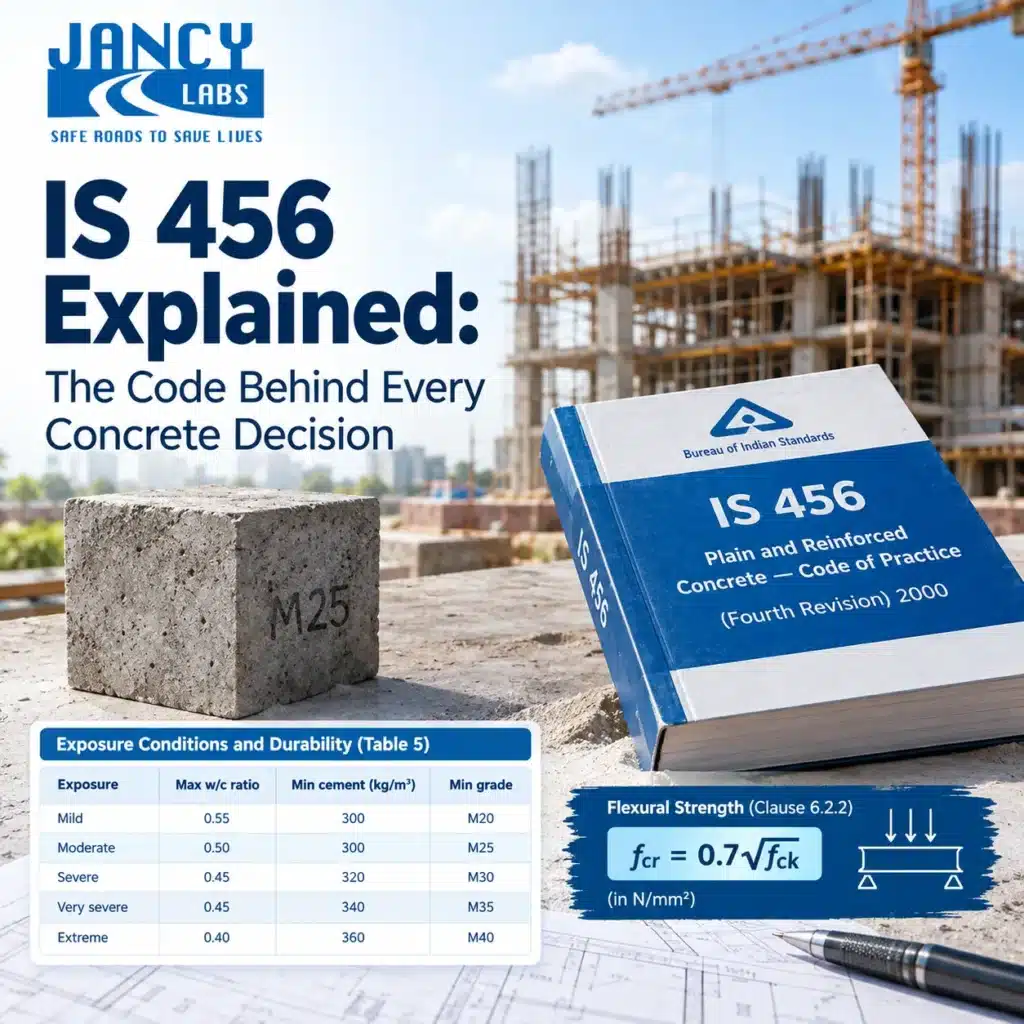
IS 456 governs almost every decision made on a concrete site in India. It decides which grade to use, how much cement the mix needs, how thick the cover over rebar should be, and which water is fit for mixing. The Bureau of Indian Standards (BIS) publishes IS 456 as Plain and Reinforced Concrete — Code of Practice, and nearly every tender, drawing note, and lab report in the country cites it. Most site engineers know the code exists, but fewer know which clause governs which decision, and that gap is where costly mistakes happen.
Key Takeaways
- IS 456:2000 (Fourth Revision) sets the current rules for plain and reinforced concrete in India, so engineers still call it the “code book IS 456 2000.”
- It classifies concrete into grades from M10 to M60 by 28-day characteristic compressive strength.
- The code separates durability from strength through five exposure conditions in Table 5, ranging from Mild to Extreme.
- Clause 6.2.2 gives the flexural strength of concrete as per IS 456: fcr = 0.7√fck.
- Clause 5.4 sets chemical limits for mixing and curing water, so chloride and sulphate failures are a common, preventable reason labs reject a water source.
What Is IS 456?
IS 456 is the BIS code that governs how engineers design, specify, and execute plain and reinforced concrete work. It sets rules for materials, workmanship, durability, and acceptance criteria — in short, it answers both “what concrete should we use” and “how do we know it’s acceptable.”
The current edition, the Fourth Revision, dates to 2000, so engineers commonly call it “IS 456:2000” or the “IS 456 code book 2000.” This revision replaced separate codes for plain and reinforced concrete and combined design philosophy, materials, and quality control into one document. As a result, structural drawings, tender documents, and lab reports all cite the same single code.
How IS 456 Classifies Concrete by Grade and Exposure
IS 456 grades concrete from M10 to M60, where the number states the characteristic 28-day compressive strength in N/mm² on a 150 mm cube. For example, M25 means 25 N/mm², and no more than 5% of cubes may fall below that value. Builders may use nominal mixes (fixed cement:sand:aggregate ratios) only up to M20; every higher grade needs a designed mix, proportioned per IS 10262 and confirmed by cube testing.
Strength alone doesn’t decide the mix, however. IS 456 Table 5 sets minimum cement content and maximum water-cement ratio by exposure condition, so durability requirements often override what strength calculations alone would allow:
| Exposure | Max w/c ratio | Min cement (kg/m³) | Min grade |
|---|---|---|---|
| Mild | 0.55 | 300 | M20 |
| Moderate | 0.50 | 300 | M25 |
| Severe | 0.45 | 320 | M30 |
| Very severe | 0.45 | 340 | M35 |
| Extreme | 0.40 | 360 | M40 |
Take a coastal foundation slab as an example. It usually falls under “Severe” or “Very Severe” exposure, regardless of what the structural design alone demands. So a mix that easily hits its strength target can still fail an IS 456 durability check.
Flexural Strength of Concrete as per IS 456
Flexural strength, also called the modulus of rupture, measures how well concrete resists bending rather than crushing, and it governs pavement, slab-on-grade, and airfield design. When a beam test isn’t practical, IS 456 Clause 6.2.2 lets engineers estimate flexural strength directly from compressive strength:
fcr = 0.7√fck (in N/mm², where fck is the characteristic compressive strength)
For M25 concrete, that gives fcr = 0.7 × √25 ≈ 3.5 N/mm². The same clause underpins the modulus of elasticity formula, Ec = 5000√fck, so one cube test result feeds several downstream design calculations. But that chain only holds if the lab tested and cured the cube correctly in the first place.
Water Quality Rules Under IS 456 That Sites Often Skip
Clause 5.4 of IS 456 sets chemical limits for mixing and curing water, yet sites often skip it, using borewell, tanker, or recycled water without testing it at all. The limits require a pH of at least 6, cap sulphate (as SO₃) at 400 mg/l, and cap chloride at 500 mg/l for reinforced concrete versus 2,000 mg/l for plain concrete. The tighter RCC limit exists specifically to protect rebar from corrosion.
Amendment No. 4 to IS 456 further tightened the ban on sea water for mixing or curing reinforced and prestressed concrete, because chloride-driven corrosion has cost Indian coastal structures dearly. If water fails these limits, the risk goes beyond long-term durability: Clause 5.4 also requires labs to run comparative setting-time and strength tests against distilled water before accepting any doubtful source.
Where Sites Get IS 456 Wrong
Site audits turn up the same three mistakes repeatedly. First, crews apply the same nominal cover regardless of exposure, even though Table 16 sets cover from 20 mm (Mild) up to 75 mm (Extreme); using a Mild-exposure cover on a coastal or industrial structure exposes reinforcement to corrosion years early. Second, teams treat minimum cement content as a target rather than a floor. Clause 9.3.2 and Table 5 set the minimum, so shaving it to cut cost quietly removes the durability margin the code guarantees. Third, designers skip deflection checks after a flexural design passes, but a member can meet bending capacity and still fail serviceability limits, so engineers must verify both independently.
If you need lab-verified compliance with IS 456 — grade verification, cube testing, or water quality testing — Jancy Labs’ concrete testing lab offers sample pickup across Tamil Nadu and accepts courier samples from anywhere in India.
Get Your Materials Tested at Jancy Labs
Jancy Labs Private Limited is an accredited civil material testing laboratory (ISO/IEC 17025:2017, Certificate No. TC-12176) in Madurai, Tamil Nadu. We collect samples across Tamil Nadu and accept courier samples from anywhere in India.
Or call +91 86800 49004 · jancylabsmdu@gmail.com · Request a quote
4.8★ · 100+ Google reviews · Mon–Sat, 10:00–18:00
Frequently Asked Questions
What does IS 456 actually cover?
IS 456 covers concrete grades, mix design principles, durability and exposure conditions, reinforcement detailing rules, and the acceptance criteria engineers use to judge whether cast concrete meets specification.
Is IS 456:2000 still the current code?
Yes. The Fourth Revision from 2000 remains the standard reference edition in current use across Indian design and construction practice.
What is the flexural strength formula in IS 456?
fcr = 0.7√fck, where fck is the characteristic compressive strength in N/mm². Engineers use it to estimate the modulus of rupture when they haven't run a direct beam test.
Can any water be used for mixing concrete?
No. IS 456 Clause 5.4 limits pH, chloride, sulphate, and dissolved or suspended solids. Untested borewell, tanker, or sea water can quietly cause corrosion or strength loss well after the pour.
Why does exposure condition matter if the concrete already meets its strength grade?
Because IS 456 governs strength and durability separately. A mix can hit its target compressive strength and still fail the minimum cement content or maximum water-cement ratio required for its exposure condition, leaving it under-protected against long-term deterioration.