
Soundness of Cement: Le Chatelier and Autoclave Tests Explained
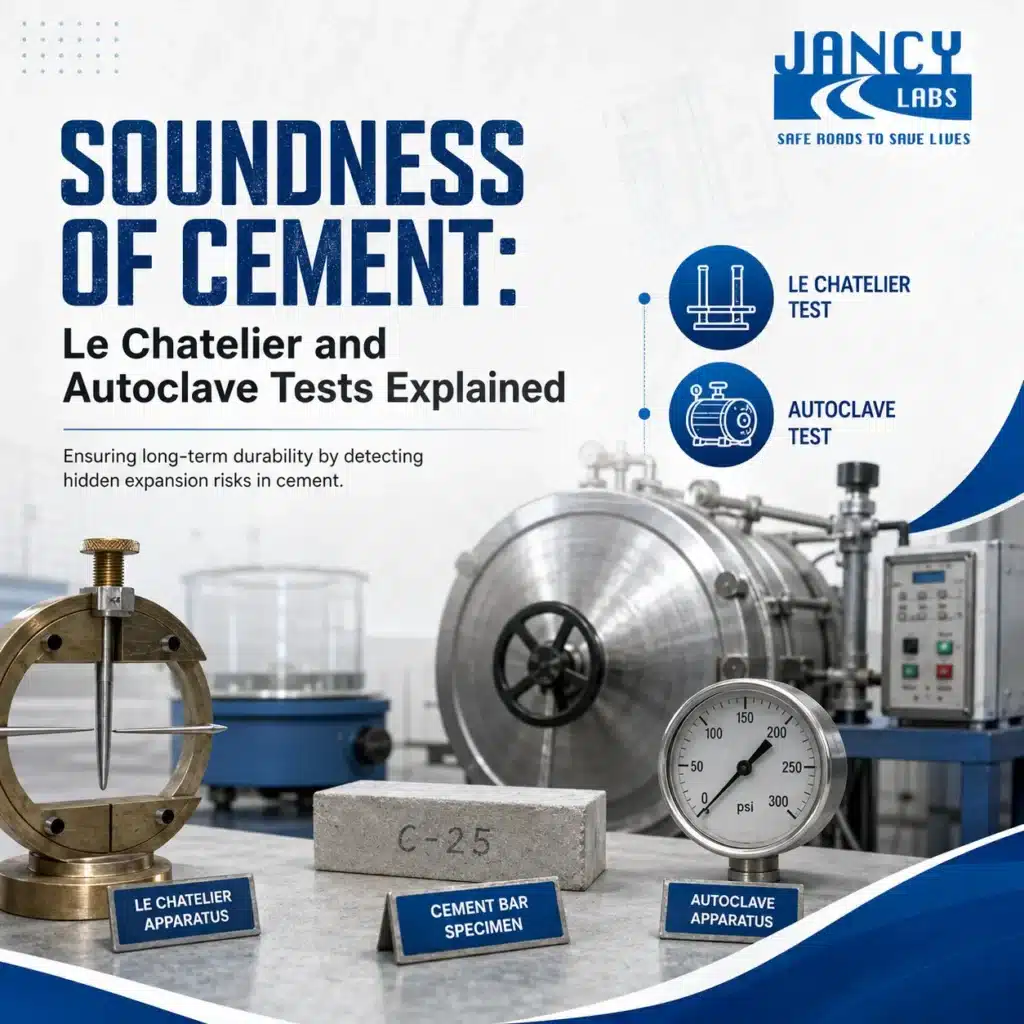
Cement that sets and hardens normally can still fail years later if it lacks soundness of cement. Unsound cement quietly expands after hardening. This cracks concrete from within, long after anyone can trace the problem back to the original bag. Two tests catch this before it happens: Le Chatelier and autoclave. Here is how each works, and when you need one instead of the other.
Key takeaways
- Soundness of cement, in short, describes its resistance to volume expansion after setting, tested under IS 4031 Part 3.
- The Le Chatelier method detects expansion from free lime; it is quick and needs simple apparatus.
- The autoclave method detects both free lime and free magnesia, using high-pressure steam over several hours.
- Cement with magnesia content above 3% specifically requires the autoclave test, not Le Chatelier alone.
- Unsound cement causes delayed expansion cracking, a defect that strength testing alone will never catch.
What soundness of cement actually means
Soundness refers to a cement paste’s ability to hold its volume after setting, without cracking or expanding. Free (unhydrated) lime and free magnesia are the main culprits, both reacting slowly after the concrete has hardened. This delayed reaction is what makes unsoundness dangerous: strength tests taken soon after casting look normal, while the expansion problem only shows up months or years later.
The Le Chatelier method
The soundness test of cement by le chatelier method uses a small brass mould split along one side, with two indicator needles projecting from the split edges. Technicians pack cement paste into the mould, then measure the gap between the needle tips before and after a fixed boiling period. Expansion of the paste widens that gap. The difference is then reported directly as the expansion in millimetres, giving a fast reading of cement soundness.
- Apparatus: the Le Chatelier mould, a glass water bath, and a measuring scale.
- Duration: roughly 30 minutes of boiling after an initial curing period.
- Limit: expansion should not exceed 10 mm for ordinary Portland cement.
The autoclave method
Where magnesia content runs above 3%, Le Chatelier alone cannot detect it reliably. The autoclave test for soundness of cement becomes necessary instead. Technicians place a hardened cement bar inside a high-pressure steam autoclave, then measure its length before and after exposure to saturated steam at roughly 216°C. The percentage change in length is reported as the autoclave expansion. This method, unlike Le Chatelier, is sensitive to both free lime and free magnesia. Internationally, ASTM International C151 covers the same autoclave principle, though the exact temperature, pressure, and acceptance limits differ slightly from IS 4031 Part 3.
- Apparatus: a calibrated autoclave, length comparator, and cement bar specimens.
- Duration: several hours, including controlled heating and cooling cycles.
- Limit: expansion should not exceed 0.8% for most cement types.
Comparing the two methods
Both methods measure expansion, but they differ in what they catch and how long they take:
Parameter | Le Chatelier method | Autoclave method |
What it detects | Free lime expansion | Free lime and free magnesia |
Apparatus | Le Chatelier mould, water bath | Autoclave, high-pressure steam |
Test duration | Roughly 30 minutes boiling | Several hours under pressure |
Acceptance limit | Expansion not exceeding 10 mm | Expansion not exceeding 0.8% |
Typical use | Routine quality control | Cement with magnesia above 3% |
Most routine quality checks rely on Le Chatelier alone, since it is faster and needs simpler equipment. The autoclave test is reserved for cement where magnesia content is a genuine concern, or where a specification explicitly requires it.
Soundness of cement apparatus, in either method
Both a cement soundness test apparatus setup and a soundness test of cement apparatus setup refer to the same underlying equipment: whichever method your specification calls for. Calibration matters more than most labs assume, since a poorly calibrated autoclave or a warped Le Chatelier mould produces a result that reflects apparatus error, not actual cement behaviour.
Why unsoundness matters more than a strength number
A cement can pass every compressive strength check and still be unsound, because the expansion problem develops over a completely different timeline than strength gain. This is why soundness testing exists as a separate, mandatory check under IS 4031, not an optional extra. Where concrete has already shown delayed cracking with no other obvious cause, our cement testing lab runs soundness testing alongside concrete cube testing to separate a cement quality issue from a mix or curing problem.
When soundness and strength results disagree
Occasionally a cement passes soundness testing but underperforms on strength, or the reverse, since the two properties test different chemistry entirely. Where results conflict, our team can help interpret the combination. Both methods follow the Bureau of Indian Standards IS 4031 (Part 3):1988 text, updated by Amendment No. 2 of 2013.
When to book a soundness test
A quick checklist for what to send when requesting this test:
- The cement type and grade, since acceptance limits vary between OPC, PPC, and other blends.
- Whether magnesia content is already known, which helps decide if autoclave testing is needed upfront.
- The project context, especially for mass concrete pours where delayed expansion risk is highest.
None of this needs to be exact upfront — our team confirms the method once we know your cement type.
Frequently Asked Questions
Which method is faster, Le Chatelier or autoclave?
Le Chatelier is significantly faster, needing roughly 30 minutes of boiling. The autoclave method takes several hours due to controlled heating and cooling cycles.
Does every cement batch need an autoclave test?
No. Autoclave testing is specifically required when magnesia content exceeds 3%, or when a project specification calls for it explicitly. Otherwise, Le Chatelier alone is standard practice.
Can unsound cement still achieve normal compressive strength?
Yes. Strength and soundness are independent properties, which is why soundness testing exists as its own mandatory check rather than being inferred from a strength result.
What causes cement to fail a soundness test?
Excess free lime or free magnesia in the clinker are the usual causes, both of which continue reacting slowly after the cement has set, producing delayed expansion.
Get Your Cement Tested at Jancy Labs
Jancy Labs Private Limited is an accredited civil material testing laboratory (ISO/IEC 17025:2017, Certificate No. TC-12176) in Madurai, Tamil Nadu. We collect samples across Tamil Nadu and accept courier samples from anywhere in India.
Or call +91 86800 49004 · jancylabsmdu@gmail.com · Request a quote
4.8★ · 100+ Google reviews · Mon–Sat, 10:00–18:00