
IS 1786 Explained: TMT Bar Requirements Every Site Must Check
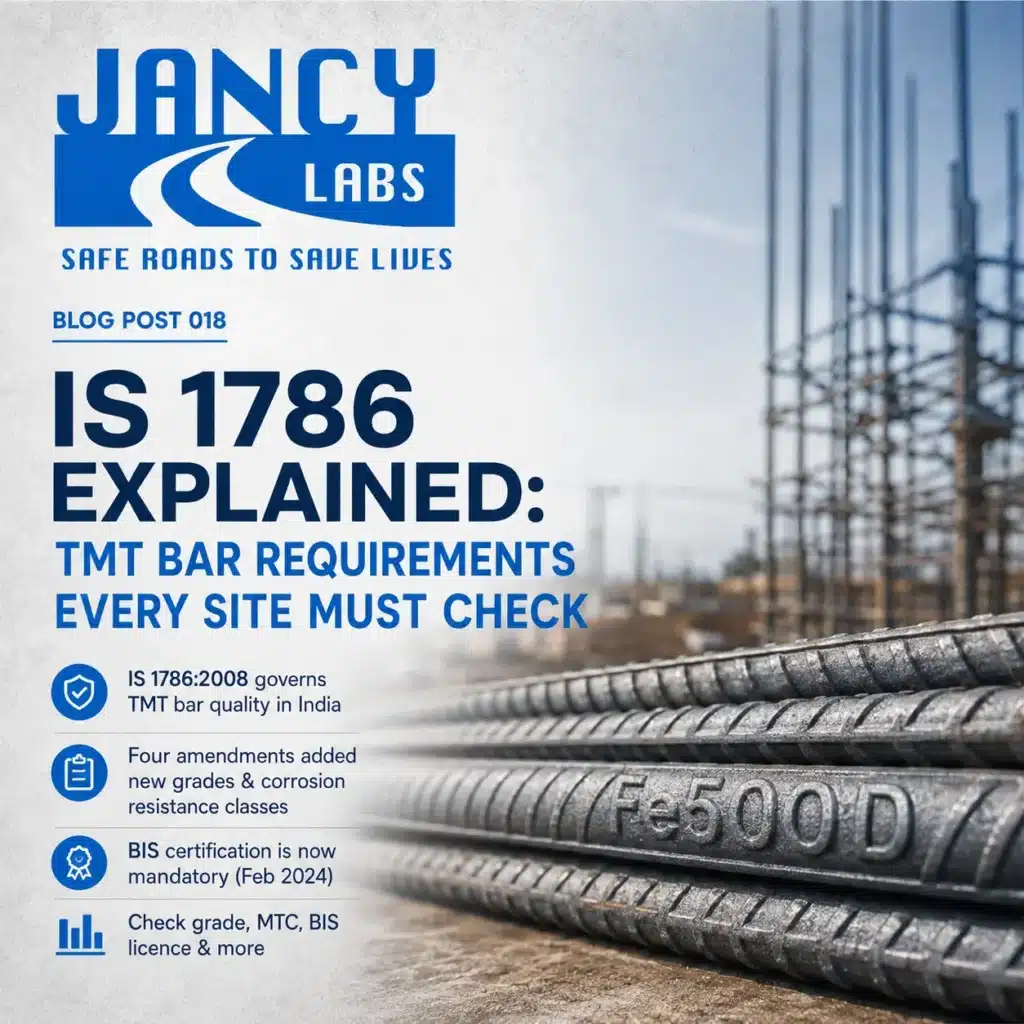
Every TMT bar on a site is supposed to comply with is 1786. Fewer sites actually verify that beyond a stamped grade name. This code covers far more than grade strength: chemical composition, ductility, and, as of 2024, a certification requirement most contractors have not caught up with. Here is what to check. Here is what most guides leave out.
Key takeaways
- IS 1786:2008 governs TMT bar grades, chemical composition, and mechanical properties for reinforcement steel in India.
- The original 2008 code has since gained four amendments, adding grades and a corrosion-resistance classification.
- BIS certification is now legally mandatory for TMT bars under a 2024 Quality Control Order, not just a quality preference.
- Instead, a grade stamp alone does not prove compliance; the mill test certificate and BIS licence number matter just as much.
- Notably, Fe500D and Fe550D exist specifically for higher ductility, not higher strength, over their non-D counterparts.
What IS 1786 actually specifies
IS 1786:2008 is published by the Bureau of Indian Standards. Its full title is High Strength Deformed Steel Bars and Wires for Concrete Reinforcement. It covers chemical composition, mechanical properties, rib geometry, and dimensional tolerance for every TMT bar sold in India. A mill test certificate references this exact specification. A site engineer, in turn, should check bars against it directly, not just the grade printed on the bundle.
TMT grades under IS 1786
The code defines minimum mechanical properties by grade:
Grade | Min. yield strength (N/mm²) | Min. UTS (N/mm²) | Min. elongation (%) |
Fe 415 | 415 | 485 | 14.5 |
Fe 500 | 500 | 545 | 12.0 |
Fe 500D | 500 | 565 | 16.0 |
Fe 550 | 550 | 585 | 8.0 |
Fe 550D | 550 | 600 | 14.5 |
Fe 600 | 600 | 660 | 10.0 |
Fe600 does not appear in the original 2008 text. Amendment No. 4 introduced it instead, and most older references and even some mill certificates still omit it.
The four amendments most guides skip
- The first amendment, in 2012, added Fe415S and Fe500S grades, bringing the total to nine.
- Amendment 2 (2013) — additionally, refined chemical composition and testing clauses.
- A third update in 2017 introduced corrosion-resistance classification for coastal and aggressive-exposure applications.
- Amendment 4 — finally, added the Fe600 grade for specialised high-strength applications such as precast prestressed elements.
A mill test certificate referencing only “IS 1786:2008” without grade and amendment context is not necessarily wrong. It is, however, incomplete for verifying anything beyond the original seven grades. Unsure which amendment applies to your project? Our
team can walk through the current grade list first.
The 2024 rule most sites have not caught up with
Since 5 February 2024, the Steel and Steel Products (Quality Control) Order makes BIS certification legally mandatory for TMT bars. This applies to bars manufactured, sold, imported, or stocked in India. It is a regulatory requirement, separate from IS 1786 itself. It means a valid BIS licence number, often written as a CM/L number, is now something every site should verify alongside the grade stamp. A supplier who cannot produce this is not simply cutting a corner on quality. They may be selling bars that are not legally permitted for sale.
What to actually check on site
- Grade stamp. First, confirm it matches what was ordered — Fe500D is not the same bar as Fe500.
- Mill test certificate. Cross-check yield strength, UTS, and elongation against the IS 1786 minimums for the stated grade.
- BIS licence number. Verify the CM/L number is valid and current, given the 2024 mandatory certification requirement.
- Rib pattern and diameter. Confirm visually against the ordered specification, since substitution errors, in practice, happen at the supply chain level.
- Independent verification. Finally, for critical structural work, an independent tensile test confirms the bars in hand match the paperwork.
Why independent testing still matters
A mill test certificate and a valid BIS number both describe the batch, not necessarily the specific bars that arrived on your site. Our steel testing lab runs tensile, bend, and rebend testing against IS 1786 grade limits independently of what the supplier’s paperwork claims. Where the concrete surrounding the reinforcement is also in question, pairing steel verification with concrete cube testing gives a fuller picture of what was actually built, not just what was ordered.
International equivalents
Outside India, ASTM International A615 and A706 cover deformed reinforcement bars, with A706 specifically addressing weldability and ductility requirements broadly comparable to the IS 1786 D-grade concept, though the exact numeric thresholds differ between the two systems.
Reading a mill test certificate against IS 1786
A genuine mill test certificate lists the heat or cast number, the exact grade ordered, and the tested values for yield strength, UTS, elongation, and chemical composition. Cross-check each figure against the IS 1786 minimum for that specific grade, not a rounded approximation. A certificate showing values suspiciously close to the bare minimum on every parameter is worth a second look, since genuine production runs rarely land exactly on the limit across every property simultaneously.
Frequently Asked Questions
Is BIS certification mandatory for all TMT bars now?
Yes, since 5 February 2024, under the Steel and Steel Products (Quality Control) Order. This applies to bars manufactured, sold, imported, or stocked in India.
What is the difference between Fe500 and Fe500D?
Both share the same minimum yield strength, but Fe500D requires higher minimum elongation and a higher UTS-to-yield ratio, making it more ductile and better suited to seismic-zone construction.
When was the Fe600 grade added to IS 1786?
It was introduced through Amendment No. 4 to IS 1786:2008, not the original 2008 text, which is why some older references and certificates do not list it.
Does a grade stamp alone prove IS 1786 compliance?
No. A stamp shows the claimed grade, but only a mill test certificate cross-checked against IS 1786 limits, plus a valid BIS licence number, confirms genuine compliance.
Get Your TMT Steel Tested at Jancy Labs
Jancy Labs Private Limited is an accredited civil material testing laboratory (ISO/IEC 17025:2017, Certificate No. TC-12176) in Madurai, Tamil Nadu. We collect samples across Tamil Nadu and accept courier samples from anywhere in India.
Or call +91 86800 49004 · jancylabsmdu@gmail.com · Request a quote
4.8★ · 100+ Google reviews · Mon–Sat, 10:00–18:00