
Concrete Cube Test: Procedure, IS 516 and How to Read the Results
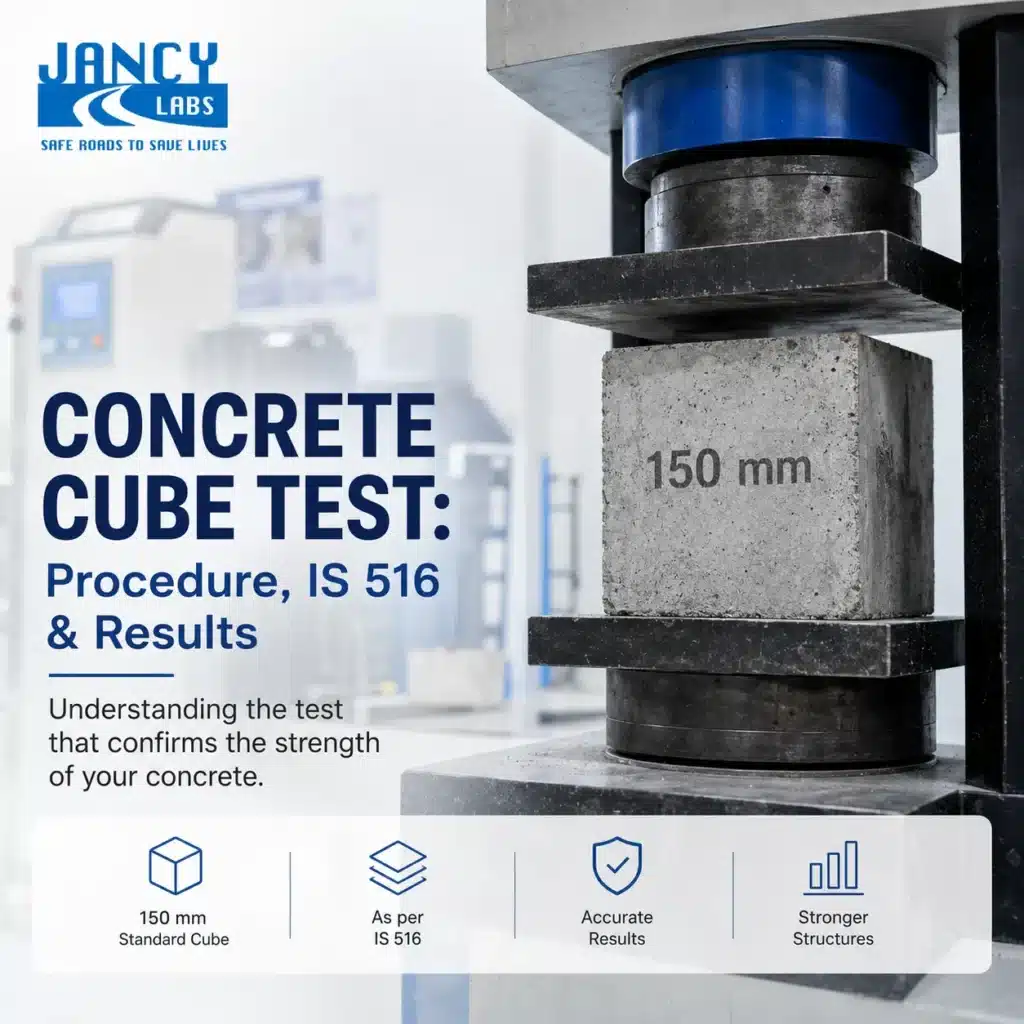
The concrete cube test is the single piece of evidence that decides whether the concrete you poured is the concrete you paid for. Every other check — slump, workability, mix design — happens before or during the pour. This one happens after, and it is the only result a structural engineer, an auditor, or a court will accept as proof of strength.
Key takeaways
- A concrete cube test measures compressive strength on 150 mm cubes cast from fresh concrete, tested at 7 and 28 days.
- IS 516 governs the method; IS 456 governs whether the result passes.
- Strength = failure load ÷ cross-sectional area (22,500 mm² for a 150 mm cube).
- 7-day strength is typically 65–70% of the 28-day value — an early warning, not a verdict.
- A single low cube does not condemn a pour. IS 456 judges you on a group of four consecutive results.
What is a concrete cube test?
A concrete cube test is a destructive compressive strength test performed on hardened concrete samples cast from the same batch that went into your structure. The method is published by the Bureau of Indian Standards as IS 516.
Cubes are cast on site, cured under controlled conditions, and crushed in a compression testing machine until they fail. The load at failure, divided by the area of the face, gives the compressive strength of concrete cube specimens in N/mm² (MPa). Compressive strength is the number every structural calculation is built on. If the cube says M25 concrete reached only 18 N/mm², the assumptions behind your column design no longer hold.
Cube size, moulds and sampling
The standard cube size of concrete specimens in India is 150 mm × 150 mm × 150 mm, as laid down in the BIS standards catalogue. IS 516 permits 100 mm cubes when the nominal maximum aggregate size does not exceed 20 mm. Smaller cubes tend to record marginally higher strengths, so never mix cube sizes within a single project data set.
The concrete cube mould must be cast iron or steel, rigid enough not to deform under compaction, and lightly oiled before filling. A warped mould produces a specimen that is not truly cubical, loads unevenly, and fails early — a result that blames the concrete for the mould defect. Sampling follows IS 1199: take concrete from the point of placing, not the mixer chute.
Concrete cube test procedure as per IS 516
The concrete cube test procedure is unforgiving — most bad results trace back to a shortcut taken here.
- Fill in three layers. Each layer roughly 50 mm deep for a 150 mm mould.
- Compact each layer. 35 strokes per layer with a 16 mm diameter, 600 mm long bullet-nosed tamping rod (25 strokes for a 100 mm cube). A vibrating table may be used instead.
- Finish the surface. Strike off level with a trowel.
- Store for 24 hours. Cover with a damp cloth and leave undisturbed at 27 ± 2 °C.
- Demould and cure. Mark the cubes, then immerse in clean water at 27 ± 2 °C until the test age.
- Wipe the bearing surfaces, centre the cube in the machine, and apply load at 14 N/mm² per minute until failure.
Load the cube on the two faces that touched the mould walls — never the rough, trowelled top face.
Concrete cube test formula and calculation
The concrete cube test formula is straightforward:
Compressive strength (N/mm²) = Failure load (N) ÷ Cross-sectional area (mm²)
A 150 mm cube has a face area of 22,500 mm²; a 100 mm cube gives 10,000 mm². So a 150 mm cube failing at 562,500 N returns 25 N/mm².
Each sample is three cubes. Average them — that is your test result. If any cube varies from the average by more than ±15%, discard the result as unreliable.
How to read the results
IS 456 Clause 16, the plain and reinforced concrete code issued by the Bureau of Indian Standards, sets two conditions, and both must be satisfied. The mean of four consecutive non-overlapping test results must reach at least fck + 4 N/mm² (for M20 and above), and no individual result may fall below fck − 4 N/mm².
Grade | fck (28-day, N/mm²) | Expected 7-day | Min. individual result | Min. mean of 4 |
M20 | 20 | 13–14 | 16 | 24 |
M25 | 25 | 16–18 | 21 | 29 |
M30 | 30 | 20–21 | 26 | 34 |
M35 | 35 | 23–25 | 31 | 39 |
M40 | 40 | 26–28 | 36 | 44 |
So a single alarming cube is not a demolition order. A low result inside a compliant group of four can still pass — and a strong-averaging group can still fail if one cube drops below the individual floor.
Why concrete cube strength comes back low
When concrete cube strength disappoints, the concrete is often innocent. The usual culprits: cubes cured in stagnant site water instead of a temperature-controlled tank; extra water added on site for workability; poor compaction leaving voids; a worn mould; or cubes left in the sun for 24 hours.
Rule out the sampling and curing chain before condemning the mix. If the concrete is genuinely suspect, core cutting and non-destructive testing assess the structure as built. For highway and structural works, the Ministry of Road Transport and Highways specifications set out the acceptance route. If the mix itself is in doubt, a concrete mix design review is the next step.
Enquire Now