
Steel Testing in Tamil Nadu — Is Your Building Safe?
By Jancy Labs | Building Materials Testing Experts, Madurai Published: May 2026 | Last Updated: May 2026
On This Page
- Tamil Nadu is Building Fast — But Are We Building Safe?
- South India is Not as Safe from Earthquakes as People Assume
- Steel is the Skeleton — If It Fails, Everything Fails
- What Does Steel Testing Actually Check?
- The IS Codes Every Tamil Nadu Builder Must Know
- The Supplier Gave a Certificate — Is That Enough?
- Frequently Asked Questions
Tamil Nadu is Building Fast — But Are We Building Safe?
Drive through Chennai’s OMR corridor, Coimbatore’s TIDEL Park belt, or Madurai’s expanding residential zones, and you’ll spot one thing everywhere: construction cranes. Tamil Nadu is in the middle of a building boom. New apartments, commercial towers, flyovers, and metro stations are rising faster than ever.
However, here is a question most homebuyers — and even some contractors — never think to ask: Has the steel inside that building actually been tested?
Not just certified on paper. Actually tested — by an independent laboratory — before it went into the concrete. If the answer is no, the consequences could be far more serious than most people expect.
Jancy Labs provides independent steel testing services as per IS 1786 and IS 2062 for construction projects across Tamil Nadu. See our full steel testing lab services | Get your steel tested today
South India is Not as Safe from Earthquakes as People Assume
There is a common belief in Tamil Nadu and across South India that earthquakes are a “North Indian problem.” This is dangerously incorrect.
Tamil Nadu falls under Seismic Zones II and III under the Bureau of Indian Standards classification — representing low to moderate seismic risk. A large portion of the state sits under the moderate-risk Zone III, which carries earthquake potential up to magnitude 6.9.
Critically, Chennai was reclassified from Zone II into Zone III by BIS after seismic studies identified the city’s increasing exposure. (Source: Natural Hazards and Earth System Sciences — Chennai Microzonation Study) Moreover, India records on average 277 earthquakes of magnitude 4 or higher every year, and at least 20 earthquakes above magnitude 7 have occurred since 1900. (Source: VolcanoDiscovery — India Earthquake Statistics)
The Policy Gap That Makes Testing More Critical
The 2004 Indian Ocean tsunami — which devastated Tamil Nadu’s coastline from Nagapattinam to Kanyakumari — was triggered by a magnitude 9.1 seismic event. Southern India is not immune. It never was.
Furthermore, India’s updated earthquake design code (IS 1893:2025), which mandated stronger steel and foundations, was withdrawn in March 2026 following pressure from the construction industry citing cost concerns. As a result, builders now operate under the 2016 standard (IS 1893:2016) — even as scientific understanding of seismic risk has advanced considerably. (Source: Drishti IAS — Rollback of Seismic Code 2025) (Source: ETV Bharat — A Bold Policy Reversed)
Consequently, when policy steps back, independent testing must step forward.
Steel is the Skeleton — If It Fails, Everything Fails
In reinforced concrete construction — which covers nearly every apartment, villa, commercial building, and bridge across Tamil Nadu, Kerala, Karnataka, and Andhra Pradesh — TMT (Thermo-Mechanically Treated) steel bars form the structural backbone. Concrete handles compression. Steel handles tension. Together, they keep a building standing under load, wind, vibration, and seismic stress.
However, not all steel sold in the market meets the IS standards it claims to meet.
For contractors and project managers across South India — especially in Andhra Pradesh, Telangana, and Karnataka — substandard steel is a genuine risk. Genuine high-grade bars such as Fe 500D or Fe 550D should carry consistent grade markings, a BIS logo, and a Mill Test Certificate for every batch. When these are missing or inconsistent, it is a clear warning sign. (Source: SteelOnCall — How to Identify Low Quality Steel)
Real Consequences in Tamil Nadu
The consequences of ignoring this warning are not theoretical. In September 2025, nine workers were killed when a steel arch collapsed at the Ennore Thermal Power construction site in Chennai. The workers fell from nearly 45 metres as a large steel framework crashed down. (Source: India.com — Ennore Collapse Report)
Similarly, the 2014 Moulivakkam building collapse in Chennai killed 61 people and triggered a landmark government investigation. The CMDA subsequently began scrutinising construction violations of all new multi-storey buildings in and around Chennai. (Source: Wikipedia — 2014 Chennai Building Collapse)
Yet more than a decade later, independent material testing at the laboratory level remains inconsistently practised across the state.
What Does Steel Testing Actually Check?
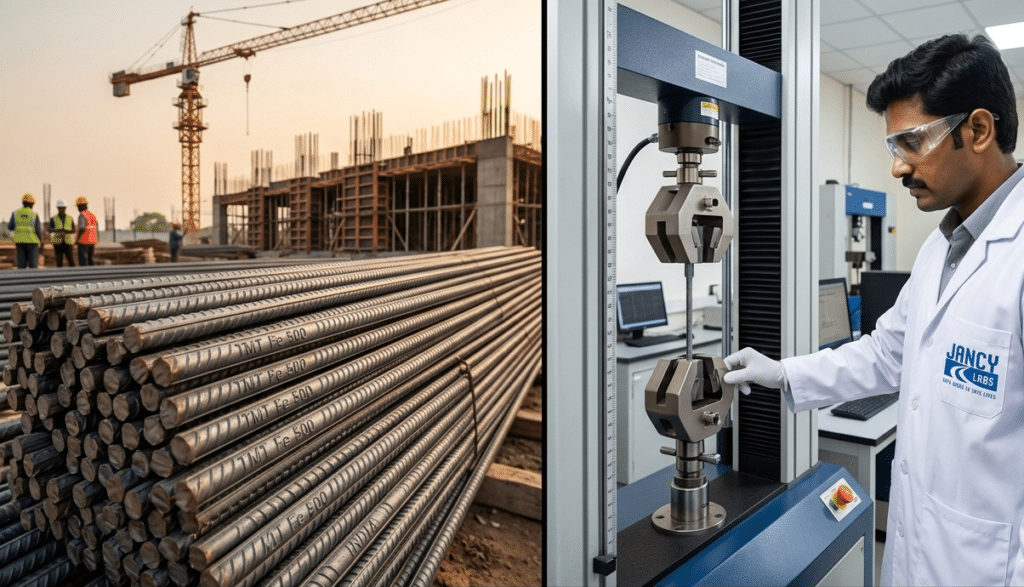
When Jancy Labs tests a batch of TMT bars or structural steel, we run a comprehensive battery of tests as specified under IS 1786 (for TMT bars) and relevant BIS standards. Each test directly determines whether your structure will perform safely under real-world conditions.
1 — Tensile Strength Test
A universal testing machine measures how much pulling force the steel withstands before it breaks. Specifically, the machine divides the cross-sectional area of the bar by the applied tensile load to arrive at maximum tensile strength. For Fe 500 grade bars — the most widely specified grade in Tamil Nadu residential construction — the minimum tensile strength must be 545 MPa.
2 — Yield Strength Test
Before steel breaks, it first yields — meaning it begins to permanently deform. Yield strength marks the point where this starts happening. A bar with low yield strength will flex and deform under everyday structural loads, consequently leading to cracked beams, sagging slabs, and structural failure. For Fe 500 bars, yield strength must be at least 500 MPa as per IS 1786.
3 — Elongation & Ductility Test
Ductility is a steel bar’s ability to bend without snapping — the single most important property in earthquake-resistant design. A ductile bar absorbs seismic energy by deforming; a brittle bar snaps instantly. Therefore, Fe 500 is the most ideal grade for civil construction, as specified by ISI standards, offering the right balance of strength and ductility for seismic zones.
4 — Bend and Rebend Test
During this test, the bar bends to a specified angle and then straightens again. If it cracks or fractures in the process, the bar fails — and it should never enter a building. This test specifically simulates what happens to steel at construction joints, column bases, and beam connections where workers bend bars on-site.
5 — Chemical Composition Analysis
Excess sulphur, phosphorus, or carbon content makes steel brittle and prone to weld cracking. For buyers in Andhra Pradesh, Telangana, and Karnataka — where rapid urban development continues — even minor chemical inconsistencies can translate into lakhs of rupees in remediation costs. Laboratory spectrometry identifies these issues before the steel enters a slab.
The IS Codes Every Tamil Nadu Builder Must Know
If you are a contractor, developer, or structural engineer operating in Tamil Nadu, these BIS standards govern steel testing for your projects:
| Standard | What It Covers | Reference |
|---|---|---|
| IS 1786:2008 | TMT bars — Fe 415, Fe 500, Fe 500D, Fe 550D | bis.gov.in |
| IS 2062:2011 | Hot-rolled structural steel — bridges, industrial structures | bis.gov.in |
| IS 432 | Mild steel bars for reinforced concrete | bis.gov.in |
| IS 1893:2016 | Earthquake-resistant design (currently enforceable standard) | archive.org |
(Source: BIS — Indian Standards on Earthquake Engineering)
Additionally, third-party laboratory testing against these standards is not a luxury. For government contracts, CMDA-approved projects, and RERA-registered developments across Tamil Nadu, it is increasingly a compliance requirement. For independent homebuilders, moreover, it is the only reliable way to verify what you are actually paying for.
- BUILDINGS: CPWD, TNPWD, CMDA, DTCP, TNHB, Smart Cities, ULBs accept lab-certified steel test reports
- ENERGY: TANGEDCO, NTPC, BHEL specify third-party material testing for structural steel on project sites
- WATER: TWAD, CMWSSB, WRD require IS-compliant steel reports for RCC water structures
Skipping independent steel testing, therefore, risks project hold-ups, failed inspections, and — most seriously — structural failure during the building’s service life. Explore our steel testing lab in Tamil Nadu
The Supplier Gave a Certificate — Is That Enough?"
This is the most common response Jancy Labs hears from clients before they run into problems.
Mill Test Certificates (MTCs) from manufacturers certify a sample from the manufacturing batch — not the specific consignment delivered to your site. Steel can be mislabelled, mixed with lower-grade material during transport, or stored improperly, causing surface and structural degradation.
Furthermore, an MTC cannot tell you whether the bars sitting on your site today match the certificate in your hand. Consequently, independent testing by a lab like Jancy Labs verifies the actual bars going into your building’s columns and beams — not a factory sample from weeks earlier. This is the only way to be certain.
Frequently Asked Questions
1. Does Tamil Nadu have earthquake risk, even though it’s in South India?
Yes — Tamil Nadu falls under Seismic Zones II and III as classified by the Bureau of Indian Standards. Chennai was specifically reclassified from Zone II to Zone III following seismic hazard studies that identified increasing exposure. Therefore, structural steel quality is critically important for all construction projects in the state, not just in high-risk northern zones.
2. Is a Mill Test Certificate from the steel supplier enough?
No — an MTC certifies a factory sample, not the specific consignment on your site. Consequently, steel can arrive mislabelled or mixed with lower-grade material. Jancy Labs tests the actual bars going into your structure, providing independent verification that no supplier certificate can substitute.
3. Which IS standards apply to steel testing in Tamil Nadu?
The primary standards are IS 1786:2008 for TMT bars, IS 2062:2011 for hot-rolled structural steel, IS 432 for mild steel bars, and IS 1893:2016 for earthquake-resistant design. Jancy Labs conducts physical and mechanical tests strictly per these BIS standards — for example, tensile, yield, elongation, and bend tests all follow IS 1786 procedures.
4. Are Jancy Labs steel test reports accepted for CMDA and government projects?
Yes. Additionally, reports from Jancy Labs are structured for submission to approving authorities including CMDA, TNPWD, TNHB, and RERA-registered project documentation. Each report cites the relevant IS standard, lists measured values against acceptance criteria, and carries sign-off from a qualified engineer.
5. How much sample do I need for a steel test at Jancy Labs?
For IS 1786 TMT bar testing, send a minimum of 3 bar samples per grade per diameter, each at least 600 mm in length. For IS 2062 structural steel, send plate or section offcuts of at least 300 mm. Furthermore, if you are unsure about sample quantities for your specific project, WhatsApp our team at +91-8680049004 before dispatch — we will guide you directly.
Get Your Steel Tested Before It Becomes Part of Your Building Forever
Your steel testing in Tamil Nadu project approval should not be an afterthought. Substandard steel in your columns and beams today means failed inspections, remediation costs, and structural risk tomorrow.
 +91-8680049004 / +91-9994421275
 WhatsApp: +91-8680049004

 No.6, Ganesh Nagar 3rd Street, Surya Nagar, Alagar Kovil Main Road, K.Pudur, Madurai — 625007
 Monday to Saturday | 10:00 AM – 6:00 PM
Request a Test Quote Visit our steel testing lab in Tamil Nadu