
Binder Course : Dense Bituminous Macadam
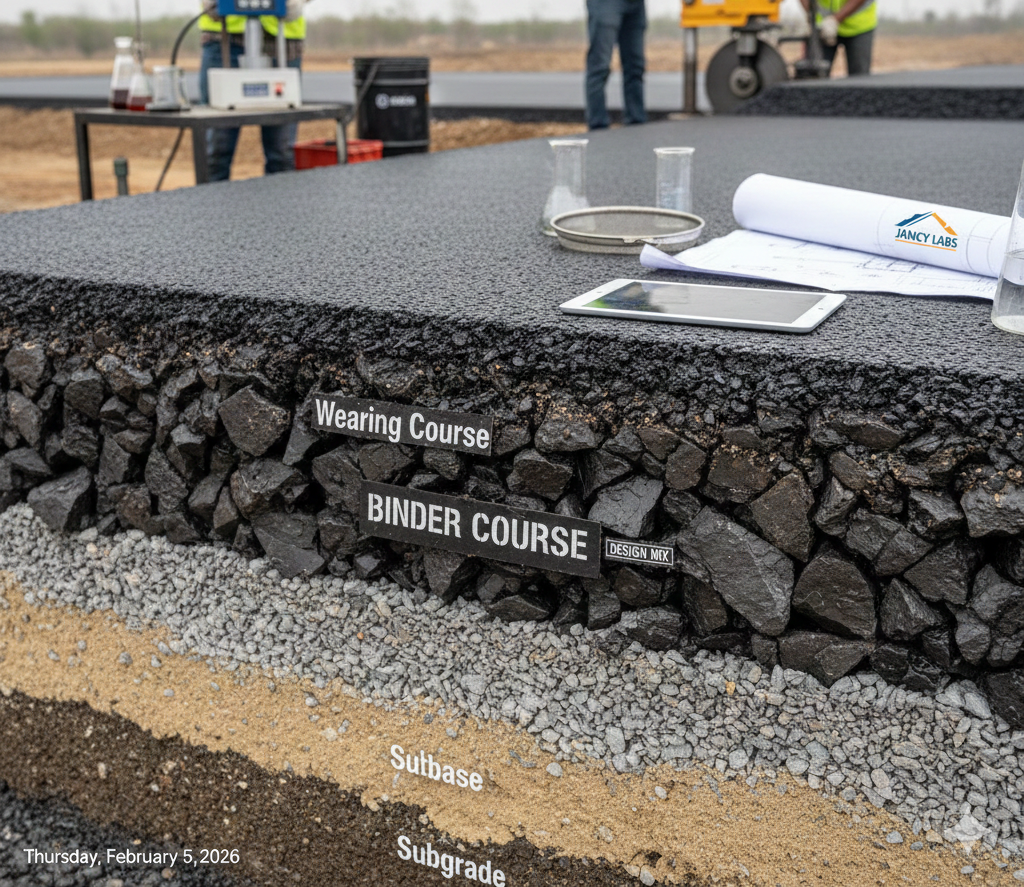
What is a Binder Course in Pavement Construction?
A binder course is an intermediate layer of asphaltic material. It is typically thicker than the wearing course above it. This layer uses larger aggregates to provide better stability. Consequently, it acts as the backbone of the flexible pavement. The Binder Course Design Mix must be precise to work well. It bridges the gap between the base and the surface layers.
Composition of the Binder Course Design Mix
The Binder Course Design Mix consists of bitumen and aggregates. Usually, engineers use 19mm or 25mm nominal maximum aggregate sizes. These larger stones provide high internal friction. In addition, the mix includes fine aggregates and mineral fillers. Each component plays a vital role in the final performance. Proper grading of these materials is essential for strength. Therefore, Jancy Labs focuses heavily on accurate material selection.
The Purpose of the DBM-BC
The primary purpose is to distribute traffic loads effectively. It transfers the weight from the surface to the base. Moreover, it provides a level surface for the wearing course. Without a proper binder course, the road would fail quickly. It also helps in preventing cracks from reaching the bottom. Thus, it adds significant longevity to the road structure.
Why is Binder Course Important for Roads?
Understanding the importance of this layer is crucial for engineers. First, it provides the necessary thickness for structural capacity. Second, it resists permanent deformation like rutting. Because it contains larger stones, it handles heavy loads easily. Furthermore, it creates a waterproof barrier for the lower layers. This protection prevents water damage to the granular base.
Enhancing Pavement Durability
Durability is the hallmark of a well-designed road. A robust Binder Course Design Mix ensures the road stays intact. It resists the shearing forces exerted by heavy vehicles. Additionally, it provides a stable foundation for the final asphalt layer. If the binder course is weak, the surface will crack. Therefore, investing in quality design pays off in the long run.
Load Distribution and Structural Integrity
Traffic loads can be incredibly heavy and frequent. The binder course absorbs these stresses efficiently. It spreads the pressure over a wider area below. As a result, the subgrade remains protected from excessive strain. This structural balance is the key to road longevity. Properly designed mixes prevent premature pavement fatigue.
Designing the Perfect Binder Course Design Mix
Designing a Binder Course Design Mix requires technical expertise. Engineers usually follow the Marshall Method or Superpave specifications. First, we determine the physical properties of the aggregates. We test for impact value, abrasion, and water absorption. Next, we select the appropriate grade of bitumen. The binder content must be optimized for maximum stability.
Selecting Aggregates
Aggregates form the skeletal framework of the mix. We prefer crushed stones with angular shapes for better interlocking. These shapes increase the shear strength of the layer. Moreover, we ensure the aggregates are clean and durable. Dust or clay can weaken the bond with bitumen. Hence, rigorous aggregate testing is a non-negotiable step.
Bitumen Selection
Bitumen acts as the glue for the stone particles. The choice of bitumen grade depends on the climate. For hotter regions, we use harder grades of bitumen. In contrast, colder areas require more flexible binders. The Binder Course Design Mix must account for these temperature shifts. Jancy Labs provides precise bitumen extraction and penetration tests.
Determining Optimum Binder Content
Quality control is the most critical part of construction. We perform several checks during and after the mix design. First, we verify the gradation of the incoming aggregates. Then, we check the temperature of the mix at the plant. Continuous monitoring ensures the Binder Course Design Mix stays consistent. Mistakes at this stage can lead to costly road repairs.
Sieve Analysis for Binder Course Design Mix
Sieve analysis confirms the particle size distribution of aggregates. We compare the results against standard specifications. If the grading is off, the mix will lack stability. Therefore, we conduct sieve tests for every batch produced. This ensures the Binder Course Design Mix remains within the limits. Consistency is the key to a smooth paving process.
Marshall Stability and Flow Tests
These tests measure the strength of the asphalt mix. Stability refers to the maximum load the specimen carries. Flow represents the deformation that occurs during loading. A high stability value indicates a strong Binder Course Design Mix. Meanwhile, the flow value ensures the mix isn’t too stiff. Jancy Labs uses calibrated equipment for these vital measurements.
Checking the Bitumen Content and Voids
Air voids are essential for allowing small thermal expansions. However, excessive voids lead to water penetration and stripping. We measure the Voids in Mineral Aggregate (VMA) carefully. We also verify the actual bitumen content via extraction tests. This confirms that the Binder Course Design Mix meets the design. Proper void management prevents long-term oxidation of the bitumen.
Field Quality Checks During Laying
Testing does not stop at the laboratory. We perform rigorous checks on the construction site. First, we monitor the temperature of the mix during laying. Cold mixes do not compact properly and fail early. Second, we verify the thickness of the laid layer. The Binder Course Design Mix must be spread evenly.
Compaction and Density Requirements
Compaction is the final step in achieving pavement strength. We use heavy rollers to remove excess air voids. We then measure the field density using core cutters. The field density must reach at least 98% of lab density. If compaction is poor, the Binder Course Design Mix fails. Thus, we supervise the rolling patterns very closely.
Surface Evenness and Leveling Checks
The binder course must provide a level profile. We use a three-meter straight edge to check for bumps. Any irregularities are corrected before the surface layer is applied. This ensures the final road surface is perfectly smooth. A level Binder Course Design Mix reduces the amount of surface asphalt. Consequently, it helps in maintaining the project budget.
How Jancy Labs Helps You with Binder Course Design Mix
Jancy Labs is a leader in civil engineering testing. We offer comprehensive solutions for your Binder Course Design Mix. Our team of experts understands international and local standards. We provide accurate data to help you build better roads. Our laboratory is equipped with state-of-the-art testing machinery.
How Jancy Labs Helps You with Binder Course Design Mix
Jancy Labs is a leader in civil engineering testing. We offer comprehensive solutions for your Binder Course Design Mix. Our team of experts understands international and local standards. We provide accurate data to help you build better roads. Our laboratory is equipped with state-of-the-art testing machinery.
- Expert Consultation for Mix Design
- Advanced Laboratory Testing Services
- On-Site Quality Assurance and Supervision
Why Choose Jancy Labs for Your Projects?
Choosing the right testing partner is a major decision. Jancy Labs stands out due to our commitment to accuracy. We prioritize transparency in all our testing procedures. Moreover, our certifications prove our high level of competence. We have years of experience in the Binder Course Design Mix field.
Contact Information
Registered Office & Laboratory Address
Jancy labs Pvt Ltd,
No.6,Ganesh Nagar 3rd street, Surya Nagar, Alagar kovil main road, K.Pudur, Madurai-625007
Phone Numbers :
+91-8680049004 , +91-9994421275
Email : jancylabsmdu@gmail.com
Working Hours :
Monday to Saturday : 10:00 AM – 6:00 PM
Leave Your Enquiry, We’ll Call You Back
We understand your time is valuable! Simply leave your details below, and our team will get back to you as soon as possible.