
Nominal Mix Is Outdated - Concrete Design Mix Saves Cost and Improves Quality
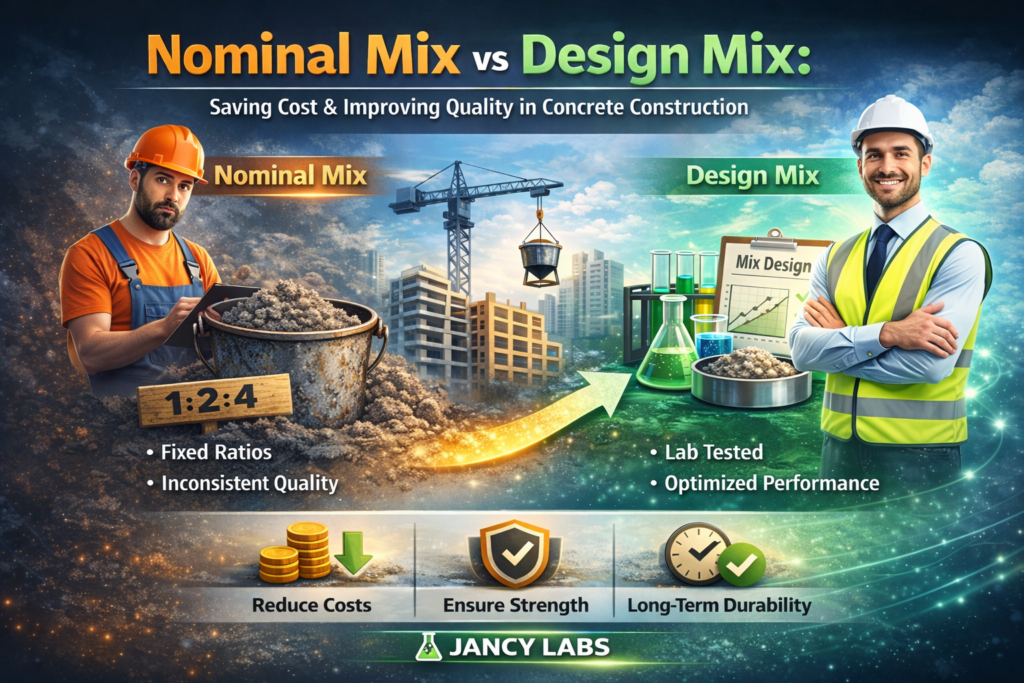
Concrete mix design plays a critical role in determining the strength, durability, and cost efficiency of any construction project. However, many projects still rely on outdated nominal mix practices. As construction demands become more complex, precision in concrete mix design becomes not just beneficial, but essential.
Moreover, rising material costs and stricter quality standards make it necessary to move away from assumptions and toward data-driven decisions. Therefore, understanding why concrete mix design matters can significantly impact both project performance and profitability.
What Is Concrete Mix Design?
Understanding Mix Design Fundamentals
Concrete mix design is the process of selecting the right proportions of cement, aggregates, water, and admixtures to achieve specific performance requirements. These requirements typically include strength, workability, durability, and economy.
Unlike traditional approaches, concrete mix design is based on laboratory trials and field conditions. As a result, it ensures consistency and reliability throughout the project lifecycle.
Mix Design vs Nominal Mix
Concrete mix design is often confused with nominal mix. However, they are fundamentally different in both approach and outcome.
Nominal mix uses fixed ratios without considering material properties. In contrast, concrete mix design adapts proportions based on actual test results, making it far more accurate and efficient.
Why We Should Not Use Nominal Mix in Today’s Construction
Limitations of Nominal Mix Concrete
Nominal mix concrete follows predefined ratios such as 1:2:4 or 1:1.5:3. While this method may seem simple, it ignores variability in materials. Additionally, aggregate grading, cement strength, and moisture content change from source to source. Consequently, nominal mix often results in inconsistent concrete quality.
Risks Associated With Nominal Mix
Nominal mix concrete frequently leads to over-cementing to achieve target strength. As a result, material costs increase unnecessarily. Moreover, excessive cement content can cause shrinkage, cracking, and long-term durability issues. Therefore, nominal mix is not suitable for modern structural demands.
Design Ensures Strength and Durability
Scientific Approach to Strength Achievement
Concrete mix design uses laboratory testing to determine the exact mix required to achieve characteristic strength. This approach reduces uncertainty and enhances structural safety.
Furthermore, it accounts for site conditions, exposure conditions, and curing methods. As a result, the final concrete performs as expected in real-world conditions.
Improved Durability Through Design Mix
Durability is just as important as strength. Concrete mix design controls water-cement ratio, which directly impacts permeability and resistance to aggressive environments. Therefore, structures designed with proper mix design last longer and require less maintenance over time.
How Concrete Mix Design Saves Cost Without Compromising Quality
Optimized Cement Content Reduces Cost
Cement is the most expensive component of concrete. Concrete mix design minimizes cement content while still achieving required strength. As a result, builders can save significant costs, especially in large-scale projects. This saving does not compromise quality, but instead improves efficiency.
Reduced Material Wastage and Rework
When concrete strength is predictable, there is less rejection and rework. Consequently, project timelines improve and indirect costs decrease. Thus, concrete mix design contributes to both direct and indirect cost savings.
How Labs Find the Perfect Concrete Mix Design
Role of Laboratory Testing in Mix Design
Concrete mix design begins with testing raw materials such as cement, fine aggregates, coarse aggregates, and water. Each material is evaluated for physical and chemical properties. Based on these results, trial mixes are prepared and tested for strength and workability. Therefore, the final mix is data-driven and reliable.
Trial Mixes and Statistical Analysis
Multiple trial mixes are conducted to achieve the desired characteristic strength with adequate margin. Statistical analysis helps account for variability. Hence, laboratory-designed concrete ensures consistency across batches and pours.
Why Third-Party Lab Testing Is a Must
Risks of Trusting RMC Design Blindly
Ready-mix concrete suppliers often provide mix designs optimized for production convenience rather than project-specific needs. Moreover, these designs may not account for site conditions or exposure requirements. Therefore, blindly trusting RMC mix designs can be risky.
Importance of Independent Verification
Third-party labs provide unbiased testing and verification. They ensure that the concrete supplied meets both strength and durability requirements. As a result, independent testing protects builders, consultants, and developers from quality failures.
Third-Party Concrete Testing Enhances Trust & Compliances
Compliance With IS Codes and Standards
Third-party labs ensure that concrete mix design complies with relevant IS codes and project specifications. This compliance is essential for approvals, audits, and long-term performance assurance.
Transparent Reporting and Accountability
Independent labs provide transparent test reports backed by documented procedures. Therefore, accountability is maintained throughout the project. This transparency builds trust among all stakeholders.
Why Concrete Mix Design Should Be Project-Specific
One Size Does Not Fit All in Concrete Mix Design
Different projects have different requirements. For example, residential buildings, industrial floors, and marine structures all demand unique concrete properties. Concrete mix design considers these variations and delivers tailored solutions.
Adapting to Local Materials and Conditions
Material sources vary geographically. Therefore, concrete mix design must adapt to local aggregate and cement characteristics. This adaptability ensures consistent quality regardless of location.
Common Myths About Concrete Mix Design
Myth: Concrete Mix Design Is Expensive
Many believe that concrete mix design increases cost. However, the opposite is true when viewed holistically. By reducing cement usage and failures, mix design saves money in the long run.
Myth: Nominal Mix Is Good Enough
Nominal mix may appear sufficient for small works. However, it lacks predictability and durability assurance. Hence, relying on nominal mix is a risk no professional should take.
How Jancy Labs Helps You With Concrete Mix Design
Expertise Backed by Experience
Jancy Labs brings years of hands-on experience in concrete testing and mix design. Our engineers understand both laboratory science and site realities. Therefore, our solutions are practical, precise, and reliable.
Independent Third-Party Testing You Can Trust
We operate as an independent third-party laboratory, ensuring unbiased results and honest recommendations. This independence makes Jancy Labs a trusted partner for builders, consultants, and developers.
End-to-End Concrete Mix Design Support by Jancy Labs
Material Testing and Trial Mix Design
Jancy Labs conducts comprehensive material testing and multiple trial mixes to arrive at the most economical and durable concrete mix design. Each design is supported by detailed test data and compliance documentation.
On-Site Support and Quality Monitoring
In addition to lab work, we support on-site quality monitoring and troubleshooting.
As a result, clients receive continuous assurance from design to execution.
Authoritativeness and Trustworthiness of Jancy Labs
Compliance With National Standards
All our concrete mix designs follow relevant IS codes and industry best practices.
This compliance reinforces our authority in concrete testing and design.
Trusted by Industry Professionals
Jancy Labs is trusted by contractors, consultants, and project owners across multiple sectors.
Our reputation is built on accuracy, transparency, and consistent performance.
Concrete mix design is not a luxury or an extra step. Instead, it is a necessity for modern, cost-effective, and durable construction.
By moving away from nominal mix and embracing scientific mix design, projects gain strength, savings, and long-term reliability.
With Jancy Labs as your third-party testing partner, you gain expertise, independence, and peace of mind at every stage of construction.
Contact Information
Registered Office & Laboratory Address
Jancy labs Pvt Ltd,
No.6,Ganesh Nagar 3rd street, Surya Nagar, Alagar kovil main road, K.Pudur, Madurai-625007
Phone Numbers :
+91-8680049004 , +91-9994421275
Email : jancylabsmdu@gmail.com
Working Hours :
Monday to Saturday : 10:00 AM – 6:00 PM
Leave Your Enquiry, We’ll Call You Back
We understand your time is valuable! Simply leave your details below, and our team will get back to you as soon as possible.