
Why Is My Concrete Compressive Strength Lower Than the Target Mean Strength?
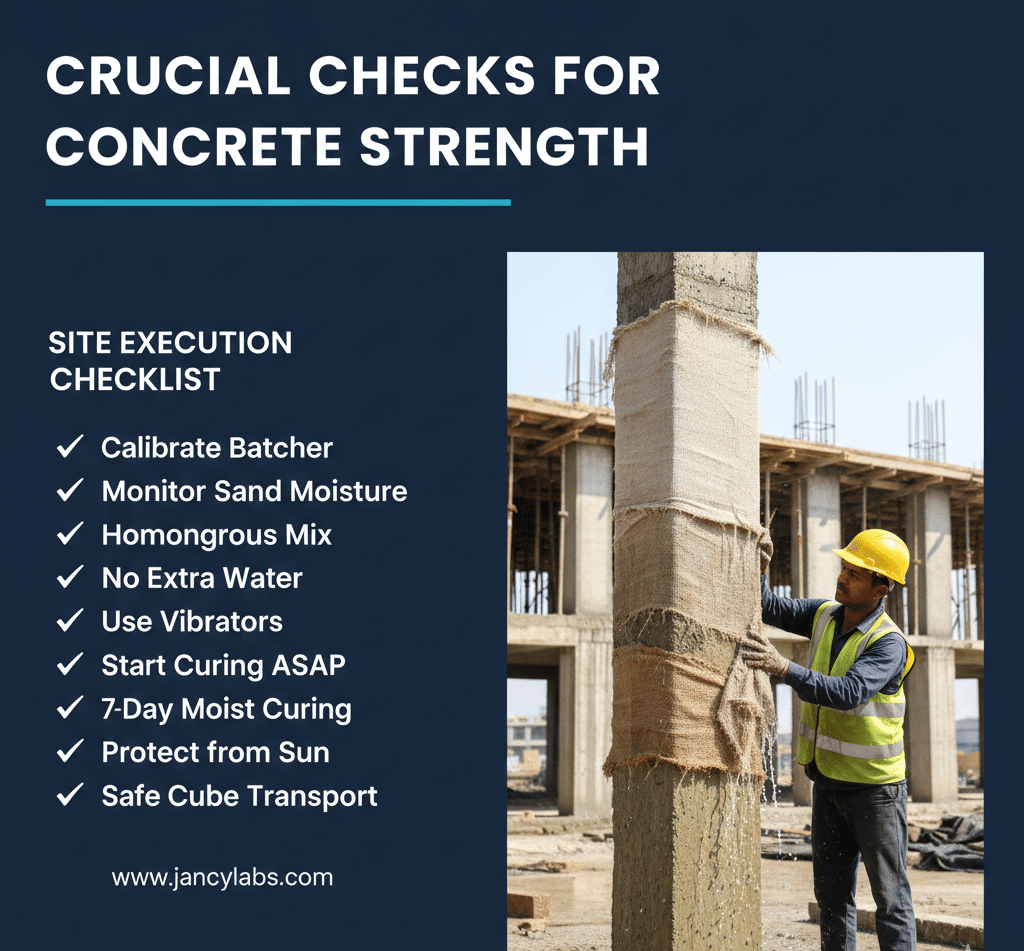
Finding that your concrete strength falls below the target mean strength is a major concern for any engineer. This discrepancy often leads to structural delays, increased costs, and serious safety worries for the entire project. At Jancy Labs, we understand these technical challenges deeply through years of field experience. Therefore, we have compiled this expert guide to help you identify and resolve these strength issues effectively.
Understanding Why Concrete Compressive Strength Is Lower Than Target
The target mean strength is designed to account for statistical variations during the construction process. Consequently, if your results fall short, it indicates a failure in material quality or site practices. Furthermore, even small deviations can compromise the long-term durability of your foundation or slab. To fix this, you must first analyze the fundamental factors affecting your specific mix design.
Primary Factors Affecting Your Concrete Compressive Strength
The water-cement ratio is the most critical factor influencing your final compressive strength results. Specifically, adding too much water creates internal voids that significantly weaken the hardened concrete matrix. Similarly, using poor-quality or unwashed aggregates can lead to bond failure between the paste and stone.
Moreover, improper cement storage often leads to partial hydration before the mixing process even begins. This reduces the chemical bonding capacity of the cement paste during the critical curing phase. Additionally, extreme ambient temperatures during pouring can disrupt the delicate chemical hydration process of the concrete.
How to Pinpoint Where the Concrete Strength Mistake Happened
To solve the mystery of low strength, you must conduct a systematic forensic audit of your workflow. First, review your batching records to ensure the mix design was followed with absolute precision. Next, examine the laboratory testing reports for any inconsistencies in sampling or cube casting techniques.
Furthermore, check the temperature and humidity logs recorded during the initial setting and transportation period. If the site-cured cubes show lower strength than lab cubes, then curing is likely the culprit. However, if both sets of cubes are low, the issue probably lies within the raw material quality.
Checklist to Attain Target Strength: Material Purchase Phase
Securing high-quality materials is the first practical step toward achieving your target mean strength consistently.
• Always source your cement from reputable manufacturers with valid, recent test certificates.
• Verify that aggregates are clean, well-graded, and completely free from clay or organic silt.
• Check the expiry date and storage conditions of chemical admixtures before every single batch.
• Test the mixing water quality to ensure it is free from harmful chlorides or sulfates.
• Store all cement bags in a dry, moisture-protected area on raised wooden platforms.
Practical Site Checklist for Batching and Mixing Operations
Precision during the mixing stage ensures the concrete performs exactly as the structural engineer designed.
• Use recently calibrated weigh batchers instead of inaccurate volume batching for better consistency.
• Regularly monitor the surface moisture of sand to adjust the added water accordingly.
• Ensure the mixing time is sufficient to produce a perfectly homogenous and uniform blend.
• Strictly forbid the practice of adding extra water to the transit mixer for easier workability.
• Supervise the discharge process closely to prevent any physical segregation of the heavy aggregates.
The Crucial Role of Curing in Concrete Strength Development
Proper curing is the most essential step to ensure the chemical hydration of cement continues until full strength. Without adequate moisture, the concrete dries too fast and develops micro-cracks that lower its load-bearing capacity. Therefore, you must ensure that the surface remains continuously wet during the first seven days of hardening.
Furthermore, the temperature of the curing water must be maintained at a steady, standard level. If the water is too cold, the strength gain will be significantly delayed or permanently stunted. Thus, skipping or rushing the curing phase is the fastest way to fail your 28-day strength tests.
Why Specimen Handling and Transportation Affect Your Test Results
Many engineers forget that how you treat the test cubes affects the final reported strength. For instance, if you leave cubes in direct sunlight after casting, they lose moisture and gain less strength. Additionally, transporting cubes to the lab in a bumpy vehicle can cause internal fractures before testing.
To avoid this, always store your cast cubes in a shaded, vibration-free area on-site. Then, move them to the curing tank or the laboratory within 24 to 48 hours of casting. Protecting these samples ensures that the lab results truly reflect the quality of the concrete in your structure.
How Jancy Labs Helps You Achieve Target Mean Strength
At Jancy Labs, we provide the technical expertise needed to eliminate guesswork from your construction project. Our NABL-accredited facility offers precise testing for cement, aggregates, and fresh concrete cubes. Consequently, we help you identify hidden material flaws before they become expensive and dangerous site failures.
Furthermore, our expert consultants provide optimized mix designs tailored specifically to your project’s unique requirements. We utilize advanced, calibrated equipment to ensure every test result is both accurate and legally reliable. By partnering with us, you gain a trusted ally committed to your structural success and safety.
Trust Jancy Labs for Your Civil Engineering Testing Needs
Achieving the target mean strength is a balance of science and disciplined site execution. Therefore, monitoring every stage of the process is essential for maintaining the highest construction standards. If you are struggling with inconsistent test results, let our laboratory experts provide the technical solution.
Contact Information
Registered Office & Laboratory Address
Jancy labs Pvt Ltd,
No.6,Ganesh Nagar 3rd street, Surya Nagar, Alagar kovil main road, K.Pudur, Madurai-625007
Phone Numbers :
+91-8680049004 , +91-9994421275
Email : jancylabsmdu@gmail.com
Working Hours :
Monday to Saturday : 10:00 AM – 6:00 PM
Leave Your Enquiry, We’ll Call You Back
We understand your time is valuable! Simply leave your details below, and our team will get back to you as soon as possible.