
Free Swell Index (FSI) Test — NABL Certified | Jancy Labs
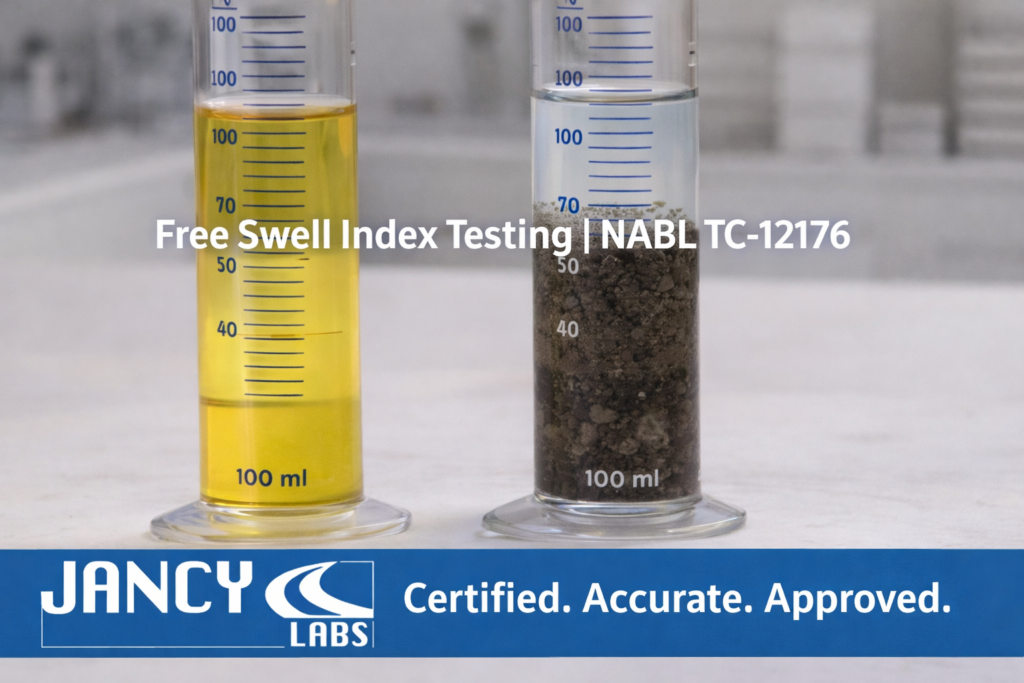
Laying a road on expansive soil without knowing the FSI? That’s a slab failure waiting to happen.
Jancy Labs provides accurate free swell index testing as per IS 2720 Part 40 — with NABL-certified reports ready for NHAI, PWD, and PMGSY submissions.
Our FSI test is conducted on calibrated apparatus by a qualified Materials Engineer. Your report carries NABL stamp TC-12176 — accepted at every site approval desk.
Get your Free Swell Index test done today → contact-us
Page Contents - Quick Links
What Is a Free Swell Index (FSI) Test?
The Free Swell Index test tells you how much your soil expands when saturated — critical for designing safe foundations and subgrades on black cotton or clay-rich ground. You collect a dry soil sample, allow it to swell freely in water, and measure the volume increase. This FSI value directly classifies your soil’s swelling potential per IS 2720 Part 40. Miss this test on an expansive soil site and you risk pavement heave, cracked slabs, and costly post-construction repairs that no project budget can absorb.
Applicable Standards
The governing standard for this test in India is IS 2720 (Part 40): 1977 — Methods of Test for Soils, Determination of Free Swell Index.
This standard covers the test procedure, apparatus calibration, and result interpretation — ensuring your FSI report is defensible at any approval authority.
At Jancy Labs, every Free Swell Index test is conducted strictly as per IS 2720 (Part 40): 1977 — no shortcuts, no omissions.
Why the Free Swell Index Test Matters
- NHAI / PWD Road Projects: Subgrade soil with FSI > 50% requires stabilisation before pavement. Your DPR cannot proceed without this data.
- PMGSY Rural Roads: Free swell index is a mandatory parameter in PMGSY soil investigation reports for black cotton soil zones.
- Foundation Design: A high FSI value (>100%) signals very high expansion risk. Structural engineers need this before finalising foundation depth and type.
- Soil Stabilisation Decisions: Lime or cement stabilisation dosage is directly derived from FSI classification. Guessing wastes project budget.
- Monsoon Resilience: Tamil Nadu’s red and black soil belts see seasonal swell-shrink cycles. FSI data protects your long-term asset.
- Project Compliance: NHAI, PWD, and PMGSY field engineers routinely request NABL-certified FSI reports before issuing work commencement clearances.
Skipping the FSI test on expansive soil is the single most avoidable cause of premature pavement failure in Tamil Nadu’s black cotton soil regions.
Why Choose Jancy Labs for Free Swell Index (FSI) Testing?
When your road project’s DPR depends on soil swell data, one wrong result costs you a rejected submission — and weeks of delay.
- Calibrated graduated cylinders and kerosene + distilled water apparatus — dedicated to IS 2720 Part 40 FSI procedure
- Free Swell Index test conducted strictly as per IS 2720 (Part 40): 1977 — every observation recorded, no shortcuts
- FSI test reports signed by a qualified Materials Engineer — not a technician
- NABL accredited laboratory — Certificate TC-12176 | ISO 17025:2017
- Reports accepted by NHAI, Tamil Nadu PWD, and PMGSY field offices
- Trusted for Free Swell Index testing by highway and infrastructure project engineers across Tamil Nadu
Jancy Labs has been built on one principle: every result you receive must hold up at a site inspection, a DPR review, or a client audit. Our NABL accreditation guarantees that.
How to Get Your Free Swell Index Test Done
Step 1 — Send Your Sample Courier, transport, or drop in your soil sample with a test request letter.
Step 2 — We Test It Your sample is tested as per IS 2720 Part 40 by our Materials Engineer.
Certified Report Delivery (Step 3) Receive your NABL-stamped FSI report by email or collect directly.
Our Free Swell Index Process — as per IS 2720 (Part 40): 1977
- Oven-dry the soil sample at 105°C ± 2°C to constant mass.
- Pulverise the dried soil and sieve through 425 micron IS sieve.
- Take 10g of sieved oven-dry soil for each test cylinder.
- Pour 10g slowly into a 100ml graduated cylinder containing kerosene. Record settled volume (Vk).
- A second 10g portion goes into another 100ml graduated cylinder containing distilled water.
- Leave undisturbed for 24 hours to allow the soil to swell fully.
- After 24 hours, record the final volume of soil in distilled water (Vd).
- Calculate FSI = [(Vd − Vk) / Vk] × 100. Classify as per IS 2720 criteria.
Every Free Swell Index result is reviewed and signed by a Materials Engineer before dispatch.
Frequently Asked Questions
1. How long does a Free Swell Index test take at Jancy Labs?
The FSI test at Jancy Labs follows IS 2720 Part 40 timelines, which include a mandatory 24-hour swell period for the distilled water cylinder. After swell readings are complete, our Materials Engineer reviews and certifies your report. Call or WhatsApp us at +91-8680049004 before dispatching your sample to confirm the current turnaround for your project timeline.
2. Can I send soil samples by courier to Jancy Labs for FSI testing?
Absolutely. Pack your oven-dry soil sample (minimum 200g) in a sealed airtight container or zip-lock bag and courier it to No.6, Ganesh Nagar 3rd Street, K.Pudur, Madurai — 625007. Before dispatch, send a WhatsApp message to +91-8680049004 with the courier tracking number and a photo of the labelled sample. Jancy Labs receives samples from contractors and engineers across Tamil Nadu regularly.
3. Is your Free Swell Index report accepted by NHAI and PWD?
Jancy Labs is NABL accredited under Certificate TC-12176 with ISO 17025:2017 compliance — so yes, your report will be accepted. Every Free Swell Index test is conducted strictly as per IS 2720 (Part 40): 1977, and our certified reports are accepted by NHAI, Tamil Nadu PWD, and PMGSY authorities. For projects requiring additional documentation, email jancylabsmdu@gmail.com and our team will assist.
4. Do you conduct testing for both disturbed and undisturbed soil samples for FSI?
The Free Swell Index test by definition uses disturbed (remoulded) soil passing a 425 micron sieve — IS 2720 Part 40 does not require undisturbed samples for this test. Jancy Labs tests disturbed samples collected from trial pits, bore holes, or surface collection as per your project specification. For related tests, [INT view our full soil testing services →
5. How much soil sample do I need to send for a Free Swell Index test?
As per IS 2720 Part 40, each FSI test requires 20g of oven-dry soil (10g per cylinder). However, Jancy Labs recommends sending a minimum of 200g to account for sieving losses through the 425 micron IS sieve and to allow for a re-test if needed. Pack the soil dry in an airtight container and label it clearly with your project details.
Get Your Free Swell Index (FSI) Test Today
Your Free Swell Index report is the foundation of every sound decision on expansive soil — don’t let missing test data delay your project approval.
Submit your sample today and receive a NABL-certified FSI report that NHAI, PWD, and PMGSY will accept, first time.
| Contact Method | Details |
|---|---|
| Phone | +91-8680049004 / +91-9994421275 |
| +91-8680049004 | |
| jancylabsmdu@gmail.com | |
| Address | No.6, Ganesh Nagar 3rd Street, Surya Nagar, Alagar Kovil Main Road, K.Pudur, Madurai — 625007 |
| Working Hours | Monday to Saturday (10 AM to 6 PM) |
Request a Test Quote → contact-us
View All Soil Testing Services → soil Tests
You May Also Need These Soil Tests
1. Atterberg Limits (LL, PL, PI) Liquid Limit and Plasticity Index complement FSI in classifying expansive soil behaviour for foundation and pavement design.
2. Proctor Compaction Test (OMC & MDD) After classifying swell potential via FSI, compaction testing determines the correct density for stabilised subgrade layers.
3. California Bearing Ratio (CBR) Test Road subgrade design requires both FSI classification and CBR value — NHAI and PWD submissions commonly need both in the same soil report.