
UPV-ULTRASONIC PULSE VELOSITY TEST
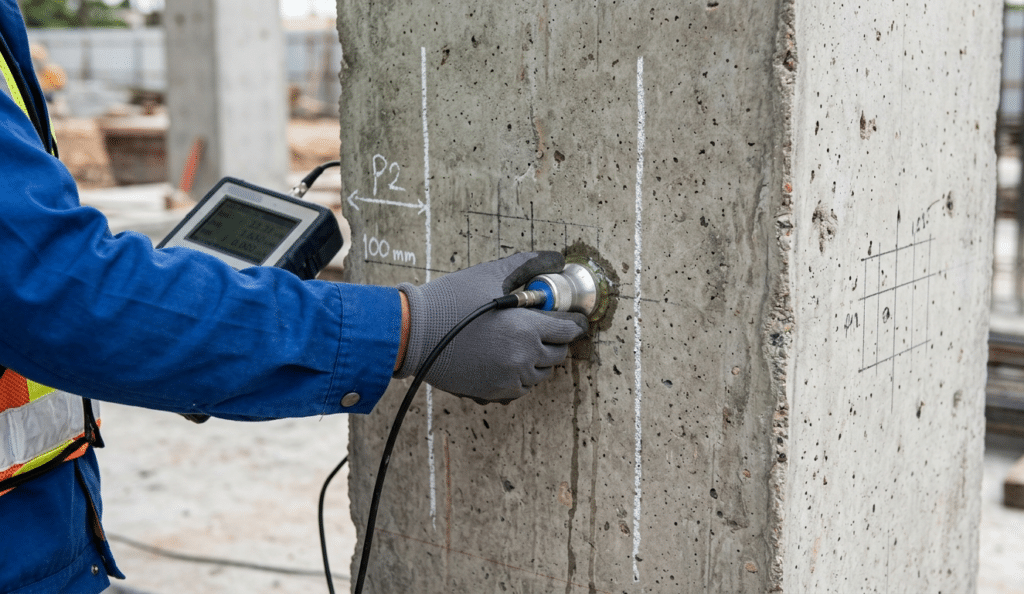
When your NHAI or PWD project demands proof of concrete integrity — without drilling new cores — you need a certified UPV test lab, not a general testing centre. Jancy Labs provides Ultrasonic Pulse Velocity (UPV) testing as per IS 516 Part 5 Sec 1 from our NABL accredited facility (TC-12176) in Madurai. Our calibrated UPV equipment and qualified Materials Engineers deliver reports accepted across Tamil Nadu and beyond.
Get your UPV test done today: Contact Us
Page Contents-Quick Links
What is ultrasonic pulse velocity (upv) testing?
UPV testing tells you the internal quality, homogeneity, and defect status of in-place concrete — without cutting a single sample. Engineers and contractors use it to assess existing structures, investigate cracks, and verify concrete placement quality for approval submissions. Skipping this test on an infrastructure project risks costly rejections, structural queries from approving authorities, and unplanned remediation expenses.
Applicable Standards
IS 516 Part 5 Sec 1 prescribes the exact apparatus, coupling procedure, pulse transit time measurement, and result interpretation for UPV testing on concrete. Furthermore, it defines quality classification thresholds — ensuring your report carries clear, defensible pass/fail criteria.
Jancy Labs conducts this test strictly as per IS 516 Part 5 Sec 1.
Why Upv Testing Matters For Your Project
- Therefore, NHAI and NHIDCL require UPV test data to verify in-situ concrete quality on road and bridge projects before issuing structural clearance.
- Additionally, PWD Tamil Nadu mandates non-destructive testing reports like UPV for inspection of existing RCC structures during rehabilitation projects.
- Consequently, Railways (Southern Railway, RVNL, IRCON) accept UPV reports from NABL labs to confirm concrete integrity on rail infrastructure.
- Furthermore, AAI specifies in-place concrete testing for airside structures — and UPV is the preferred non-destructive method for pavement and slab assessments.
- Moreover, CPWD project auditors reference UPV results to identify voids, honeycombing, or delamination in government building structures before handover.
- Specifically, a UPV report from an NABL accredited lab like Jancy Labs protects you from RFI delays, departmental queries, and liability during defect-liability periods.
Skipping UPV testing on an assessable structure risks non-compliance notices, remediation costs, and project delay — particularly on government and infrastructure contracts.
Why choose jancy labs for upv testing?
Jancy Labs operates one of Tamil Nadu’s few NABL accredited labs (TC-12176) that conducts UPV testing strictly as per IS 516 Part 5 Sec 1 — with calibrated equipment, qualified engineers and reports built for departmental submission.
- Calibrated PUNDIT Pro+ / UPV meter maintained as per IS 516 equipment requirements
- UPV testing conducted strictly as per IS 516 Part 5 Sec 1 — no shortcuts
- Every UPV test report reviewed and signed by a qualified Materials Engineer
- NABL accredited lab — TC-12176 | ISO 17025:2017
- UPV reports accepted by NHAI, PWD, Railways, AAI, and CPWD
- Trusted for UPV testing by infrastructure and building project engineers across Tamil Nadu
Our NABL accreditation under ISO 17025:2017 ensures every UPV test meets international quality benchmarks.
How To Get Your Upv Test Done
Step 1 — Send Your Sample
Sample requirements for UPV testing depend on the element type: concrete cores (typically 100mm or 150mm diameter), standard cubes, or direct in-situ access. As UPV is a non-destructive test, the element is not consumed. However, if submitting laboratory cores or cubes, ensure they meet IS 516 Part 5 Sec 1 dimensional requirements.
On receipt, a Materials Engineer logs and inspects your sample against IS 516 Part 5 Sec 1 requirements. Our calibrated UPV apparatus then transmits ultrasonic pulses through the concrete, measuring transit time across the element. Subsequently, the engineer calculates pulse velocity, classifies concrete quality per IS 516 thresholds, and prepares your certified report.
Step 3 — You Receive Your Certified Report
Your UPV test report from Jancy Labs contains every detail approving departments require.
Our UPV Testing Process — as per IS 516 Part 5 Sec 1
- First, inspect the concrete element or laboratory specimen to identify test point grid locations per IS 516 requirements.
- Next, clean and prepare the concrete surface at each test point to ensure full transducer contact.
- Then, apply coupling agent to both transducer faces and position transmitter and receiver transducers at defined test points.
Finalising the UPV Results
- Subsequently, activate the UPV apparatus, record pulse transit time for each test path, and confirm stable readings.
- Consequently, calculate the ultrasonic pulse velocity (m/s) using the measured path length and transit time per the IS 516 formula.
- Next, classify each reading against IS 516 Part 5 Sec 1 quality thresholds (Excellent / Good / Medium / Doubtful).
- Then, compile all readings, classifications, and observations into the structured test report format.
- Finally, a qualified Materials Engineer reviews every UPV result and signs the report before we dispatch it.
FAQs: UPV Testing at Jancy Labs
Q1: How long does a UPV test take at Jancy Labs?
Jancy Labs typically completes UPV testing within 1–2 working days of sample or inspection request receipt. However, turnaround depends on queue and site access — therefore, we recommend confirming timing when you submit your sample or book the test.
Q2: Can I send samples by courier to Jancy Labs?
Yes, you can send concrete cores or cubes via courier to our lab at No.6, Ganesh Nagar 3rd Street, K.Pudur, Madurai — 625007. Additionally, please WhatsApp us at +91-8680049004 before dispatch so we can log your details and ensure priority handling.
Q3: Is your UPV test report accepted by NHAI, PWD, and Railways?
Yes — NHAI, PWD, Southern Railway, RVNL, AAI, and CPWD accept UPV reports from Jancy Labs because our laboratory holds NABL accreditation TC-12176 under ISO 17025:2017. Furthermore, all reports cite IS 516 Part 5 Sec 1 and carry a Materials Engineer’s signature and NABL stamp.
Q4: Do you test in-situ structures or only lab specimens?
Jancy Labs conducts UPV testing on both laboratory cores/cubes and in-situ structural elements. Moreover, we can arrange site visits for direct UPV assessment of bridges, columns, slabs, and other RCC elements — contact us to discuss your project scope.
Q5: How much sample do I need for a UPV test?
UPV is a non-destructive test — consequently, your sample is not consumed or damaged. You need to submit at least one concrete core or cube of standard IS 516 dimensions, or provide site access for in-situ testing. Specifically, confirm minimum specimen dimensions with us before dispatch to avoid any delays.
Get Your Upv Test Report Today
Need a certified UPV test report for your NHAI, PWD, or Railways project in Tamil Nadu? Jancy Labs delivers IS 516 Part 5 Sec 1 compliant UPV testing with fast turnaround — because your project approvals cannot wait.
| Contact | Details |
|---|---|
| Phone | +91-8680049004 / +91-9994421275 |
| +91-8680049004 | |
| jancylabsmdu@gmail.com | |
| Address | No.6, Ganesh Nagar 3rd Street, K.Pudur, Madurai — 625007 |
| Hours | Monday to Saturday, 10:00 AM – 6:00 PM |
Related Services: You May Also Need These Tests
Rebound Hammer Test– Non-destructive surface hardness assessment of concrete — often conducted alongside UPV for comprehensive in-situ quality evaluation.
Core Cutting & Compressive Strength Test- Destructive test for actual compressive strength of in-place concrete — use with UPV for complete structural assessment.